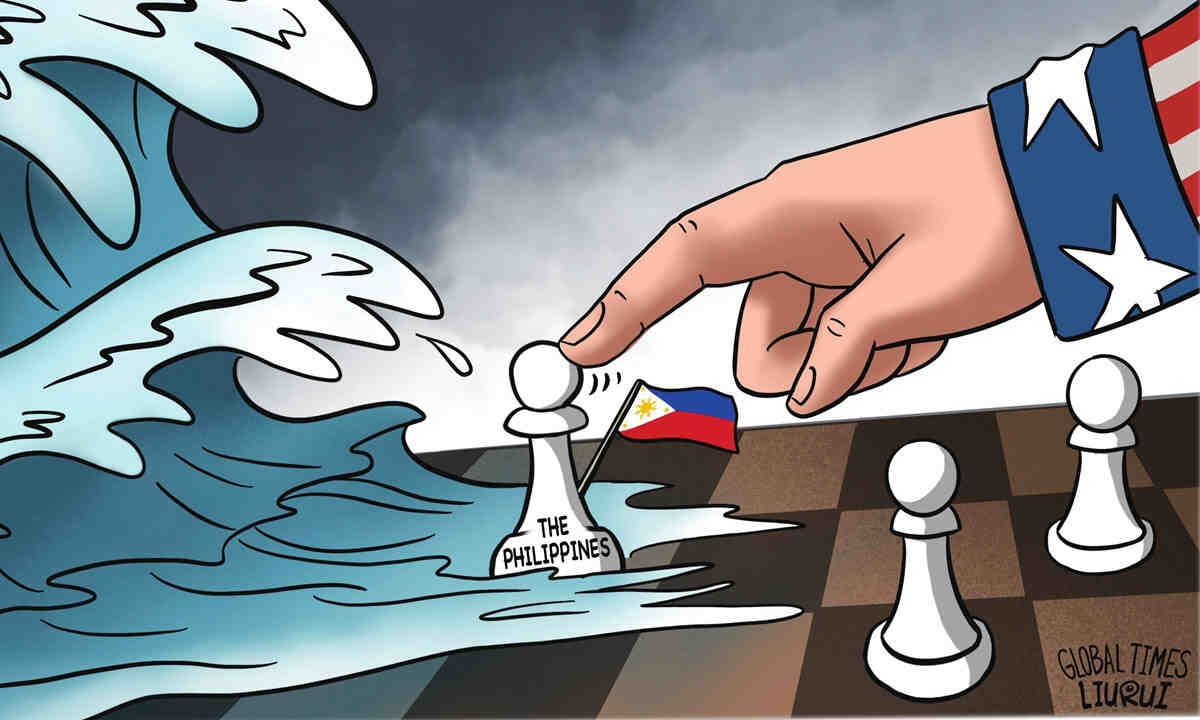
Illustration: Liu Rui/GT
Philippine President Ferdinand Marcos Jr. on Sunday departed for Washington on a three-day official visit, but what he faces is a 20 percent tariff. On April 2, among the brutal tariffs imposed by the US in its bullying of the world, the Philippines, despite being an ally of the US, was also included on the list and subjected to a 17 percent "Liberation Day" tariff. After the 90-day tariff-free grace period expired, the US sent a letter to increase the rate to 20 percent.The Philippines is undoubtedly one of the most loyal partners in supporting the US "Indo-Pacific Strategy." In order to align with the US strategy of containing China, the Philippines has acted comprehensively: Politically, it continues to hype up the South China Sea disputes. Militarily, it allows the US to deploy the Typhon Mid-Range Capability launch system in the Philippines. It even interferes in Taiwan-related affairs.
Some Filipinos may believe that it is worth siding with the US in order to gain in the South China Sea disputes. But in reality, in the repeated provocative actions launched by the Philippines in the South China Sea, what the US has done is merely hide behind the scenes and conduct political, diplomatic and media performances, while Filipinos take the hits by themselves. In order to maintain supplies to personnel stationed on the warship illegally grounded at Ren'ai Jiao, the Philippines ultimately had to reach a temporary arrangement with China.
Regarding issues involving the Philippines and the South China Sea, two facts have become more and more evident.
First, the overall US approach to containing China runs counter to the Philippines' goal of national development. As a nation with a large population, underdeveloped infrastructure and a weak industrial base, the Philippines needs to engage in essential international cooperation to achieve its development. The country that can truly help the Philippines is China, which is willing to take responsibility for the international community and possesses the complete industrial system in the world, along with strong technological and financial capabilities.
Second, the specific tactics employed by the US in hyping up the South China Sea issue run counter to the Philippines' actual goals in asserting its maritime claims. In order to turn the South China Sea into a persistent "wound" that strategically harasses China and diplomatically sows discord between China and ASEAN, the US seeks to maintain a certain level of tension rather than facilitate the control or resolution of disputes. This includes silently disrupting the negotiations for a Code of Conduct in the South China Sea between China and ASEAN.
However, the Philippines has barely gained any substantive benefits from US "assistance," be it in the standoff near Huangyan Dao, the so-called South China Sea arbitration case, or more recently to the Marcos administration's strenuous efforts to maintain resupply missions to the illegally grounded warship at Ren'ai Jiao. This highlights that negotiations and dialogue remain the most realistic path for the Philippines to safeguard its interests, given the country's limited national power as well as the current erosion of the international legal and regulatory framework by the US.
In short, the US is strategically using the Philippines for its geographic location, placing it at the forefront of its efforts to contain China. Tactically, Washington seeks to extract all possible value from Manila, including by using tariffs as leverage to fully open up the Philippine market. Even if President Marcos Jr. were to gain some concessions during his visit to the US, these would likely come with a heavily unequal trade arrangement - possibly at the cost of deeper political, diplomatic and military alignment with Washington, thereby harming the Philippines' long-term strategic interests.
There are, however, sober voices within the Philippine society. For instance, on July 14, former Philippine Air Force general Romeo Poquiz stressed on social media that the Philippines' confrontational stance toward China in the name of defending sovereignty serves US, not the Philippines' interests. He noted that the real battle lies in avoiding becoming a pawn in the China-US rivalry while safeguarding the Philippines' own interests. He also urged the Philippine leadership not to turn the country into "another Ukraine."
Regrettably, such voices are immediately labeled by some Philippine officials as "mouthpieces for China." When reasoned discourse has no space, the Philippines is left with an increasingly narrow path for its future.
The author is the vice president of Shanghai Institutes for International Studies. opinion@globaltimes.com.cn
RELATED ARTICLES