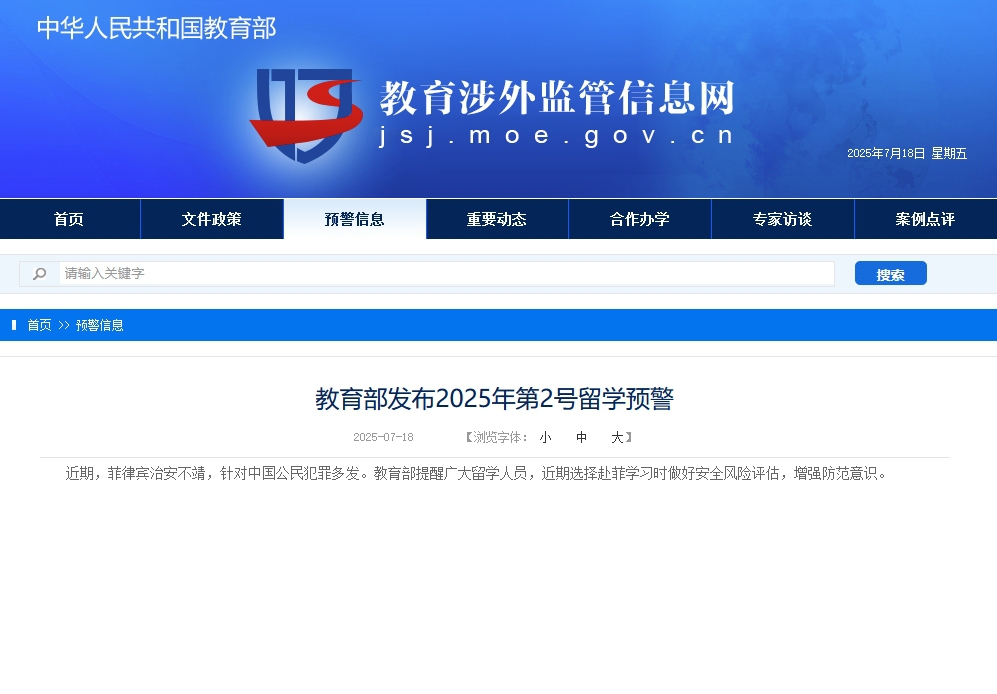
Photo:Screenshot from the official website of China's Ministry of Education
On July 18, China's Ministry of Education issued its second overseas study alert of 2025, urging students to assess the security risks of studying in the Philippines. Ge Hongliang, deputy director of the College of ASEAN Studies at Guangxi University for Nationalities, noted that beyond the country's troubling public security situation, the Philippine government's increasingly irrational policy toward China may also be a critical factor that Chinese students should consider before heading there.
Starting with education itself, questions surrounding the academic credibility of certain Philippine universities have previously stirred public debate in China. Previously, due to the widespread offering of low-quality online courses targeting the Chinese market, China's Ministry of Education strengthened its reviews of degree verification applications from four institutions.
Next is the issue of safety. In recent years, there have been repeated incidents of discriminatory treatment targeting Chinese students in the Philippines. In April 2024, Philippine congressman Joseph Lara introduced a resolution noting "an alarming increase in the number of Chinese citizens coming into the province of Cagayan as students enrolled in the various higher education institutions" - calling the trend "highly suspicious." When international students become pawns in political maneuvering, it reflects the Philippines' irrational foreign policy shift.
On May 16 of this year, the Chinese Embassy in the Philippines published an open letter addressing several reports from Chinese citizens in the Philippines regarding unfair treatment they have suffered. This includes instances of individual Philippine institutions and personnel abusing their authority in law enforcement to conduct unwarranted checks and harassment of Chinese individuals, enterprises and institutions in or visiting the Philippines, delaying and obstructing the processing of work visas for Chinese enterprise employees, and unreasonably detaining Chinese citizens that hold valid work visas. In addition, without solid evidence, the Philippines has fabricated and sensationalized cases involving Chinese citizens, such as "gambling cases," "espionage cases," "arms cases" and "child labor cases." The Philippine side has also groundlessly accused Chinese personnel of involvement in "espionage activities" using the excuse that they had passed by sensitive areas.
China-Philippine cooperation in education once had a solid foundation, but it is now being severely undermined - primarily due to unilateral actions by the Philippine side. In light of China's latest overseas study alert, the Philippines needs to reflect on issues that go far beyond education.