ARTS / CULTURE & LEISURE
Sanxingdui bronze keeling figurine identified as a sacrificial scene, not myth
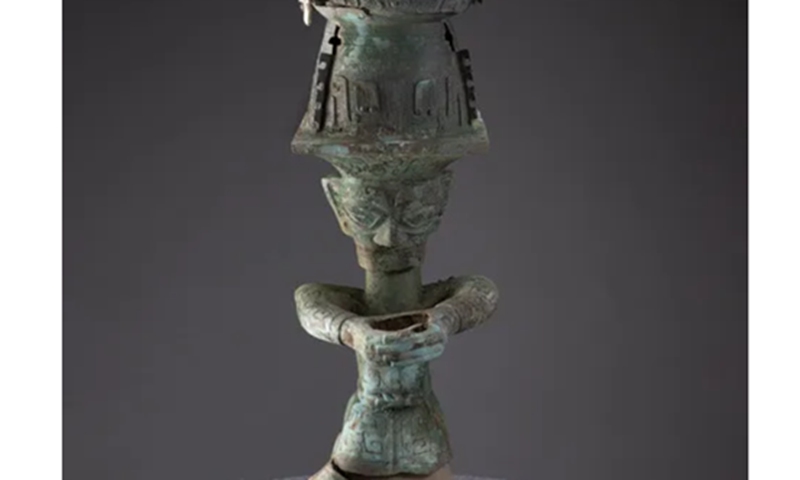
The bronze kneeling figurine unearthed at Sanxingdui Ruins. Photo: Xinhua
New research on a bronze kneeling figurine bearing a Zun vessel on its head, unearthed from the Sanxingdui Ruins in Southwest China's Sichuan Province, shows that the artifact is not an abstract mythological symbol but a vivid recreation of real sacrificial rituals, reflecting the ancient Shu people's worship of deities thousands of years ago, according to findings released by the Sichuan Provincial Cultural Relics and Archaeology Research Institute on Friday.
After conducting metal composition analyses on the bronze figurine unearthed from No.3 pit at the ruins and studying its cultural origin, experts drew two conclusions: First, the bronze statue and the Zun vessel it carries were crafted separately by different artisans at different times and locations, and then assembled on-site at Sanxingdui. The fingings confirms that while some Sanxingdui bronzes were cast outside the site, the final assembly was completed at Sanxingdui itself, Guo Jianbo, an associate researcher at the institute, told the Xinhua News Agency.
Second, the imagery of the kneeling figure with a Zun is a faithful reflection of real sacrificial scenes from ancient times, Guo said.
"The figure holds sacred artifacts in its hands and bows forward in worship. Though bearing a huge Zun atop its head, its face remains solemn and serene, radiating a sacred and devout aura. Precious goods such as cowrie shells were once placed inside the Zun. This bronze artifact vividly depicts sacrificial rituals at Sanxingdui and embodies the ancients' reverence for deities," said Guo.
Located in the city of Guanghan in Chengdu, the Sanxingdui Ruins, believed to be remnants of the Shu Kingdom dating back between 3,000 and 4,500 years, have been called one of the world's greatest archaeological finds of the 20th century. Two sacrificial pits were discovered in 1986, while another six were found in 2021. The core area of this site covers 3.6 square kilometers, Xinhua reported.
The ruins are renowned for their large and medium-sized bronze artifacts, many of which feature striking and elaborate designs.
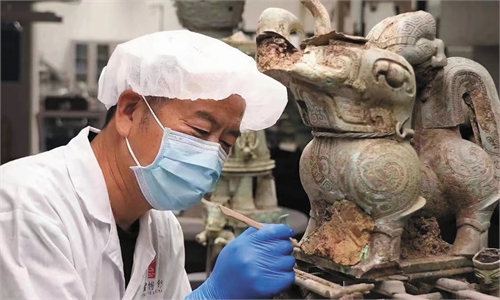
Previous studies have confirmed that this kneeling figurine artifact can be assembled with a "divine beast" unearthed from pit No.8. According to Guo, motifs featuring divine beasts supporting human figures and human figures bearing Zun vessels repeatedly appear on multiple bronzes. These scenes reconstruct ancient Shu sacrificial ceremonies, mirroring the Shu people's understanding of all living things, heaven, Earth and the universe during sacrificial rites. They also embody the integration of Central Plains cultural elements and ancient Shu culture.
This huge bronze artifact was cast in separate components and assembled afterwards, boasting an intricate and distinctive shape that demonstrates the superb bronze design and casting craftsmanship mastered by the ancient Shu inhabitants. These relics not only reveal the uniqueness of the ancient Shu civilization, but also bear the strong influence of Central Plains culture, testifying to the long-standing, profound, extensive and integrated pluralistic nature of Chinese civilization, said Guo.
RELATED ARTICLES