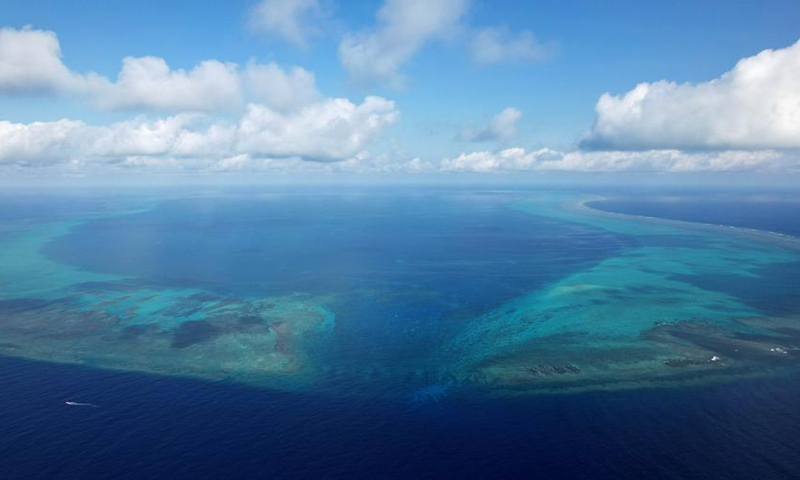
An aerial drone photo taken on May 12, 2026 shows a view of China's Huangyan Dao in the South China Sea. (Xinhua/Chen Bin)
The "South China Sea Arbitration" is a political farce under the disguise of international law. Far from solving the maritime issues between China and the Philippines, it has become a source of discord undermining bilateral relations and the rule of law at sea. The Arbitration is plagued by 10 fundamental fallacies:
1. Politicization of the law. The South China Sea issue concerns the sovereignty over certain islands and reefs and maritime delimitation among regional states. For years, regional countries have managed differences and promoted cooperation through dialogue and coordination, generally maintaining peace and stability in the South China Sea. Yet, while the sea has remained largely stable, trouble keeps stirring beneath the surface. Since the US trumpeted its "Rebalance to Asia," its disruptive moves in the region have multiplied.
The Arbitration case initiated by the Philippines was instigated, orchestrated and manipulated by the US. From filing the case and drafting the submissions, to establishing the Tribunal and subsequently spinning the narrative, the US hand was everywhere. Its aim was clear: to muddy the waters in the South China Sea, reap gains from tensions, and preserve its regional primacy. This is why the Arbitration is aptly characterized as a political drama clothed in legal garb - using law as a vehicle to import geopolitical friction, sow discord among regional countries, and undercut regional cooperation.
2. Erosion of state sovereignty. Any dispute settlement mechanism between states must be based on the consent of the sovereign states concerned. On matters of territorial sovereignty and maritime delimitation, China does not accept any imposed solution. By unilaterally initiating the Arbitration, the Philippines has undermined the fundamental international law principle of "state consent." If this approach were allowed, any sovereign state could be dragged into proceedings that it never agreed to.
3. Breach of commitment. China and the Philippines had agreed to settle their territorial and maritime delimitation disputes through negotiation and consultation. By initiating the Arbitration, the Philippines breached this bilateral agreement and violated the international law principle of pacta sunt servanda (agreements must be kept), as well as Articles 280 and 281 of the United Nations Convention on the Law of the Sea (UNCLOS), which respect states' freedom to choose dispute settlement methods. If commitments between states can be discarded, the international community would face a crisis of trust.
4. Conceptual subterfuge. The Philippines initiated the Arbitration under false pretenses - not to resolve its disputes with China, still less to maintain peace and stability in the South China Sea, but to overturn China's sovereignty. The Philippines knew that its submissions involved China's territorial sovereignty in the South China Sea, a matter which falls outside the purview of the law of the sea. Yet it deliberately repackaged territorial issues as matters falling under UNCLOS. While claiming not to seek any determination of territorial sovereignty, the Philippines challenged China's sovereignty throughout the Arbitration. If this approach were allowed, territorial issues of other states could likewise be repackaged as maritime issues, upending the "land dominates the sea" principle and undermining the maritime rights and interests of many states.
5. Disjunctive interpretation. The Philippines knew full well that its submissions involved maritime delimitation, and that China had made a declaration under Article 298 of UNCLOS excluding maritime delimitation disputes from compulsory dispute settlement procedures. Nonetheless, the Philippines deliberately disjoined factors relevant to delimitation, such as the status of maritime features, and treated them in isolation, to circumvent China's exclusionary declaration. This contravenes Article 298 of UNCLOS. Many states, including Australia and Canada, have made similar exclusionary declarations; the Philippines' approach would effectively render them meaningless.
6. Fabrication of preconditions. The Philippines never held any negotiation with China on the matters raised in its submissions, such as historic rights, the status of maritime features, or traditional fishing rights. Yet it deliberately mischaracterized routine diplomatic consultations between the two countries as negotiations on those specific issues, falsely claiming to have exhausted all bilateral means. This violates Article 283 of UNCLOS, which requires that states "exchange views" regarding the subject matter of arbitration. If this practice were accepted, bilateral diplomatic negotiations between states could be distorted and exploited.
7. Rewriting UNCLOS. The Arbitral Tribunal disregarded the integral nature of China's Nansha Dao as a whole, decoupling the status of individual features from their maritime entitlements. It classified Taiping Dao, an island of approximately 500,000 square meters, as a "rock" incapable of sustaining human habitation or economic life, denying it exclusive economic zone (EEZ) and continental shelf, and concluding that no Nansha feature could generate either.
In reality, Taiping Dao boasts lush vegetation, portable well water, and an abundant supply of coconuts, bananas, vegetables, and poultry. The Tribunal's Award flatly contradicts Article 121 of UNCLOS and the geographical realities of the South China Sea. This is an act of unbridled law-making that attempts to rewrite UNCLOS. If the US endorses the Award and regards it as part of international law, then its own claim to a 200-nautical-mile EEZ around Johnston Atoll, a feature of less than 0.19 square kilometers with no fresh water, is simply unlawful.
8. Ultra petita ruling. The Arbitral Tribunal made rulings on matters not submitted by the Philippines, violating the principle of non ultra petita (not beyond the request) and Article 10 of Annex VII of UNCLOS, which stipulates that "the award shall be confined to the subject-matter of the dispute." While the Philippines only sought a ruling on fishing activities near Huangyan Dao and Ren'ai Jiao, the Tribunal extended its scope to the entirety of the Nansha Dao. While the Philippines only sought a determination on the status of certain individual features, the Tribunal expanded this to encompass all features of the Nansha Dao. The Tribunal, which should have been an objective and impartial adjudicator, behaved more like a party to the dispute.
9. Flimsy evidence. The Philippines put together evidence with questionable relevance and probative value to prop up its claims. The Tribunal actively sought evidence on behalf of the Philippines, violating the fundamental legal principle of onus probandi incumbit actori (the burden of proof is on the plaintiff).
In establishing critical facts, the Tribunal relied on evidence lacking relevance, materiality, or probative force. For instance, it relied on just 3 affidavits from Filipino fishermen - manufactured for litigation after the Arbitration was initiated - to conclude that Filipino fishermen possessed traditional fishing rights near Huangyan Dao. If such standards were applied, anyone could, by mere affidavit, assert rights over maritime areas.
10. Undermining the rule of law. The South China Sea Arbitration has not helped to resolve the disputes between China and the Philippines; on the contrary, it has further complicated them. The so-called Award undermines the integrity and authority of UNCLOS, challenges the international maritime legal order, deviates from the basic requirements of international rule of law, and jeopardizes the overall interests of other states and the international community as a whole. The international community should take heed and draw lessons from this case.
The author is an observer on international affairs. opinion@globaltimes.com.cn
RELATED ARTICLES