EU is reportedly developing 'solidarity instrument' amid trade differences with China; Chinese expert warns move adds uncertainties to companies of both sides
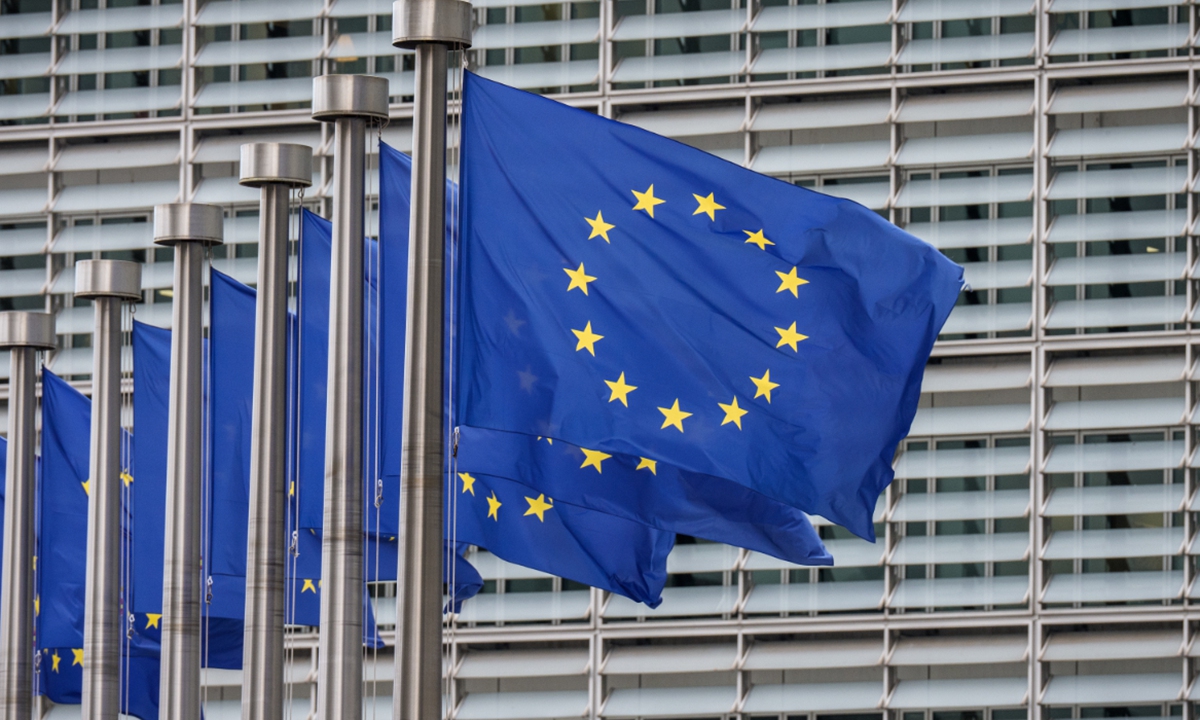
The European Union (EU) flags in front of EU headquarters in Brussels, Belgium. Photo: VCG
In a latest push to address its trade issue with China, the European Union (EU) is developing a "solidarity instrument" to support companies that diversify critical supplies away from China and cushion the impact of any retaliation in the event of a trade conflict, according to Bloomberg's Saturday report. The reported tool may require financial support to move forward.
However, Chinese experts described the proposed "solidarity instrument" as an extension of the EU's de-risking policy. They stressed that genuine solidarity means approaching China-EU trade relations rationally and helping businesses maintain a stable policy environment for trade with China, rather than creating greater uncertainty for companies on both sides.
Citing people familiar with the matter, Bloomberg report said the tool will come at a price, and would require funding, just as member states haggle over the bloc's next multiyear budget.
The tool, which is being developed by the bloc's executive arm, would be part of the EU's efforts to address a massive trade deficit with China, the report claimed.
Although details of the proposed "solidarity instrument," including its scope and implementation, remain unclear, it already appears to carry a strong protectionist undertone, said Jian Junbo, director of the Center for China-Europe Relations at Fudan University's Institute of International Studies. "This also reflects a lack of confidence on the European side in economic and trade competition with China, as well as persistent misperceptions about the country," Jian told the Global Times on Sunday.
"Decoupling, imposing restrictions or intensifying confrontation will not genuinely improve Europe's competitiveness, nor does it offer a sustainable path toward long-term growth and prosperity," Zhang Jian, a vice president of the China Institutes of Contemporary International Relations, told the Global Times. Instead, such moves will only inject greater uncertainty into China-Europe economic and trade ties, he stressed.
The proposed instrument comes shortly after the first meeting of the China-EU trade and investment consultation mechanism concluded on June 29. Meanwhile, officials from China and European countries have held a series of intensive meetings in recent weeks to address trade frictions and revive dialogue mechanisms.
At the first meeting of the China-EU Trade and Investment Consultation mechanism held on June 29, both sides emphasized the significance of properly addressing challenges affecting bilateral economic and trade relations and agreed to seek practical and workable solutions, according to Chinese Ministry of Commerce.
Regarding this situation, Chinese experts also called on the European side to make better use of dialogue and consultation mechanisms rather than continuing to pursue de-risking from China at the expense of bilateral economic and trade ties.
Rather than further distancing itself from the Chinese market, Europe should deepen cooperation and with China to address its own competitiveness challenges, while strengthening its comparative advantages and industrial capabilities through engagement, Jian said.
In recent years, the EU has continued to advance its so-called "de-risking" strategy, seeking to reduce what it describes as dependence on China in key industries. While the EU appears to have consistently overlooked the gains it derives from areas where it holds a competitive edge in trade with China.
Regarding trade in services, the EU continues to maintain a trade surplus with China, though it is decreasing. In 2025, it amounted to €21.3 billion ($24.3 billion), a report released on EU's official website showed. China is the EU's fourth-largest services trading partner, the report said.
In 2024, the service trade surplus with China exceeded $50 billion, while intellectual property royalties alone generated more than $10 billion annually from China, official data showed.
The Chinese Foreign Ministry has repeatedly responded clearly to the EU's previous plans to expand its policy tools to address what it calls imbalanced trade with China.
"International trade is a two-way street. There's no forced trade. The China-EU trade relations are win-win in nature. China does not aim for trade surplus. Focusing only on trade in goods while ignoring trade in services and investment returns, on pure quantities while overlooking trade structure and profit flows, and on imports from China while neglecting one's own export restrictions—anyone who sees trade this way sees nothing but imbalance," FM spokesperson Mao Ning said told a press conference on May 28.
Whatever the terms — "de-risking," "reducing reliance" or "trade imbalance," they are just different names for protectionism, and will only hurt the interest of European consumers, raise companies' costs and weaken Europe's industry competitiveness in the long run, Mao said. "The EU needs to put trade ties with China in perspective and honor its commitment to free trade. China will closely follow the EU's moves and take all measures necessary to safeguard legitimate rights and interests."
RELATED ARTICLES