Chinese industry group slams EU’s anti-dumping probe into Peking duck; ‘move shows Brussels’ lack of confidence’, obstinacy in expanding trade aggressions
By Published: Jul 10, 2026 03:21 PM

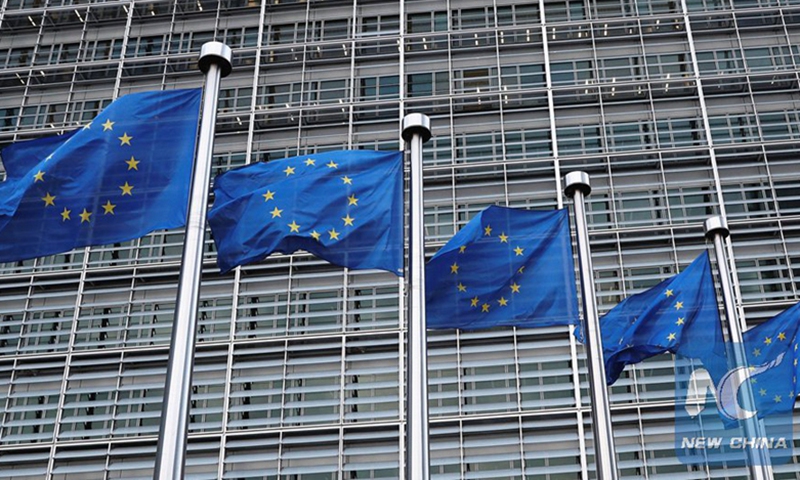
The European Union flags in front of EU headquarters in Brussels, Belgium. Photo: Xinhua
Peking duck is a famous delicacy and must not become a casualty of trade frictions, the China Chamber of Commerce to the EU (CCCEU) told the Global Times on Friday, commenting on the European Commission (EC)'s probe into imports of Peking duck on alleged dumping grounds.
The EC on Thursday (EU time) launched a so-called anti-dumping investigation into Chinese Peking duck, media reported.
The probe into imports of Peking duck, which represents a tiny section of bilateral trade but is an iconic Chinese product, is notable and carries a major symbolic message. It signals Brussels' attempt to further expand its trade aggressions with China, in an apparent bid to gain leverage in potential talks, seriously undermining bilateral efforts to stabilize ties, Chinese experts said. They added that EU's move has also revealed its deep anxiety stemming from its lack of confidence of facing its structural issues head-on.
The EC launched an investigation on Thursday into Chinese Peking duck after several EU producers complained of unfairly low prices harming their industry, according to Euro News. Some media reports noted that this will be the first so-called anti-dumping case initiated by the EU against Chinese agri-food products.
In an online post on Thursday, the China Chamber of Commerce to the EU (CCCEU) highlighted the negative trend reflected by this move.
"This trend indicates that the EC's focus of its so-called trade defense measures may be expanding from the industrial manufacturing sector to that of agri-food imports," read the CCCEU post.
The EU market for duck was worth an estimated 800 million euros ($915 million) in 2025, and imports from China were 199 million euros, according to the Financial Times. That represents only a small fraction of the total China-EU trade, which reached 5.93 trillion yuan ($860 billion) in 2025, according to Chinese customs data.
'Politically chosen'
The EU's targeting of Chinese duck products has been noticed by observers, with many believing the move carries political connotations amid ongoing trade talks between the two trading partners.
John Clarke, a former senior agriculture trade negotiator for the EU, said the timing was odd as the EU was about to recognize Peking Duck as a meat product of protected origin, banning non-Chinese producers from using the term, according to the Financial Times. He warned that hitting an "iconic product" would likely prompt a tough response from China and "prosecco (sparkling wine) producers should be nervous."
The case against Peking duck is baffling, according to a source who closely follows China-EU trade.
"There are many types of ducks that are being exported to the EU from China, but Peking duck is chosen for the probe... this can hardly make one not doubt that this particular type is chosen for political purposes due to it being a famous Chinese cuisine of the Chinese capital," the source said.
The targeting of Peking duck meat, a small commodity but one that bears strong symbolic significance, highlighted the EU's obstinacy in continuing to expand its protectionist trade measures against China in recent years, with the apparent aim of gaining more cards in potential trade negotiations with China, said Yang Chengyu, an expert on European affairs at the Chinese Academy of Social Sciences.
Zhang Jian, a vice president of the China Institutes of Contemporary International Relations, told the Global Times that the EU move on Peking duck while mentioning a subsidy and agricultural modernization program is absurd, as the EU itself a major practitioner of agricultural subsidies.
Information on the European Parliament website showed that under the EU's budget for 2021-2027, a total of 386.6 billion euros has been set aside for the agriculture sector, accounting for roughly one-third of the EU's total budget.
As an agricultural food product bearing China's geographical indication characteristics, "Peking Duck" is well-loved by consumers both in China and abroad, with its primary production and consumption markets located in China, the CCCEU said in a statement sent to the Global Times on Friday.
The EU's decision to investigate it on grounds of "dumping", which runs counter to the shared understanding of consumers in China and Europe alike, reflects an inherent contradiction between its logic of "economic security" and the principle of "open trade", the CCCEU said.
We believe that "Peking Duck" is not only a delicacy on the dining table, but also an important bond bringing cultural and people-to-people exchanges and agricultural cooperation between China and Europe. It should not, and must not, become a casualty of trade frictions, per the statement.
"Despite certain progress having been made in recent rounds of engagement, the EU actions taken on Thursday showed that it continues to pile on new protectionist measures and enlarge its so-called toolkit in its trade aggression toward China," Yang told the Global Times on Friday.
The EU's forceful intervention on duck meat trade has also revealed its deep anxiety stemming from its lack of confidence of facing its structural issues head-on, Yang said.
Act raises concerns
Meanwhile, more EU actions targeting China were also reported on Thursday. According to a Reuters report, Brussels has drafted a new EU procurement rule that will seek to harness the EU's collective purchasing power to favor the bloc's own companies and reduce dependence on foreign suppliers.
Although the draft document does not specifically name China, the EC has adopted relevant policies as it seeks to reduce China's dominance of critical materials production and narrow a trade gap, Reuters noted.
The EC on Thursday also announced that it has published a regulation imposing definitive anti-dumping duties of up to 45.3 percent on imports of passenger car and light lorry tyres originating in China.
The EU's protectionist moves have sparked concerns from the business community.
The CCCEU on Friday slammed the EU's so-called anti-dumping duties on Chinese passenger car and light truck tyres, saying that the additional tariffs may create further cost pressures across the broader automotive ecosystem, affecting both Chinese and EU companies throughout the value chain.
"We hope trade defense measures can continue to be applied in a fair, transparent and proportionate manner, supporting a stable and predictable China-EU trade environment," the CCCEU said in a statement to the Global Times.
The EU's latest round of protectionist actions against Chinese products runs counter to the EU's stated goals to "stabilize bilateral relations" with China and undermines bilateral efforts to address disputes through consultation, according to Zhang Jian.
"The EU needs to align its actions with its words and stop shifting blame and take up a serious attitude in stabilizing the important China-EU trade ties," Zhang told the Global Times on Friday.
Notably, the two sides have kept communication over trade issues. On June 29, China's Minister of Commerce Wang Wentao and Maroš Šefčovič, European Commissioner for Trade and Economic Security, co-chaired the first meeting of the China-EU trade and investment consultation mechanism in Brussels, Belgium. Šefčovič has been invited to visit China this autumn to co-chair the second meeting of the newly established China-EU trade and investment consultation mechanism, the Chinese Ministry of Commerce (MOFCOM) said on July 2.
Chinese Vice Minister of Commerce and Deputy China International Trade Representative Ling Ji held a video meeting with Deputy Director-General Denis Redonnet of the EC's Directorate-General for Trade and Economic Security, during which they exchanged views on China-EU economic and trade relations on Thursday, the MOFCOM said on Friday.
The Chinese government has repeatedly stressed the economic complementarity of China and EU and that the two are partners, not rivals.
At a regular press conference on Monday, Chinese Foreign Ministry spokesperson Mao Ning said that China-EU trade is driven by market demand and shaped by economic complementarity. China-EU trade has benefited consumers and profited dealers. It is not something that can be forced, but is a result of mutual choice that benefits both sides, Mao said.
"We hope the EU will put things into perspective, ditch the zero-sum mentality and work with China to make the pie of win-win cooperation bigger," the spokesperson said.
RELATED ARTICLES