China's railways handle 12.3 million foreign passengers in H1, up 33.6% as visa-free policies boost inbound travel
Visa-free policies and rail networks reinforce each other, fueling inbound travel growth: experts

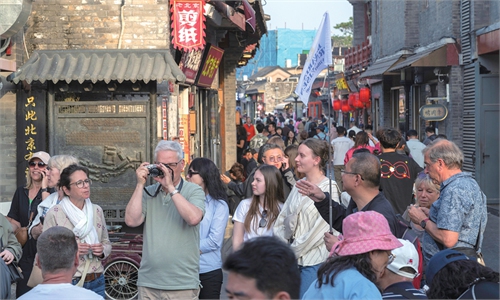
Foreign tourists pose for a photo at Beijing's Beihai Park on July 13, 2026, as China's expanded visa-free policies continue to boost inbound tourism. Photo: VCG
At a railway station in South China's Guangxi Zhuang Autonomous Region, Nigerian national Oluwabunmi Henry and his family were waiting to board a high-speed train bound for the southern Chinese city of Guangzhou. Traveling with his wife and their five-month-old baby, Henry said the trip was more than just a way to reach their destination — it was part of their China experience. Choosing first-class seats, Henry told the Global Times that the train was "very convenient and much faster" than other options, allowing his family to enjoy the scenery along the way before exploring Guangzhou's food and cityscape.
More foreign visitors like Henry are choosing to explore China by rail as visa-free policies continue to expand and inbound travel rebounds. China's railways handled over 12.31 million foreign passengers in the first half of the year, up 33.6 percent year-on-year, according to the latest data from China State Railway Group released on Monday. Meanwhile, China recorded 22.91 million foreign arrivals during the same period, with visa-free entries accounting for 77.7 percent of the total, data from the National Immigration Administration (NIA) showed on Friday.
The two sets of figures point to a broader trend, with inbound travel showing a steady recovery and rail becoming an increasingly important mode of transportation for foreign travelers in China. Experts said that visa-free policy support, including greater travel convenience, has encouraged more overseas travelers to explore the country by high-speed rail, reflecting China's expanding consumption potential and economic vitality.
Travelers embrace high-speed rail
China's railways handled 2.348 billion passenger trips in the first half of the year, marking a 5.0 percent year-on-year increase and a record high for the same period. To meet rising travel demand, China State Railway Group utilized ticketing and waitlist booking data from the 12306 platform to adjust capacity, with an average of 11,468 passenger trains operating daily, up 630 trains, or a 5.8 percent increase, year-on-year.
Cross-border rail travel has also continued to grow. In the first half of the year, the China-Laos Railway handled 188,000 cross-border passenger trips, up 25.9 percent year-on-year. The Guangzhou-Shenzhen-Hong Kong high-speed railway handled 16.962 million cross-border passenger trips, up 13.8 percent. China also operated international passenger trains linking China with Russia, Vietnam, Mongolia and North Korea to facilitate cross-border exchanges and economic cooperation, according to China State Railway Group.
Meanwhile, railway authorities successfully handled travel demand during major holidays, including the Spring Festival, Qingming Festival, May Day and Dragon Boat Festival holidays, with multiple passenger records set. On May 1, China's railways recorded a daily high of 24.844 million passenger trips.
To facilitate travel for overseas visitors, China's railway system has optimized ticketing services, including support for foreign passengers using online platforms, multilingual services and passport-based ticket verification.
Beyond the numbers, high-speed rail travel is becoming more than just a means for foreign travelers to get from one place to another; it is increasingly becoming an experience in itself during their trips in China.
An Australian tourist told the Global Times on Monday that he had taken high-speed trains to Qingdao and Shanghai, describing the experience as "easy and accommodating." He noted that ticket services were efficient, recalling how staff quickly helped resolve a ticketing issue and guided him with patience and courtesy.
He mentioned that boarding procedures were smooth, with staff helping passengers line up in an orderly manner and quickly completing passport checks. "The trains are comfortable, with enough space even for someone tall like me," he said, adding that the clean carriages and no-smoking policy made the journey more enjoyable.
For some foreign travelers, the speed of China's high-speed rail has become one of the most memorable parts of their journey. Nigerian national Oluwabunmi Henry, who has traveled by train in Japan and Nigeria, said that China's high-speed rail system stood out for its speed and efficiency. "When it comes to high-speed trains, I think China is leading the world," Henry told the Global Times.
Beyond speed, frequent users of China's high-speed rail also highlight the convenience brought by its extensive network. Russian scholar Egor, who has taken China's high-speed rail many times, told the Global Times that the railway system impressed him with its efficiency, comfort and connectivity.
"I especially appreciate how easy, comfortable and well-organized the whole experience is," Egor said. "You arrive at the station, board the train, and can immediately start working, reading or simply enjoying the view."
He noted that the extensive network has made business, academic and personal travel across cities much easier. "For short and medium-distance journeys, I would prefer high-speed rail," he said, noting that conveniently located stations, efficient travel procedures and comfortable carriages make it one of the most convenient ways to travel in China.
"High-speed rail makes the journey itself part of the travel experience," Bian Yongzu, executive deputy editor-in-chief of Modernization of Management magazine, told the Global Times. He added that through train windows, foreign travelers can observe China's diverse landscapes, urban and rural development, and everyday life. By traveling across different cities and provinces in a short period, they can gain a more direct understanding of China's vast geography, cultural diversity and regional development.
High-speed rail has evolved beyond a means of transportation, becoming a window for foreign travelers to understand China's modernization, Bian said. "It showcases not only speed, but also the country's capabilities in advanced manufacturing, infrastructure development and large-scale transport management. For overseas visitors, a high-speed rail journey is not just a trip across regions, but also an opportunity to observe China's efficiency, public services and economic vitality firsthand," he said.
Opening-up drive fuels inbound travel
In recent years, China has accelerated infrastructure development while expanding its opening-up efforts, creating stronger support for the momentum of inbound travel.
The country has expanded its visa-free policies, allowing eligible foreign travelers to stay longer and explore more conveniently. China has introduced unilateral visa-free entry for citizens of 50 countries and 240-hour transit visa-free policies for travelers from 55 countries, along with other entry facilitation measures. About seven out of every 10 foreign arrivals entered China visa-free, the NIA said, according to the Xinhua News Agency.
China recorded 369 million entry and exit trips in the first half of the year, up 10.8 percent year-on-year and a record high, according to data released by the NIA on Friday. Foreign nationals accounted for 45.91 million trips, up 20.6 percent, including 22.91 million arrivals, up 20.4 percent. Visa-free arrival numbers reached approximately 17.82 million, accounting for 77.7 percent of all foreign arrivals and rising 30.6 percent year-on-year.
Wang Peng, an associate research fellow at the Beijing Academy of Social Sciences, told the Global Times that the rising popularity of inbound travel reflects China's continued opening-up and improved visa facilitation policies. Easier entry procedures have lowered travel barriers, making short-term trips to China more convenient. The growth in foreign arrivals and inbound consumption also shows international confidence in China's economic vitality and tourism market.
"Visa-free policies help foreign travelers enter China more easily, while the extensive high-speed rail network allows them to explore more destinations beyond major cities," he said. The combination of greater openness and better connectivity is transforming the growing inbound traffic into tourism and consumption growth, while offering overseas visitors a closer look at China's diverse regions, Wang said.
The State Council on Monday approved in principle a five-year plan to expand consumption, which called for boosting inbound consumption by improving the travel environment for foreign visitors and building the "Shopping in China" brand. The plan proposed steadily expanding the scope of visa-free countries, optimizing transit visa-free policies, increasing international flights, and improving payment, customs clearance, accommodation and transportation services for overseas travelers.
"Visa-free transit policies have contributed to sustained growth in inbound travel. Once in China, foreign visitors often travel between cities for sightseeing, making high-speed rail an important mode of transport. Visa-free entry and high-speed rail tourism therefore reinforce each other," said Bian.
The simultaneous growth in inbound arrivals and intercity travel demand has boosted spending across transportation, accommodation, dining, tourism and retail. It also reflects the continued release of economic vitality in China and the country's growing appeal to international travelers and consumers, Bian added.
From the continued expansion of visa-free policies to improved connectivity through modern transportation networks, China is leveraging greater opening-up and infrastructure development to make it easier for foreign travelers to visit and explore the country more deeply. The growth of inbound travel not only reflects stronger people-to-people exchanges, but also offers the world a firsthand perspective on China's economic vitality and consumption potential, experts said.
RELATED ARTICLES