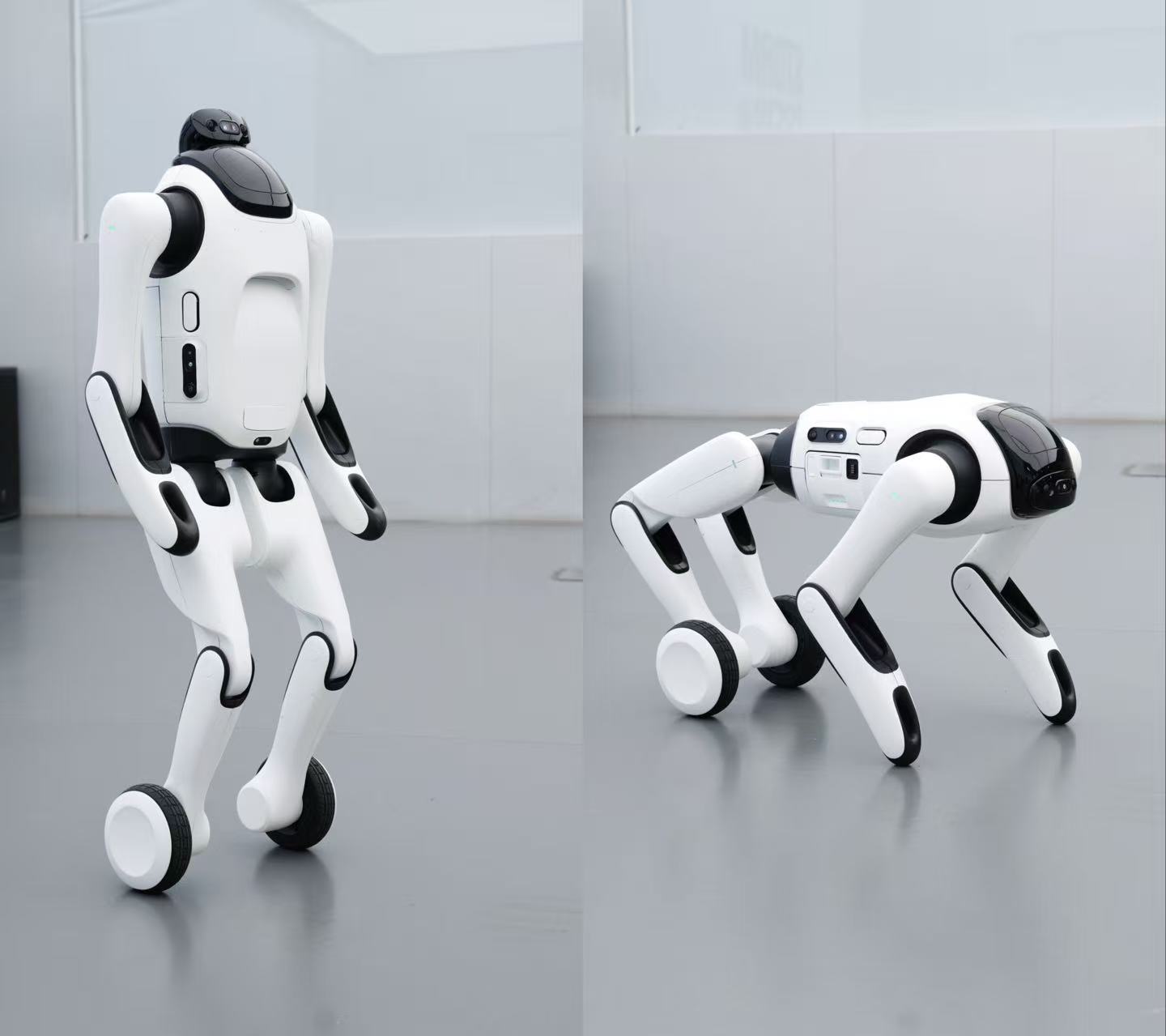
The Quester1, a shape-shifting personal robot that can automatically switch between wheeled bipedal and quadrupedal forms, will debut at the 2026 World Artificial Intelligence Conference in Shanghai on July 17, 2026. Photo: courtesy of Swancor Advanced Materials Co
A Chinese company will debut its groundbreaking Quester1 shape-shifting personal robot - "transformer-like" - at the 2026 World Artificial Intelligence Conference (WAIC), which will open in Shanghai on Friday, the Global Times learned.
Analysts said that the innovative move will open new industry paths by moving beyond the current development path of humanoid robots.
The Quester1, built around a single chassis, can automatically switch between wheeled bipedal and quadrupedal forms. This allows it to adapt to different environments and handle real-life scenarios such as home companionship, outdoor escort, and smart filming, Swancor Advanced Materials Co, the maker of the robot, told the Global Times on Monday in the statement.
The robot also uses an industry-first "transformer cross-morphology integrated architecture," enabling fully automatic, smooth switching among forms on a single chassis, the company said.
"Unlike traditional personal robots stuck in one fixed shape, the Quester1 offers two morphologies on the same body. This flexibility lets the robot choose the most suitable form for different spaces, road conditions, and tasks," Swancor said in the statement.
Swancor, primarily known for composite and circular materials, is one example of China's broader push into deformable robotics. In recent years, domestic enterprises and research institutions have been aggressively developing multi-morphology robots across household, commercial, industrial, special-purpose, and scientific research applications, forming a comprehensive innovation ecosystem, according to corporate releases and media reports.
As one of the latest examples, Unitree Robotics launched its manned transformable mecha GD01 in May 2026. The 2.7-meter-tall, 500-kilogram machine, touted as the world's first production-ready manned mecha, can transform and operate as a civilian vehicle, the company told the Global Times previously.
In December 2025, domestic robotic company LimX Dynamics unveiled LimX TRON 2, a modular, 3-in-1 embodied artificial intelligence (AI) robot.
Using just a single base unit and interchangeable modules, the robot can switch among dual-arm, bipedal, and wheeled-bipedal configurations. It can also be experimentally reconfigured into humanoid or quadrupedal forms, greatly reducing hardware costs, the company said in a release.
Academic breakthroughs are equally impressive. In January, China's Southern University of Science and Technology developed the GrowHR soft-bodied extendable robot. The robot stands at 1.36 meters and weighs only 4.5 kilograms, which is less than 20 percent of the weight of traditional rigid robots of the same size, the university said in a release.
"Domestic spillover from cross-industry technologies has provided strong support. Expertise from new-energy vehicle companies in chassis control and power trains, combined with mobile phone makers' strengths in edge-side chip optimization and human-machine interaction, has greatly lowered the technical barriers for cross-sector innovation," Wang Peng, an associate researcher at the Beijing Academy of Social Sciences, told the Global Times on Monday.
This trend allows companies to move beyond conventional robot industry thinking and create more flexible, versatile products, Wang said, adding that leveraging China's complete industrial chain in servomotors, sensors, and lightweight composite materials, companies are pursuing differentiated paths from overseas players that focus mainly on single-morphology development.
"Quester1 and GD01 reflect that China has entered a new era of embodied intelligence. Products are no longer just lab prototypes or proof-of-concept - they are now market-ready products with defined commercialization road maps," Wang said.
Industry insiders said that more innovative intelligent products from Chinese companies are expected to show up at the 2026 WAIC.
The total exhibition area will surpass 100,000 square meters for the first time. More than 1,100 companies are participating, showcasing more than 3,000 exhibits, including more than 300 products making their global debut. Both the intelligent computing and embodied intelligence tracks feature more than 200 companies each, according to official statistics.
RELATED ARTICLES