Analysis shows cutting China reliance would cost West $23t
‘Decoupling’ from China is unrealistic and costly, experts warn
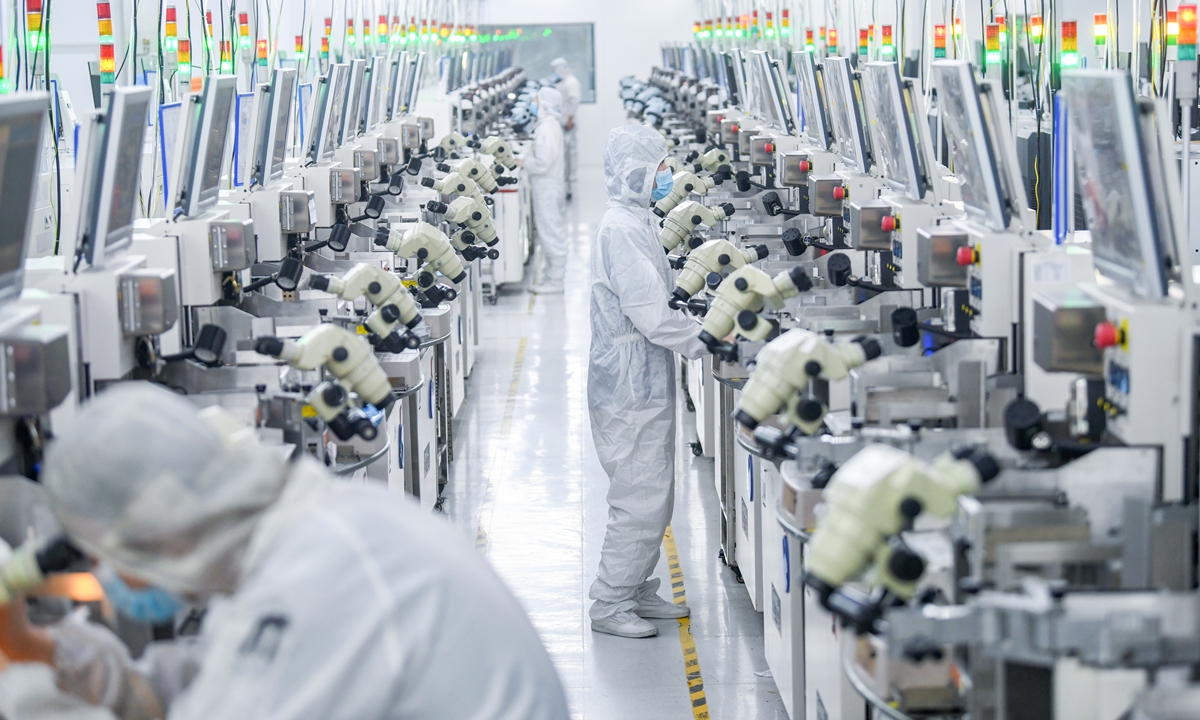
Workers fulfill orders and testing products in a production workshop of a company in Haikou, South China's Hainan Province on May 23, 2026. The company utilized production equipment imported under Hainan Free Trade Port's zero-tariff policy to independently manufacture and successfully export 773,000 transistors, with a total value of 1.849 million yuan.
An economic analysis has suggested that Europe and the US would need to invest an extra $23.6 trillion over the next 25 years to end their reliance on China in critical industries such as manufacturing and technology, which Chinese experts said serves as the latest evidence that Western countries' so-called "decoupling" from China is unrealistic and comes with enormous costs.
According to a report by the Financial Times on Monday, consultancy EY-Parthenon calculated that replicating the infrastructure, research, software, manufacturing and supply chains currently reliant on China would cost the US $13.7 trillion, the eurozone $9.1 trillion and the UK $800 billion by 2050.
At $550 billion a year, the annual investment required from the US government and American companies to decouple from China is roughly equivalent to the $600 billion invested by big US technology groups in data centers in 2025. For the EU, the spending required would amount to a near doubling of its annual budget, EY-Parthenon said.
The additional collective investment of an average of $940 billion a year for 25 years was, in theory, "not insurmountable" the EY-Parthenon analysts wrote. But it would be required on top of existing investments in energy, technology, defense and infrastructure.
"The report, through a wealth of data, clearly demonstrates the close degree of economic and trade cooperation among China, the US, and Europe. China's strong industrial capabilities and economic scale play an irreplaceable and vital role in the economic development and long-term sustainability of the US and Europe," Zhou Mi, a senior research fellow at the Chinese Academy of International Trade and Economic Cooperation, told the Global Times on Monday.
Zhou noted that if the West genuinely attempted a full decoupling from China, the damage inflicted on its economies would be long-term and profound. This harm would not only be reflected in enormous financial costs, but also in the fact that many development drivers and industrial supports would be extremely difficult to replace effectively.
Hu Qimu, a professor at the Maritime Silk Road Institute of Huaqiao University, told the Global Times on Monday that due to the relatively severe industrial hollowing-out in Europe and the US, their industrial sectors are incomplete and heavily reliant on China's manufacturing capabilities. To achieve "decoupling," they would need to independently rebuild the missing industrial categories.
However, even if Europe and the US invested enormous sums to reconstruct some of these sectors, the costs would be extremely high, ultimately leading to a sharp rise in expenses for downstream industries and consumers, Hu said, noting that "Therefore, decoupling is simply unrealistic."
The EY-Parthenon analysis found that given that Chinese-made goods typically enjoyed a 20- to 100-percent factory price advantage over their Western competitors, reducing reliance on Chinese manufacturing would push up prices and drive inflation.
In Europe, severing reliance on China could leave prices 1 to 2.5 percent higher in critical sectors, and the European Central Bank (ECB) and Bank of England perpetually above their 2 percent inflation targets, the EY-Parthenon report said, citing an ECB analysis.
Hu noted that the current global industrial competition is primarily concentrated in two key areas: cutting-edge technologies such as artificial intelligence and critical minerals and resources. The latter is closely linked to new materials and high-end equipment, forming part of the real economy and physical industry sector.
China is projected to supply more than 60 percent of the world's refined lithium and cobalt, which are essential for the transition to cleaner energy sources, and roughly 80 percent of battery-grade graphite and rare-earth elements by 2035, according to an assessment by the International Energy Agency.
On keeping the global industrial and supply chains of critical minerals safe and stable, China's position has not changed. However, some Western countries including G7 members have continuously ramped up efforts to build small circles to impose unilateralist measures against China.
In practice, even with massive investment the West could not decouple from China in the short run because of Beijing's stranglehold over many critical industrial materials, said Alicia García-Herrero, chief economist for Asia Pacific at investment bank Natixis, according to the Financial Times.
Zhou noted that China's advantages in tech, manufacturing and other areas stem from its stable economic policies, the predictable environment it has created for the market, and its open trade and economic environment.
According to the European Business in China Business Confidence Survey 2026, China remains "the heavyweight champion of efficient and cost-effective supply chains", with 75 percent of respondents saying their China-based production is more efficient than operations elsewhere.
Findings from the 2026 China Business Climate Survey Report released by AmCham China showed that China remains a cornerstone for foreign investment, with 50 percent of respondents still ranking it among their top three global destinations.
"The trend of globalization is irreversible. Western countries should clearly recognize the deeply intertwined economic relationship with China and understand that only by strengthening cooperation can they achieve mutual benefit and win-win outcomes," Hu noted.
RELATED ARTICLES