High-tech investment, manufacturing power China’s steady economic growth in Jan-Apr period
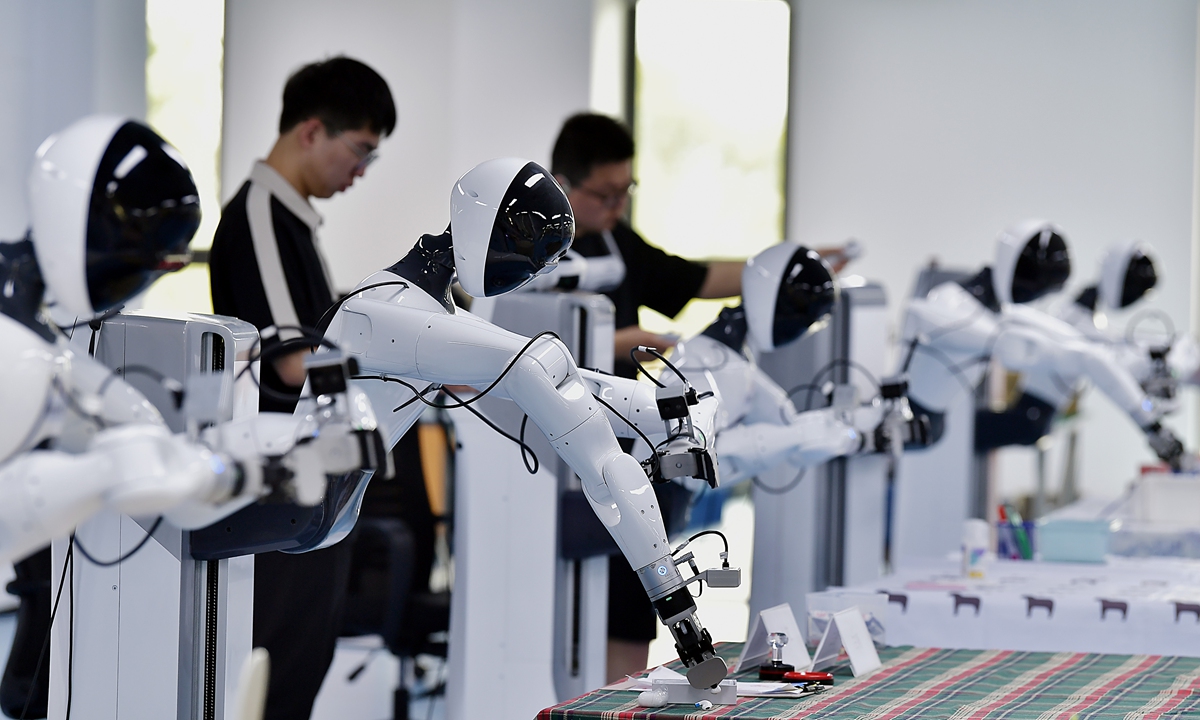
Data collection workers train embodied robots on April 27, 2026, teaching tasks such as sorting food and grasping bottles at a software park in Fuzhou, East China's Fujian Province. The factory acts as a "pre-job training school," bridging lab demonstrations and real-world applications across industries. Photo: VCG
Speaking of China's economic performance in the first four months, Fu Linghui, spokesperson and chief economist of the National Bureau of Statistics (NBS), cited several reasons that show steady economic growth: Production and supply maintained steady growth, market sales continued to expand, foreign trade showed strong resilience, employment and prices remained stable overall, new growth drivers strengthened, and high-quality development advanced with improved momentum.The April economic data released on Monday pointed to steady economic momentum in the first four months of the year and continued gains in high-quality development despite external uncertainties.
Statisticians from the NBS and Chinese experts noted that in general, China's economy maintained a steady recovery and upward momentum from January to April, with continuous structural optimization, growing new drivers, and steadily increasing foreign investor confidence. Despite a complex and volatile external environment and remaining domestic structural challenges, the Chinese economy remains highly resilient, full of potential and vitality. The fundamentals supporting long-term positive growth have not changed.
Despite new challenges both internationally and domestically, China's economy remains stable, Wang Guanhua, a spokesperson for the NBS, stated at a press conference on Monday.
"China is a super-large economy, so observing its performance requires focusing on the overall trend. For a long time, the Chinese economy has been advancing while overcoming difficulties and has been actively adjusting in response to changes," Wang stressed.
She also cited several factors that will allow China's economy to continue operating steadily: the expanding capacity to withstand pressure and room for policy maneuvering; a stronger material and technological foundation; a more resilient industrial system; and a broader domestic market.
New highlights
According to NBS data, in the first four months there were positive signs in investment, export and consumption - the foundational triad of economic growth.
Market sales continued to expand, with service retail growing at a faster rate. Investment in high-tech industries increased rapidly. Imports and exports of goods grew strongly, and the trade structure continued to optimize.
Industrial production grew relatively quickly, with equipment manufacturing and high-tech manufacturing expanding at a faster pace. The service sector maintained steady growth, and modern services showed favorable development.
Chinese analysts said investment and manufacturing related to high-tech industries were the spotlight of China's economic growth in the first four months.
Wen Bin, chief economist at China Minsheng Bank, told the Global Times on Monday that the January-April economic data showed continued divergence between old and new growth drivers.
"Industrial structure continues to optimize and upgrade. Industries related to the artificial intelligence (AI) investment boom and those with enhanced Chinese competitiveness maintained rapid growth.''
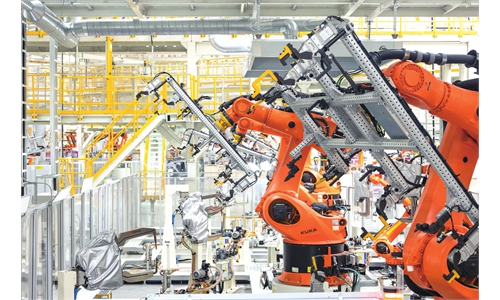
In the first four months, value-added industrial output above designated size rose 5.6 percent year-on-year. Among major industrial categories, equipment manufacturing and high-tech manufacturing remained key bright spots, rising 8.7 percent and 12.6 percent year-on-year, respectively, both faster than overall industrial output growth.
Cutting-edge high-tech industries were also spotlight. For example, robot-related products witnessed a boom. The output of robot speed reducers - one of the three core components of industrial robots - grew by 38.3 percent year-on-year in April, while that of industrial robots and service robots grew by 15.1 percent and 12.3 percent, respectively.
Yet this is only an epitome of China's fast development in high-tech industries in April - the added value of high-tech manufacturing enterprises above designated size increased by 12.8 percent year-on-year in April, contributing 52.1 percent to the industrial growth, according to NBS.
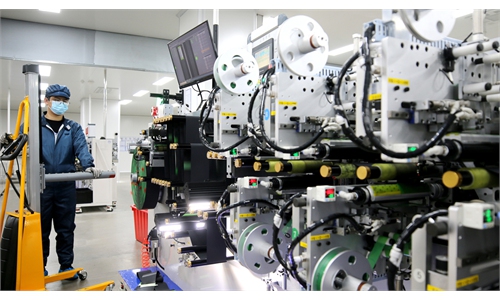
Investment in high-tech industries continued to grow at a relatively fast pace. In the January-April period, high-tech industry investment grew 6.1 percent, led by a 44.3 percent rise in electronic circuit manufacturing industry, a 28.8 percent increase in lithium-ion battery manufacturing, and a 20.9 percent gain in aviation manufacturing, NBS data showed.
Investment in high-tech services also increased by 10.5 percent year-on-year in the first four months. Among them, driven by the rapid development of AI, investment in information services rose by 18.1 percent, per NBS.
China's economy is currently in a policy observation period. The key focus is on vigorously advancing high-tech manufacturing, building a modern industrial system, and promoting the transformation from old to new growth drivers, Wang Qing, chief macroeconomic analyst at Golden Credit Rating International, told the Global Times on Monday.
In terms of consumption, Monday's data also showed expanding market sales and faster growth in service consumption. The total retail sales of consumer goods and services online rose 6.6 percent year-on-year in the first four months. Online sales of consumer goods accounted for 25.0 percent of total retail sales. Service retail remained a bright spot, rising 5.6 percent year-on-year in the first four months, according to the NBS.
New consumption formats also emerged as growth drivers. For example, from January to April, the retail sales of unmanned stores increased by more than 20 percent year-on-year.
Yuan Yan, a statistician at the NBS, attributed the online sales growth to the advanced logistics system nationwide, which has made commercial circulation in urban and rural areas convenient.
China's economy showed strong momentum in the first four months of 2026, with rapid industrial growth, steady consumption expansion, and exports returning to a fast track, Lian Ping, director of the China Chief Economists Forum, told the Global Times on Monday.
Raising China growth forecasts
China's solid economic performance has won broad recognition from international markets. This month, several global investment banks have raised their 2026 China GDP growth forecasts, expressing confidence in the country's economic resilience and high-quality development prospects.
In its latest mid-year outlook, Morgan Stanley upgraded China's 2026 and 2027 real GDP growth forecasts to 4.8 percent and 4.7 percent, respectively, citing China as one of the biggest beneficiaries of global AI development and energy transition.
Morgan Stanley's Chief China economist Xing Ziqiang highlighted a "K-shaped recovery," with strong performance in China's exports and high-end manufacturing. Meanwhile, AI and energy investment will also drive economic growth.
Michael Spence, a Nobel Laureate in Economic Sciences, told the Global Times on Monday on the sidelines of the 2026 Tsinghua PBCSF Global Finance Forum that the positive side is that China has invested successfully and heavily in science and technology that drives long run growth. "That's just obvious to everybody who spends any time here,'' he added.
"A typical pattern in many countries is the short run looks good, but the long run looks more kind of questionable. It's kind of the opposite in China - in the long run, it looks pretty good," said Spence, noting that China's economic contribution to the world "will continue to be very large."
RELATED ARTICLES