Chinese scientists develop world’s first bionic auditory neural interface, enabling artificial auditory nerve to ‘understand’ sounds
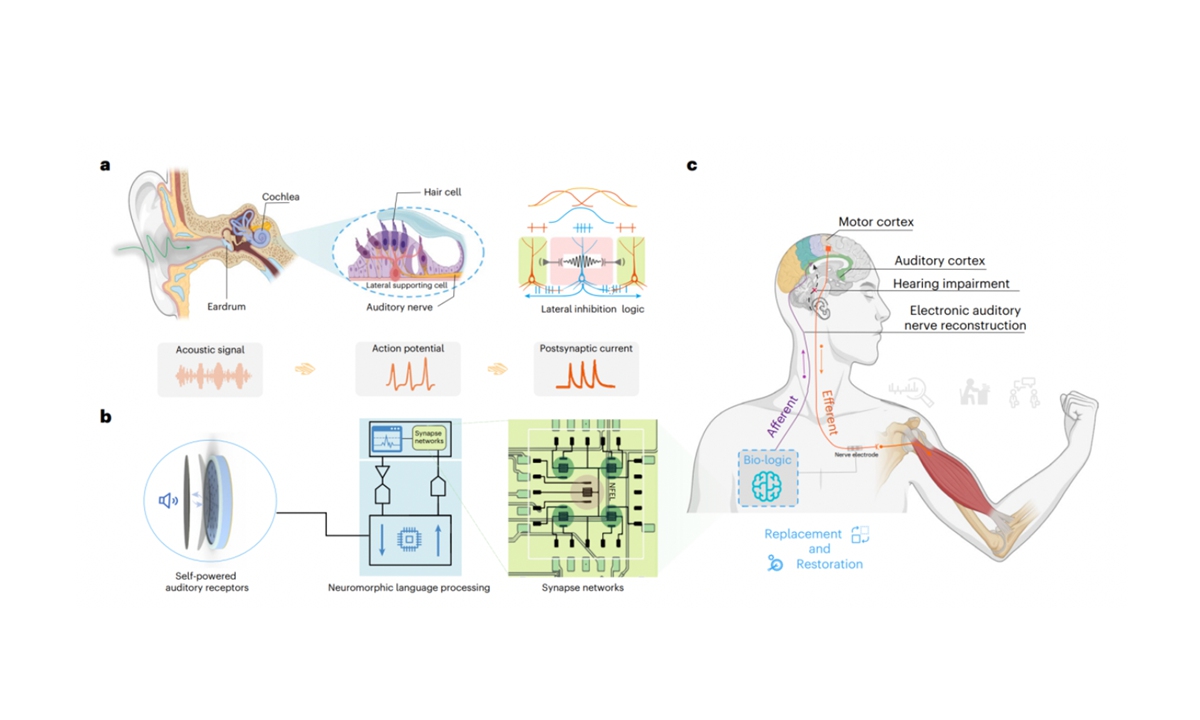
Photo: Courtesy of Xu Wentao
Chinese scientists have successfully developed the world's first bionic auditory neural interface, enabling conventional cochlear implants to progress from helping users hear sounds to helping them understand what they hear, marking a major advance from restoring hearing perception to rebuilding auditory function, the Global Times learned from the research team on Monday.
Beyond traditional cochlear implants, this research led by Xu Wentao, professor from the College of Electronic Information and Optical Engineering, Nankai University, provides a new technological pathway for auditory reconstruction through an innovative electronic replacement and restorative solution. The research results were recently published in the international academic journal Nature Materials.
According to the researchers, sensorineural hearing loss affects nearly 3 percent of the global population, yet effective solutions remain limited. Conventional cochlear implants can capture sound and convert sound into electrical signals but still depend on a patient's remaining auditory nerve to deliver those signals to the brain. Once the auditory nerve is absent or severely damaged, even the most advanced cochlear implants are unable to function effectively.
Developing a system that can directly replace the biological auditory nerve to overcome the limitations caused by missing natural auditory nerves has long been a key goal of global neural repair research, according to the Science and Technology Daily.
While current cochlear implants can restore hearing, they still lag behind the natural auditory system in sound resolution and speech recognition in noisy environments. The research team aims to develop an artificial auditory system that can not only hear but also understand sound by filtering, identifying, and processing auditory information before relaying it to the brain, Xu told the Global Times on Monday.
To achieve this goal, the research team developed an artificial neuromorphic interface capable of deep integration with the mammalian nervous system, creating a complete artificial auditory circuit that combines sound sensing, neuromorphic encoding, semantic processing, and bioelectrical signal output, forming a closed-loop pathway from sound perception to neural signal transmission.
Simply put, this system does more than just enable users to hear sounds. Like a natural auditory nerve, it can also filter, analyze, and encode sound signals, allowing an "artificial auditory nerve" to progress from merely hearing to truly understanding. This marks a critical step in the evolution of hearing restoration from recovering perception to reconstructing function.
In animal trials, deaf rabbits implanted with the bionic auditory neural interface regained sound perception, recognized voice commands and performed related tasks, demonstrating an artificial auditory processing chain spanning sound detection, and behavioral responses.
Next, the research team will continue to focus on neural repair and bionic intelligence, accelerating the transition of key technologies into clinical applications and industrial development, Xu said, according to the report.
RELATED ARTICLES