China’s export of sports equipment hits 67.53 billion yuan in first 6 months of 2026 as World Cup sparks a surge in global demand
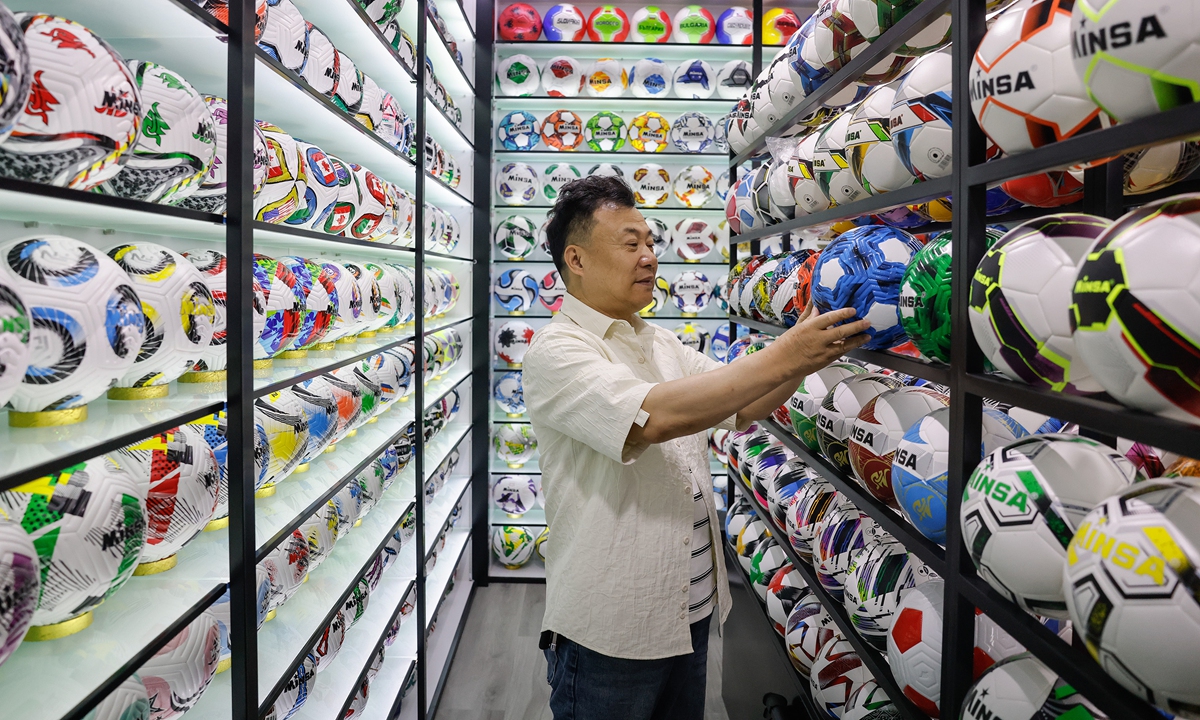
A Chinese vendor checks a football at the Yiwu International Trade Market in Yiwu, East China's Zhejiang Province on April 19, 2026. Photo: VCG
China's exports of sports goods and equipment reached 67.53 billion yuan ($9.95 billion) in the first half, including 3.08 billion yuan worth of balls, as the World Cup sparked a global surge in consumer demand, Lü Daliang, spokesperson of the General Administration of Customs (GAC), said on Tuesday.
The sports goods production lines in Yiwu, East China's Zhejiang — known as the "world's supermarket" — provide important supporting evidence.
According to Yiwu Customs statistics, the city exported sports goods worth 4.91 billion yuan in the first five months of the year. Driven by the US-Canada-Mexico World Cup, the US has become Yiwu's largest export market for sports goods. In the first five months, sports goods exports to the US reached 960 million yuan. Exports to Canada surged nearly three times year-on-year.
Two commemorative soccer balls, featuring elements from the US, Canada, and Mexico, have become best-selling products for Minsa Sports during this World Cup. According to Chen Shaomei, the company's manager in the Yiwu International Trade Market, total sales of the soccer balls in recent months have exceeded 100,000.
Independent design, production, sales, and the creation of its own brand have become the core competitiveness of the company, Chen told the Global Times on Tuesday.
For a new product, all the necessary accessories and raw materials can be quickly sourced, and the entire process, from design and pattern making to sampling, can be completed in just one week. "This is also the core reason why brand owners and overseas buyers firmly choose Yiwu," Chen said.
Lü, the GAC spokesperson, said that in recent years, China has been the world's largest exporter of sports goods, accounting for more than 40 percent of global exports. In competitive sports, Chinese-made products have become familiar fixtures at top international events, from table tennis tables used in the Summer Olympics to lightweight ski poles used in the Winter Olympics, and even the official World Cup match balls, which are embedded with chips.
In recreational sports, China offers a wide array of products fitting diverse scenarios. In the first six months, exports of fitness and rehabilitation equipment such as treadmills totaled 2.67 billion yuan, while water sports gear such as paddleboards reached 4.77 billion yuan. Notably, exports of trendy skateboards — a favorite among younger consumers — grew by 20.4 percent in the first half, according to Lü.
China's sports equipment has maintained a stable presence in traditional markets such as Europe and North America, while also performing strongly in emerging markets including Latin America and Africa. In the first half of the year, exports to Latin America increased by 18.9 percent while exports to Africa grew by 8.1 percent, Lü said, noting that China will continue to meet diverse global demands for active and healthy lifestyles with its abundant supply and high-quality sports products.
RELATED ARTICLES