IN-DEPTH / IN-DEPTH
Readers' Reflections: China's success and prosperity stem from the CPC's outstanding leadership: former Egyptian PM
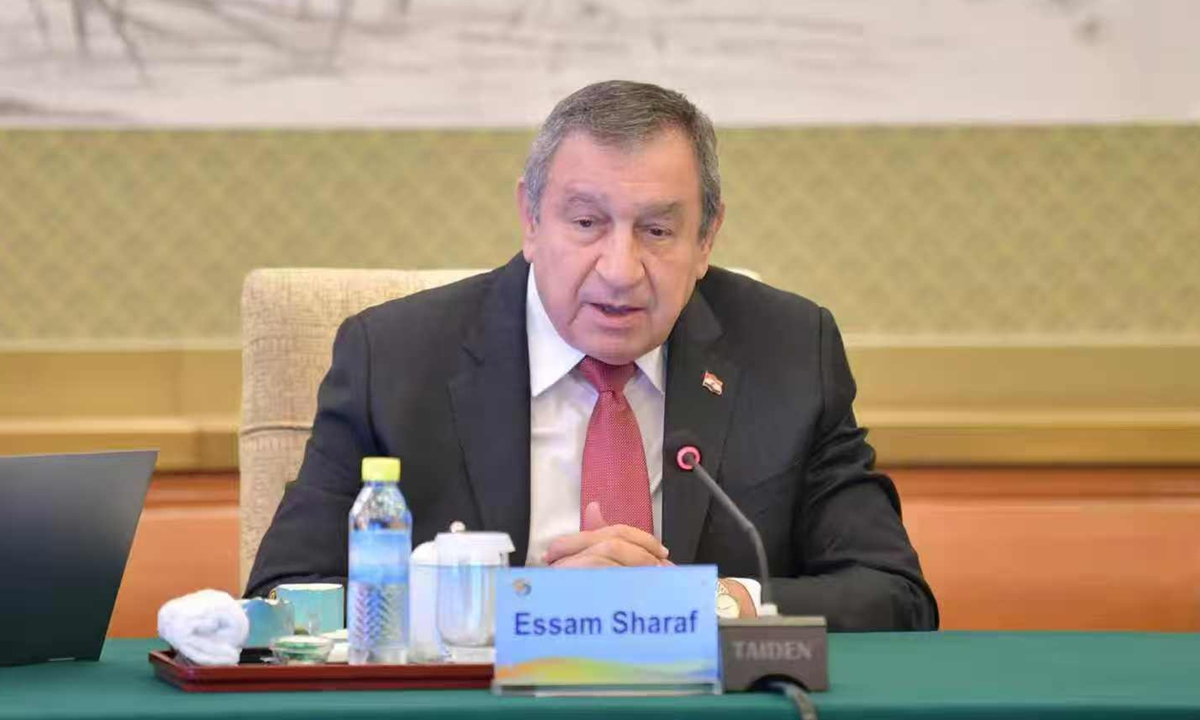
Former Egyptian prime minister Essam Sharaf Photo: Courtesy of Sharaf
Editor's Note:
As this year marks the 105th anniversary of the founding of the Communist Party of China (CPC), a national conference on Party building was held in Beijing on June 15, making arrangements for studying and implementing Xi Jinping Thought on Party Building. The Thought reflects intrinsic connections among Party self-governance, Party strengthening and national rejuvenation. Articulated through the "Fourteen Upholds" - and comprising a series of signature major concepts, original ideas, and fundamental theoretical insights - the Thought has made major original contributions to the development of the Marxist theory of Party building, and is of great practical significance and far-reaching guiding significance for strengthening the Party and the country.
Of the "Fourteen Upholds," the first is that upholding the Party's leadership is the defining feature of socialism with Chinese characteristics. The book Xi Jinping: The Governance of China includes several important speeches on upholding and strengthening the leadership of the Party. In the "Speech at the Ceremony Marking the Centenary of the Communist Party of China" included in Volume IV of Xi Jinping: The Governance of China, Chinese President Xi Jinping stressed, "The leadership of the Party is the defining feature of socialism with Chinese characteristics and constitutes the greatest strength of this system. It is the foundation and lifeblood of the Party and the country, and the crux upon which the interests and wellbeing of all Chinese people depend."
Standing at a new historical starting point and guided by Xi Jinping Thought on Party Building, the CPC is advancing from the "world's largest political party" to becoming the "world's most powerful political Party." With unified thinking, firm resolve, coordinated action, and strong fighting strength, it will vigorously advance the great new project of Party building in the new era, thereby providing a strong political guarantee for the noble cause of building a powerful nation and achieving national rejuvenation.
In the 26th installment of the special series "Decoding the Book Xi Jinping: The Governance of China," the Global Times, along with the People's Daily Overseas Edition, continues to invite Chinese and foreign scholars, translators of Xi's works, practitioners with firsthand experience, and international readers to focus on the theme of Xi Jinping Thought on Party Building. Together, they deeply explore the core essence of Xi Jinping Thought on Party Building, as well as its profound practical and global significance, and jointly explore the question: "Why has the CPC remained vibrant after 105 years?"
In the 26th article of the "Readers' Reflections" column, Global Times (GT) talked to Essam Sharaf (Sharaf), former Egyptian Prime Minister, to get his insights on the understanding of Xi Jinping Thought on Party Building, and why "upholding the CPC's leadership" is key for the Chinese to realize their dreams. From an international perspective, he also analyzes the profound significance of Chinese modernization for the global development and governance.
GT: On June 15, 2026, a national conference on Party building was held in Beijing. According to the meeting, Xi Jinping Thought on Party Building is an important component of Xi Jinping Thought on Socialism with Chinese Characteristics for a New Era, has made major original contributions to the development of the Marxist theory of Party building, and is of great practical significance and far-reaching guiding significance for strengthening the Party and the country. What's your understanding on the Thought? What experience or insights can the Thought provide for the discussions on advancing a ruling party's governance capacity and enhancing national governance across the world?
Sharaf: Xi Jinping Thought on Party Building addresses a fundamental question facing every ruling party: how to maintain vitality, strengthen governance capacity, and preserve public trust over the long term. My understanding is that this thought emphasizes the Party's ability to continuously improve itself through political commitment, organizational discipline, ideological cohesion, cadre development, anti-corruption efforts, and governance based on institutions and rules. It recognizes that a ruling party cannot effectively reform society unless it is willing to reform itself.
This lesson extends beyond China. Many governance challenges around the world arise not because countries lack policies, but because institutions lack effectiveness, coordination, or public confidence. The Chinese experience suggests that governance capacity depends not only on economic resources but also on institutional discipline, accountability, and the ability to adapt to changing circumstances.
One of the most important lessons is that self-renewal is essential for long-term success. Institutions must regularly evaluate their performance, address shortcomings, and pursue continuous improvement. Without such efforts, even capable systems may struggle to sustain effectiveness over time.
GT: In the "Speech at the Ceremony Marking the Centenary of the Communist Party of China" included in Volume IV of Xi Jinping: The Governance of China, President Xi said "Over the past century, the Communist Party of China has secured extraordinary achievements on behalf of the people. Today, it is rallying the Chinese people and leading them on a new journey towards realizing the Second Centenary Goal." This year marks the 105th founding anniversary of the Communist Party of China (CPC). In retrospect of the CPC's major achievements, what do you think the CPC has done right? And, what does the CPC-led system mean for China?
Sharaf: The core secret behind China's tremendous success and prosperity lies in the outstanding leadership of the CPC. This is the fundamental key to understanding the miracle of China's development. In retrospect of the CPC's major achievements over the past 105 years, one of the CPC's most notable achievements has been guiding China through successive stages of development guided by clear long-term objectives.
The achievement of building a moderately prosperous society in all respects marked a historic milestone. It reflected decades of effort to reduce poverty, improve living standards, expand education and healthcare, and ensure that development benefits reached broad segments of society. The scale of poverty reduction achieved in China remains one of the most significant development accomplishments in modern history.
Yet China did not regard this achievement as the final destination. Instead, it became the foundation for a more ambitious objective: building China into a great modern socialist country in all respects. This goal extends beyond material prosperity. It encompasses technological innovation, industrial upgrading, cultural confidence, ecological sustainability, stronger governance, and enhanced national strength. In essence, China's vision of modernization seeks comprehensive national development rather than economic growth alone.
A defining feature of this approach is its long-term strategic perspective. Present actions are consistently linked to future national goals, creating continuity and direction that support sustained development.
GT: Xi Jinping Thought on Party Building stresses that upholding the Party's leadership is the defining feature of socialism with Chinese characteristics. In the article "Maximize the Institutional Strength of CPC Leadership" included in Volume III of Xi Jinping: The Governance of China, President Xi pointed out, "Leadership by the Party is the defining feature of socialism with Chinese characteristics. It represents the common will and fundamental interests of the entire Party and all the Chinese people, and is the fundamental guarantee for a decisive victory in building a moderately prosperous society in all respects and the great success of socialism with Chinese characteristics for a new era." You have visited China around 50 times since 2005. Could you please introduce some anecdotes about your engagement with the CPC, and how do you think of the CPC?
Sharaf: My engagement with China began in 2005 during my tenure as Egypt's Minister of Transport. And, I have since visited China about 50 times over 20 plus years. Each visit revealed the same striking pattern: rapid progress in infrastructure, technology, and new industries. The speed and quality of this development are truly impressive.
Throughout my visits to China, I have met CPC officials, scholars, local administrators, and representatives of various institutions. One observation emerged repeatedly: the strong connection between strategic vision and practical implementation. Whether visiting development zones, infrastructure projects, or areas transformed through poverty alleviation programs, I was struck by the degree of coordination among different actors. Government agencies, enterprises, communities, educational institutions, and Party organizations appeared to be working toward common objectives.
What particularly impressed me was that local officials rarely discussed projects in isolation. Instead, they consistently linked local initiatives to broader national priorities and long-term development strategies. This reflected a governance culture that emphasizes continuity, coordination, and strategic thinking.
These experiences helped me better understand what Chinese leaders describe as the institutional strength of CPC leadership. Its effectiveness lies not only in leadership itself but also in its ability to align institutions, mobilize resources, maintain policy continuity, and translate long-term visions into practical outcomes.
GT: In the article "Chinese Modernization: Our Path to a Great Country and National Rejuvenation" included in Volume V of Xi Jinping: The Governance of China, Xi pointed out that Chinese modernization is "a significant result of the enduring efforts of the Chinese people under CPC leadership," and that "Party leadership has a direct bearing on the fundamental orientation, future trajectory, and ultimate success of Chinese modernization." How do you view the significance of Chinese modernization under CPC leadership for China and the world? How does it differ from Western modernization? What insights does Chinese modernization provide for other countries, including Egypt?
Sharaf: Chinese modernization represents one of the most significant concepts in contemporary development discussions. Its importance lies in demonstrating that modernization does not have to follow a single universal model. Historically, many countries assumed that modernization required adopting a specific political, economic, or cultural template. China's experience challenges that assumption.
Chinese modernization combines economic growth with social development, technological advancement with cultural continuity, and modernization with national independence. It emphasizes common prosperity, environmental sustainability, social stability, and long-term planning while preserving China's civilizational identity.
This approach differs from some historical Western modernization experiences, which were often associated with colonial expansion, external dominance, or development models driven primarily by market forces. China's path instead highlights peaceful development, institutional coordination, and modernization based on national conditions. The broader message is not that one model should replace another, but that every country should have the confidence to pursue development in a manner consistent with its own history, culture, and aspirations.
RELATED ARTICLES