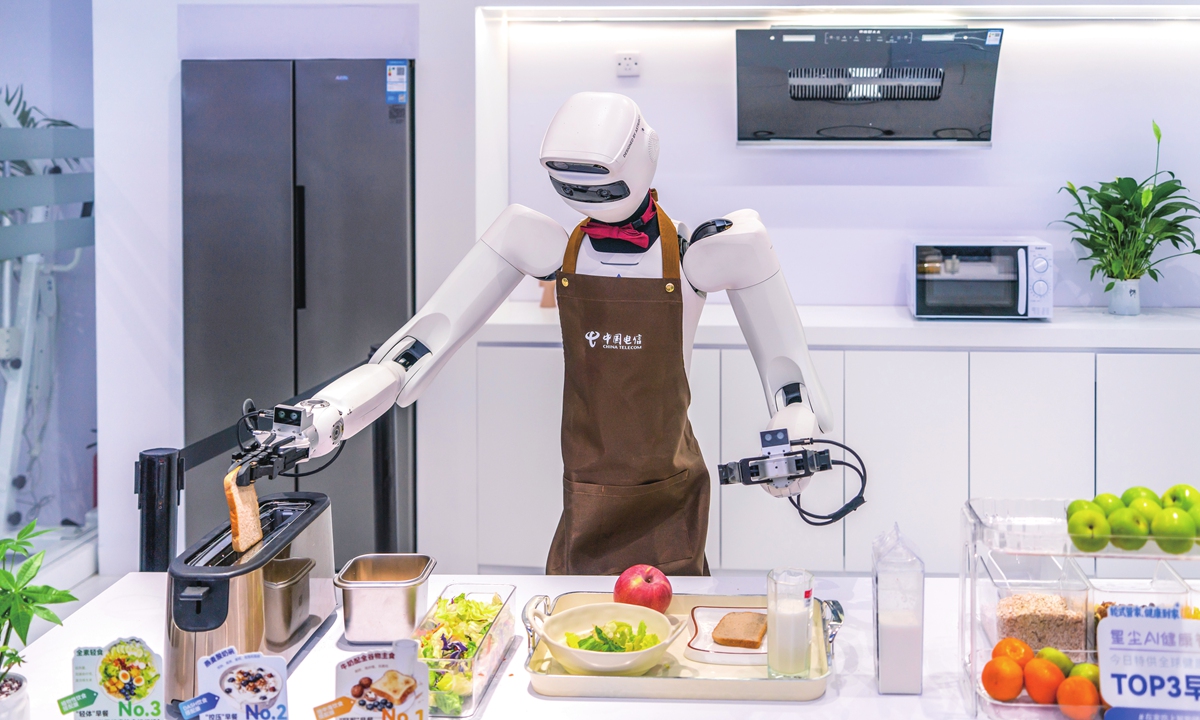
A humanoid robot demonstrates a toast-making service at the 2025 Digital Intelligence Technology Ecosystem Conference in Guangzhou, South China's Guangdong Province, on December 5, 2025. Photo: VCG
China's service sector stood out as a bright spot in the first half of the year, as steady expansion in modern services and accelerating growth in service consumption bolster overall economic stability, official data showed on Wednesday.
The value-added output of the service sector rose 5.2 percent year-on-year in the first half, according to the National Bureau of Statistics (NBS), higher than the 4.7 percent growth of China's GDP during the same period. Meanwhile, retail sales of services increased 5.3 percent, faster than the 1.1 percent growth in goods retail sales.
Analysts said the latest figures indicate that service demand has gradually improved, while modern services linked to technological development and industrial upgrading have become increasingly important drivers of growth.
China's service sector has maintained steady growth in the first half of the year, with modern services showing positive momentum, while the consumer market continued to expand and service retail sales grew at a faster pace, NBS Deputy Commissioner Mao Shengyong told a press briefing on Wednesday.
The NBS data showed that the national service production index rose 4.7 percent year-on-year in June, accelerating 0.3 percentage points from May. Business activity in sectors including telecom, internet software and IT services, finance and insurance remained robust, with indexes above 55 percent, NBS data showed.
"The strong performance of the service sector in the first half year provided confidence in China's economic resilience and development prospects, as expanding consumption has become a key priority in strengthening domestic demand and supporting growth," Song Ding, a research fellow at the China Development Institute, told the Global Times on Wednesday.
Song said the improvement in service sector performance in the second quarter, especially toward the end of the first half, was partly supported by stronger policy efforts to promote consumption and expand domestic demand.
"A series of measures aimed at boosting service consumption and expanding domestic demand have gradually taken effect, helping improve market activity in recent months," he added.
The growth of modern services was a notable feature of the first-half data. Among major sectors, leasing and business services, information transmission, software and information technology services, financial services, and accommodation and catering services saw value-added output increase 11.9 percent, 10.7 percent, 6.7 percent and 5.0 percent, respectively.
Song said the rapid growth of modern services reflected changes in the structure of China's service sector. "As technological innovation advances, technology-related and production services are growing faster, helping strengthen an area where China's service sector was previously relatively weak," Song said.
He added that the expansion of technology industries has created more demand for related services, making them an increasingly important source of growth.
Mao told the briefing that new growth drivers represented by advanced manufacturing, the digital economy and modern services contributed more than 40 percent to economic growth in the first half of the year, excluding the upgrading and transformation of traditional industries.
The expansion of service consumption also stood out in the first-half data. Retail sales of services rose 5.3 percent year-on-year, with communications and information services, tourism consulting and rental services, and cultural, sports and leisure services recording relatively rapid growth.
Total retail sales of consumer goods reached 24.87 trillion yuan ($3.45 trillion) in the first half, up 1.3 percent year-on-year. Catering revenue rose 2.8 percent to 2.83 trillion yuan, while online retail sales of goods and services increased 5.2 percent to 10.07 trillion yuan.
Song said service consumption would become an important area for China's future economic growth as the country seeks to strengthen domestic demand. He noted that with economic development entering a new stage, expanding domestic consumption and improving services will play a more important role in supporting growth.
"The first-half data showed stronger momentum in production-oriented services, while consumer-oriented services still have room for further improvement," Song said, adding that continued policy support could help boost life-related services and further release consumption potential.
China has stepped up policy support to expand service consumption. A State Council work plan issued earlier this year called for improving service supply, fostering new consumption scenarios and cultivating new growth drivers in areas including tourism, domestic services, online audiovisual services and inbound consumption.
The expansion of modern services has been accompanied by the rapid growth of new business formats. Digital platforms, online services and technology-enabled consumption scenarios have continued to reshape consumer patterns, while creating new opportunities for service-sector development, according to official data.
RELATED ARTICLES