Emerging risks, 'backdoor' incident point to necessity of fairer, inclusive AI global governance: seminar attendees
By Published: Jul 15, 2026 09:39 PM

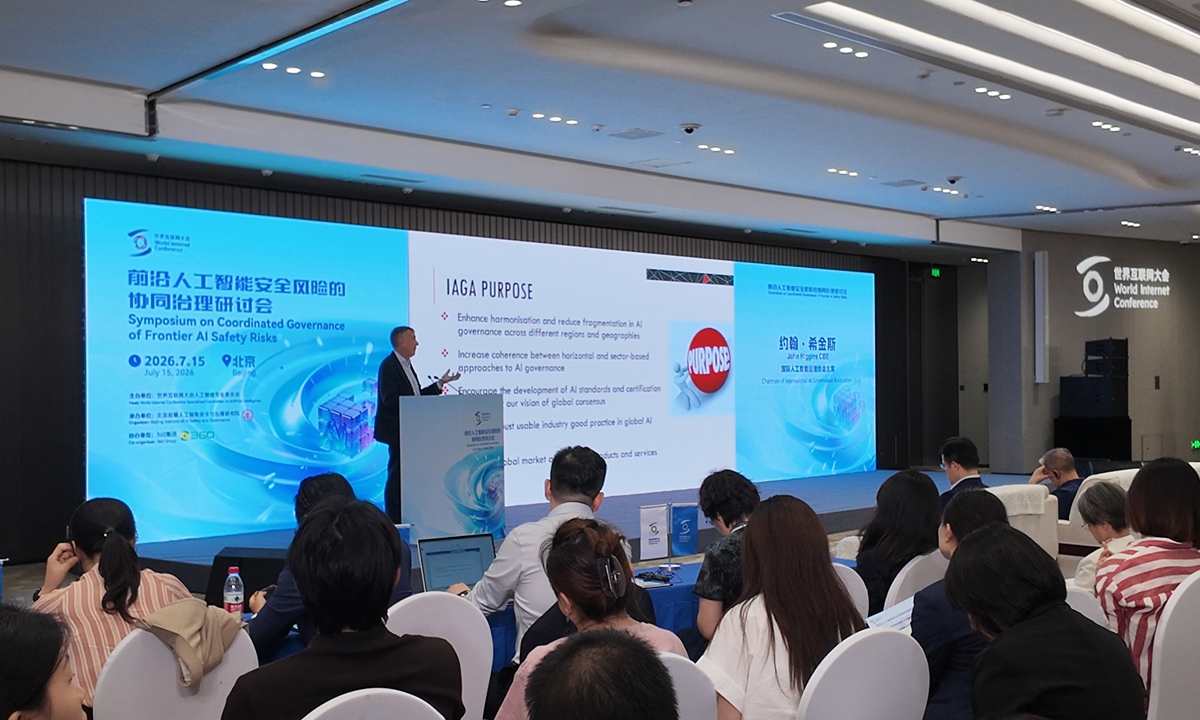
John Higgins, Chairman of the International AI Governance Association, delivers a keynote speech at the symposium on Coordinated Governance of Frontier AI Safety Risks organized by the World Internet Conference on July 15 in Beijing. Photo: Liu Caiyu/GT
At a seminar on AI safety and risk governance organized by the World Internet Conference in Beijing on Wednesday, experts warned that frontier AI tools are entering a period of accelerating risk spillover, with geopolitical factors playing a role in amplifying these risks.
Over the past two years, AI capabilities have evolved far faster than expected - from large models, to generative AI and agents. Risks are spreading just as quickly, Wang Wei, COO of China's social media Weibo, told the audience at the seminar.
Previously, when we talked about AI risks, people mostly thought of inaccurate content and biased information. However, the impact brought by AI risks is no longer limited to these. It not only affects users' judgment, but could also erode social trust, and even further disrupt the order of public opinion, Wang said.
Multiple scholars and industry participants at the seminar highlighted other risks including model misuse, cybersecurity threats, data leakage and disinformation.
Zeng Yi, Dean of the Beijing Institute of AI Safety and Governance, pointed out that AI risk governance is further complicated by varying levels of preparedness, with high-income countries demonstrating significantly higher readiness.
Pan Jianfeng, Chief Scientist and Senior Vice President of 360 Group, mentioned that his team has systematically analyzed OpenClaw and 10 related products on the market, and has identified 23 distinct security vulnerabilities, which pose a serious threat to users' systems and data privacy.
Regarding system security, news about backdoor vulnerabilities has made headlines. Days earlier, China's National Vulnerability Database, a national cyber-security repository operated by the Ministry of Industry and Information Technology (MIIT), released a statement warning of security backdoor vulnerabilities in the AI coding tool Claude Code, an AI programming tool developed by US company Anthropic.
The warning followed Anthropic's acknowledgement that it had embedded a tracking code into Claude Code to prevent the illicit "distillation" - or unauthorized copying - of its models, per SCMP.
Anthropic's backdoor incident acts like a mirror that exposes the Western governments' "politicized double standards" on AI security issues, a security expert from a leading AI security company based in Beijing who preferred not to be named, told the Global Times at the seminar.
"On the surface, it claims to be preventing Chinese model developers from distilling its technology, but the core issue is great power competition and the blatant targeting of China," the expert said, on the condition of anonymity.
John Higgins CBE, Chairman of the International AI Governance Association and a keynote speaker at the seminar, told the Global Times that geopolitical tensions combined with commercial interests can easily escalate into AI security disputes.
Faced with these emerging security challenges brought by frontier AI tools, no single country, institution, or technological approach can address them alone, scholars at the seminar agreed.
To reduce misunderstandings and ease tensions, Higgins suggested establishing direct dialogue mechanisms, particularly among leading AI labs, governments, enterprises, and universities.
"Global AI safety and governance requires a central platform that is inclusive and effective, a role that the UN is uniquely positioned to fulfill," Zeng added. Echoing this view, Pan called for the establishment of a globally unified international benchmark system for AI uncertainty measurement, evaluation, and mutual recognition.
RELATED ARTICLES