China's power use rises 5.3% in H1, showing strong economic activity
By Published: Jul 15, 2026 10:34 PM

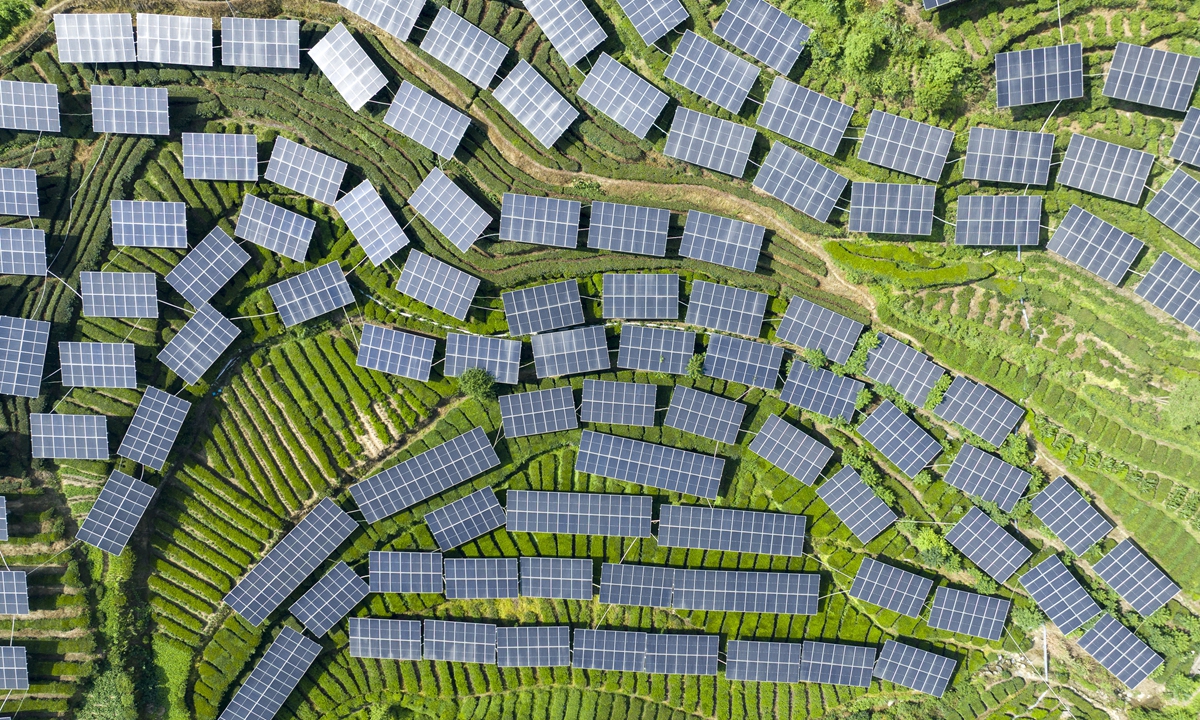
The photovoltaic (PV) panels in the tea fields deliver green electricity under the sunlight in Zigui county, Central China's Hubei Province. Photo: VCG
China's electricity consumption, a key barometer of economic activity, rose 5.3 percent year-on-year to 5.09 trillion kilowatt-hours in the first half of 2026, according to the National Energy Administration (NEA) on Wednesday.
Electricity consumption saw an uptick with households consuming more electricity during the summer heat and as the country's digital industries continued to gain momentum.
China's peak electricity load climbed to a record high of 1.518 billion kilowatts on Friday, a record for the year, according to the National Development and Reform Commission (NDRC), China's top economic planner.
The NDRC attributed the nationwide surge in power consumption to multiple factors, including robust industrial demand driven by the rapid growth of high-tech manufacturing, new-energy vehicles (NEVs), and computing equipment, the Xinhua News Agency reported.
The services sector, including battery charging and internet data services, also contributed to the surge in power consumption, while increased air-conditioner use played a part as well, the NDRC said.
New records quickly followed, with the peak electricity load breaking that record to reach 1.551 billion kilowatts on Tuesday, with Central China and four other provincial-level power grids including Sichuan in Southwest China, and Hubei and Hunan in Central China, breaking their records on the same day.
To provide strong support for nationwide electricity supply security, the NEA stated that inter-provincial and inter-regional market mechanisms have effectively supported electricity supply security.
Relevant parties have leveraged the national unified electricity market system to strengthen power interconnections. On Friday, the total maximum transmitted power across inter-provincial, inter-regional, and inter-grid channels reached 263 million kilowatts, and on Tuesday, the total reached a new high of 278 million kilowatts, the NEA said in a statement on Tuesday.
According to NEA data, electricity consumption rose 3.7 percent year-on-year to 898.1 billion kilowatt-hours in June, up 3.7 percent year-on-year. By sector, the high-tech and equipment manufacturing industry consumed 112.1 billion kilowatt-hours in the month, an annual increase of 10.3 percent.
Lin Boqiang, chair professor and dean of the China Institute for Studies in Energy Policy of the School of Management at Xiamen University, told the Global Times on Wednesday that robust growth in electricity has reflected the resilience of the Chinese economy, with a transportation sector featuring mass adaptation of new-energy vehicles and electrification across industries.
Lin said that even as summer power demand fluctuates, China's power system has enough leeway to cope with any peaks in the coming months, as the country's coal-fired plants still have redundant power capacity of some 20 percent.
China reached a climate milestone in 2025 as its additional renewable energy entirely covered the country's growing power needs. This marked the first time that green energy alone had supported all additional energy demand driven by economic growth, Xinhua reported in June.
Qian Jing, vice president of Jinko Solar, a Chinese solar giant, told the Global Times that building a self-reliant, controllable, and sustainable energy system is not only about addressing climate change, but also about national energy security, independence, and economic competitiveness.
"A geopolitical conflict [in the Gulf Region], coupled with record-high temperatures, has brought about a shift and a positive change in many foreigners' perception of China's green energy development, bringing new opportunities for the industry," Qian said.
In recent years, China has made major strides in power infrastructure, helping ensure a stable electricity supply during peak periods and effectively supporting economic and social development as well as meeting people's basic needs.
China's total installed power generation capacity reached 4.01 billion kilowatts as of the end of May, according to data from the NEA. The figure puts China at the top of the world, according to Xinhua.
RELATED ARTICLES