Chinese chipmaker CXMT set to list in Shanghai
Increased fundraising helps firms seize new opportunities from AI
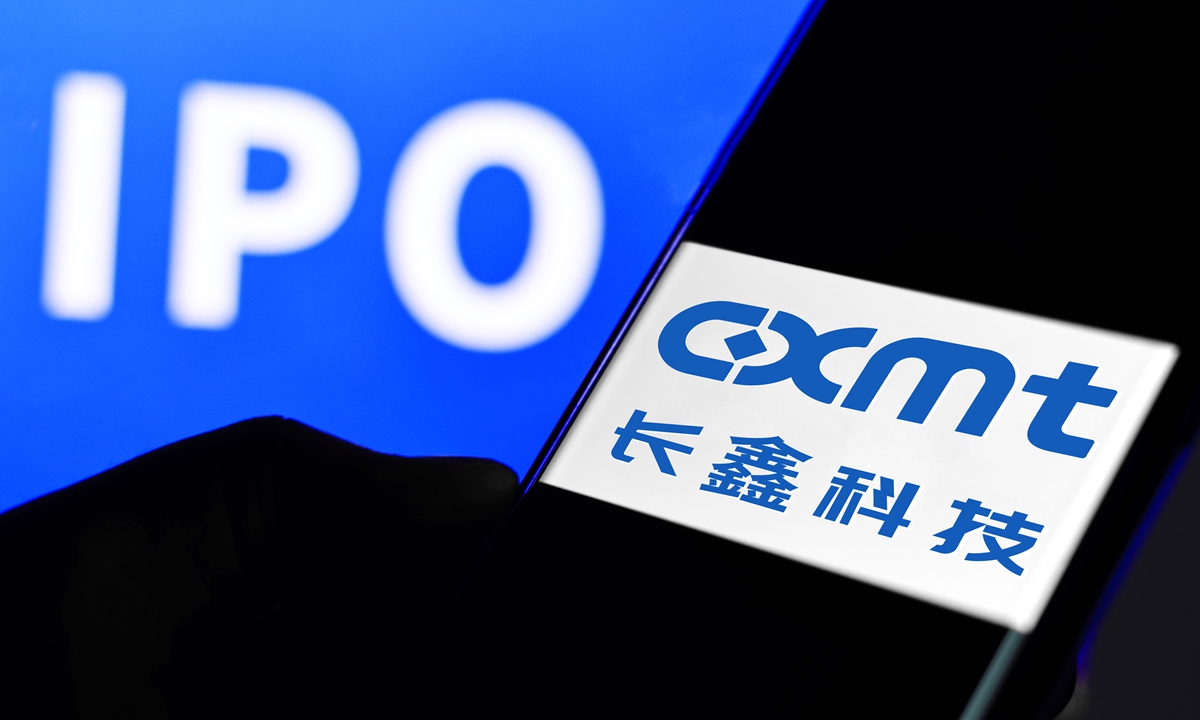
Chinese memory chipmaker CXMT File Photo: VCG
Chinese memory chipmaker ChangXin Memory Technologies (CXMT) is set to list on the Shanghai Stock Exchange's STAR Market, with subscriptions opening on Thursday, according to an exchange announcement issued on Wednesday.
The company, which is also China's leading Dynamic Random-Access Memory (DRAM) maker, plans to offer about 66.88 billion shares at 8.66 yuan ($1.21) each, implying a post-listing market capitalization of more than 579.1 billion yuan, according to the announcement.
The listing comes as the global memory chip market enters a new investment cycle driven by the rapid expansion of artificial intelligence (AI). Meanwhile, DRAM is one of the most technologically demanding and capital-intensive segments of the semiconductor industry.
In the first half of this year, the global memory chip industry entered a strong upcycle, driven by surging demand for AI computing power. As AI development accelerates, rapidly growing demand from AI servers and data centers for high-performance memory chips has fueled a new wave of investment and fundraising across the upstream AI computing supply chain, industry experts said.
Based on Omdia data on global DRAM vendors' sales in the fourth quarter of 2025, CXMT's global market share rose to 7.67 percent, ranking fourth worldwide and first in China, according to the company's prospectus released on the Shanghai Stock Exchange on July 9.
The company acknowledged that it still lags behind the world's top three DRAM manufacturers and that its current production capacity remains insufficient to fully meet China's vast market demand, according to the prospectus.
However, with the steady advancement of projects funded by the IPO proceeds, CXMT said it will accelerate process upgrades, lower unit costs, enhance competitiveness and profitability, and better capture growing global demand, further strengthening its position in the global DRAM market, read the prospectus.
China's self-sufficiency rate in domestically produced DRAM remains relatively low, leaving significant room for growth, the company said in the prospectus, with experts noting increased fundraising could help domestic players seize expanding market opportunities, accelerate capacity and market expansion, and support the broader development of the industry.
CXMT's IPO comes amid broader capital market activity among China's memory chip companies.
The China Securities Regulatory Commission published the first progress report on Yangtze Memory Technologies Co's IPO guidance process on May 19, stating that CITIC Securities and China Securities Co would serve as the IPO advisors.
Market research firm Counterpoint Research said in its latest data release that YMTC's share of the global NAND flash memory market by revenue rose from 8 percent in the first quarter of 2025 to 13 percent in the first quarter of 2026, driven by tight supply and rising memory prices.
The rise of AI is driving a structural shift in capital allocation, with investment expanding from large models to the broader industrial chain, including computing power, semiconductors, memory chips, energy, and end-use applications, Ma Jihua, a veteran tech analyst, told the Global Times on Wednesday.
The investment focus is increasingly shifting from model-driven narratives toward infrastructure and broader supply-chain capabilities, Ma said.
Ma said that rising demand for high-performance memory driven by AI is pushing the global memory chip industry into a new round of restructuring, creating a valuable window of opportunity for Chinese companies. As domestic players continue to make technological breakthroughs and expand capacity, they could secure a larger and more sustainable share of the global market as the industry landscape evolves, he said.
The global AI boom has unleashed surging demand for advanced computing and memory chips, while China's upstream semiconductor supply chain is expanding rapidly to support the sector's continued growth.
China produced 279.8 billion integrated circuits in the first half of the year, up 23.1 percent year-on-year, data from the National Bureau of Statistics showed on Wednesday. That translates to an average daily output of more than 1.5 billion units.
Ma said that the growth of domestic memory chipmakers marks China's transition from a follower to a global competitor in the sector, reflecting broader efforts to strengthen supply chain resilience and move up the semiconductor value chain.
RELATED ARTICLES