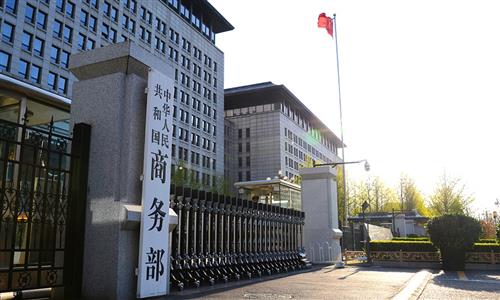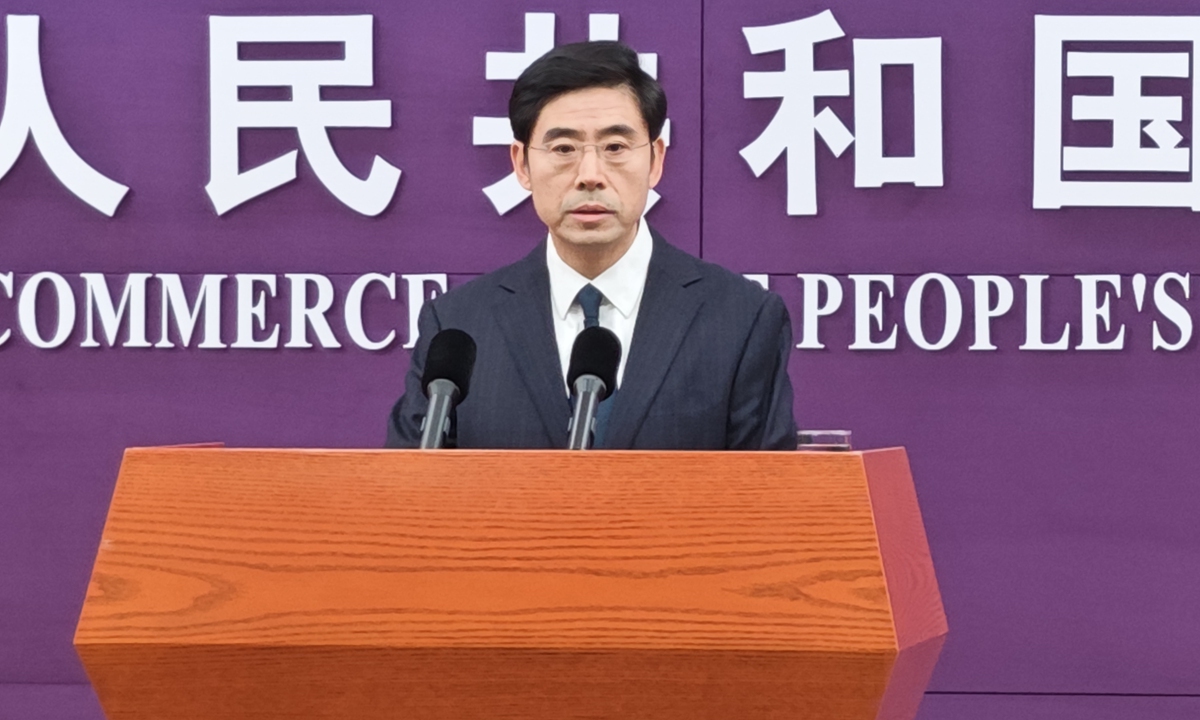
MOFCOM spokesperson He Yadong Photo: Yin Yeping/GT
China will adjust its helium export control policy as appropriate based on changes in domestic and international supply and demand, a spokesperson of China's Ministry of Commerce said on Thursday.
Spokesperson He Yadong made the remarks at a press conference on Thursday in response to a question regarding a temporary ban on helium exports.
As a major importer of helium, China has decided to impose temporary export controls on helium in order to ensure domestic supply. The move complies with relevant provisions of China's Foreign Trade Law and World Trade Organization rules, he said.
The ministry will adjust the policy as needed in accordance with evolving global and domestic market conditions, He said.
China has rolled out a temporary ban on helium exports, said a joint notice issued on July 10 by the MOFCOM and the General Administration of Customs.
The ban, which took effect upon announcement, was made in accordance with China's Foreign Trade Law, the notice said. Further adjustments will be announced separately, it added.
"China's imposition of temporary export controls on helium demonstrates its firm stance in safeguarding the national security and fulfilling international obligations. Meanwhile, its explicit commitment to adjusting management measures in a timely manner based on supply and demand changes fully reflects China's sense of responsibility as a major country and its resolve to maintain the stability and safety of global industrial and supply chains," Wu Chenhui, an independent analyst specializing in the critical minerals sector, told the Global Times on Thursday.
Helium is a vital strategic resource bearing on economic development, public health, and national security. In 2025, China's total domestic helium supply reached 5,818 tons, with imports at 4,913 tons, leaving the external dependence ratio as high as 84 percent, according to the China Industrial Gases Industry Association.
"The stable supply of helium holds irreplaceable significance for safeguarding the security of strategic emerging industry chains in China, including semiconductors, healthcare, aerospace, and aviation," the association said.
China's temporary export controls on helium represent a significant initiative to ensure resource security, steer regulated distribution, and drive the high-quality growth of the domestic helium sector and relevant industries, thereby contributing to the stability of the global gas industrial chain, according to the association.
As a strategic resource, helium is extensively utilized across core industries such as semiconductors, medical magnetic resonance imaging (MRI), fiber-optic communications, and aerospace. Ultra-high-purity helium, characterized by its low boiling point, high thermal conductivity, chemical inertness, and superior leak-detection capabilities, is an essential input for advanced chip fabrication processes. It also plays a critical role as a cryogenic coolant for superconducting magnets in medical MRI systems.
Amid the rapid expansion of China's relevant industries and sustained growth in helium demand, the domestic helium sector must bolster its support to safeguard these vital downstream industries.
As the situation in the Middle East gradually stabilizes, global helium supply is on the mend, Wu said. With supplies from Qatar and Russia - two main global helium producers - rebounding, domestic helium prices are expected to stabilize progressively, the expert said.
RELATED ARTICLES