The roots of the US fentanyl problem: A look at three waves of the opioid crisis
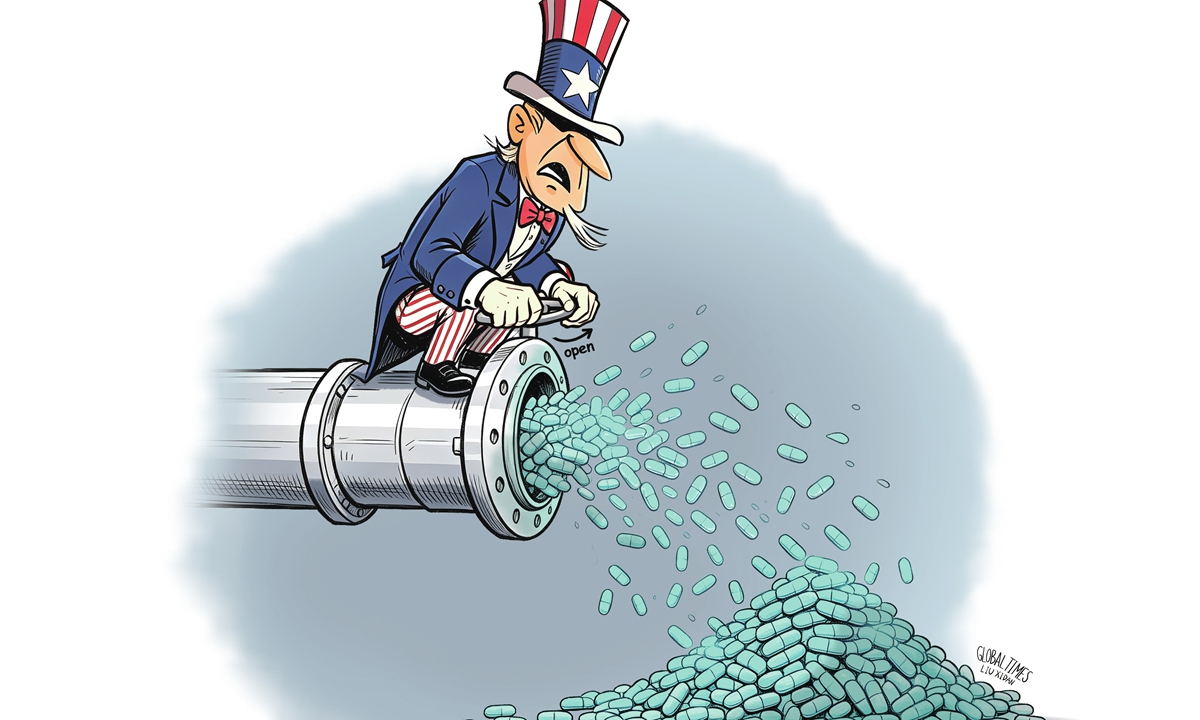
Illustration: Liu Xidan/GT
The US fentanyl crisis, also known as the opioid crisis, has unfolded in three successive waves since the mid-1990s: the abuse of the prescription opioid OxyContin, the surge of fentanyl-laced heroin, and the proliferation of illicit synthetic fentanyl, including the mixtures of fentanyl and xylazine. Widespread opioid abuse has led to a massive population in the US suffering from various mental and physical illnesses, triggering social problems such as skyrocketing overdose deaths and crushing public health costs, which fuel America's unrelenting fentanyl crisis.Opioids cover natural alkaloids such as morphine, semi-synthetic compounds such as oxycodone, and synthetic substances such as fentanyl, relieve pain and produce euphoria by binding to opioid receptors in the brain. Among these, oxycodone and fentanyl are commonly used in clinical settings worldwide to manage moderate to severe pain, and are controlled substances under UN regulations. Misuse carries severe risks, including respiratory depression that can quickly escalate to fatal respiratory failure.
According to statistics from the US Centers for Disease Control and Prevention, since 2021, more than 320,000 Americans have died from overdoses of synthetic opioids such as fentanyl.
Why has opioid abuse persisted and even escalated in the US? How has it led to numerous fatal tragedies, triggered a public health crisis, and severely eroded the foundations of US governance and political trust?
By analyzing the three waves of the opioid crisis, the systemic shortcomings exposed in the US - particularly in pharmaceutical regulation, drug control models, and social governance - offer much food for thought.
Loopholes in pharmaceutical regulation: The first crisis—the abuse of the prescription OxyContin
Since its first clinical use in 1917, the opioid oxycodone has been a well-established analgesic.
In 1995, Purdue Pharma in the US rolled out an extended-release oxycodone tablet under the brand name OxyContin, based on its sustained-release technology. That same year, the US Food and Drug Administration approved the drug for much broader use beyond cancer pain, extending it to nearly all chronic pain conditions and noting that "Delayed absorption, as provided by OxyContin tablets, is believed to reduce the abuse liability of a drug." This led doctors to lower their guard regarding its addictive potential.
To promote the drug, Purdue Pharma invested heavily in funding relevant experts and associations to peddle the narrative that "opioids are harmless." In reality, OxyContin did not deliver the sustained-release effects touted in its marketing. To maintain its selling points of being "non-addictive" and providing "up to 12 hours of relief," Purdue Pharma instructed doctors to increase the dosage if the effects did not last 12 hours, thereby further fueling its addictive potential.
Since then, the number of users and prescriptions for OxyContin in the US has skyrocketed. According to data from the US Drug Enforcement Administration, prescriptions surged from 300,000 in 1996 to 6 million in 2002, while the number of users rose from 400,000 in 1999 to 2.8 million in 2003. In 2010 alone, per capita annual consumption of morphine milligram equivalents - the core clinical metric used to assess appropriate opioid dosing - reached 800 milligrams, far exceeding any threshold of legitimate clinical demand. Countless chronic pain patients were trapped in a vicious loop: regular opioid use, mounting tolerance, ever-higher doses, and crippling physical dependence. Many ended up as full-blown addicts, driving fatal overdose figures even higher.
According to other public reports, since 2007, thousands of lawsuits have been filed against Purdue Pharma across the US. The firm has admitted to making false claims in its promotion of OxyContin, intentionally downplaying the risk of addiction, misleading doctors about the risks of opioid medications, providing inaccurate training to sales representatives, and using various tactics to induce doctors to prescribe the drug.
The first wave of the opioid crisis exposed significant blind spots in the administrative approval and management systems of US drug regulatory authorities. American agencies failed to adequately assess the risks of abuse before the problems emerged. They not only approved OxyContin for use in chronic pain but also endorsed claims that it could reduce the potential for drug abuse. Particularly as abuse issues became more prominent, there was a lack of effective control over related prescriptions, and a failure to detect and respond promptly to dependence and addiction caused by dosage increases. Behind this lies a vicious cycle driven by distorted pharmaceutical supply and consumer demand shaped by economic interests.
Under the misleading promotion by pharmaceutical companies that "opioids are harmless," American society developed the so-called "right to pain management" advocacy and an "immediate release" medication mindset. In particular, Purdue Pharma's drug instructions noted that cutting, crushing, or chewing the oxycodone tablet could lead to dangerous adverse events, effectively guiding drug abusers on how to misuse the medication.
In 2019, Purdue Pharma declared bankruptcy, but the population addicted primarily to oxycodone had already formed. Under various factors, the overprescription of opioids by healthcare practitioners in the US became a norm in the industry. The renowned medical journal The Lancet noted in 2019 that the US has about 5 percent of the world's population but consumed 80 percent of the world's oxycodone.
Imbalance in the drug war model: The second crisis - fentanyl-laced heroin proliferation
In 2011, the US government released the Prescription Drug Abuse Prevention Plan, which called for comprehensive strengthened control over opioid prescriptions. Although the volume of these prescriptions decreased afterward, millions of Americans had already fallen into opioid addiction.
Because of the high potential for dependence and the difficulty of withdrawal, addicted individuals require a steady supply of substitutes to satisfy their drug dependence. As access to prescription medications became increasingly restricted, many abusers have turned back to heroin, a traditional opioid, ushering in a second wave of the opioid crisis.
Data from the National Institute on Drug Abuse show that among those receiving treatment for opioid addiction, 94 percent said they chose heroin because prescription opioids were "far more expensive and harder to obtain."
Between 2013 and 2014, the number of heroin users increased by 51 percent. From 2010 to 2014, heroin seizures in the US increased from 2,763 kilograms to 5,014 kilograms, nearly doubling.
This set of data from the National Seizure System vividly reflects the objective reality of soaring opioids demand at the onset of the second crisis.
Against this background, more and more criminals discovered that, compared with heroin, fentanyl-like substances are cheaper to produce, more profitable, faster to iterate, and stronger in effect, while also being easier to synthesize. The booming market and enormous profits in the US have driven drug traffickers to manufacture fentanyl as counterfeit prescription drugs or to adulterate heroin and other drugs to increase potency.
Fentanyl, a synthetic opioid, was first discovered in 1960 by Belgian pharmacologist Paul Janssen, and began widespread use in Europe in the mid-1960s. In 1968, the US approved its use in general anesthesia, and many countries around the world now use fentanyl as a primary anesthetic.
Research indicates that fentanyl's pain-relieving effect is 80 to 100 times that of morphine, and 50 times that of heroin. This means that 100 milligrams of heroin can be lethal, whereas only 2 milligrams of fentanyl can cause death.
According to data from the US Drug Enforcement Administration, in 2021, approximately 42 percent of the fentanyl pills seized in the US contained more than the generally recognized lethal dose of 2 milligrams of fentanyl. Statistics from the US Centers for Disease Control and Prevention show that the number of overdose deaths involving synthetic opioids primarily consisting of fentanyl reached 9,580 in 2015, an increase of 72.2 percent from 5,544 in 2014. The figure further rose to 19,413 in 2016 and 28,466 in 2017. Meanwhile, the geographic spread of abuse continued to expand, and the fentanyl crisis broke out across the US.
However, the US response policies have been problematic, with insufficient attention and inadequate investment in universal prevention and the treatment of drug users, leaving a large number of low-income addicts unable to receive professional care. Statistics from the US Department of Health and Human Services show that only 10 percent of people with drug addiction in the US received specialized treatment.
In 2017, the US government declared the opioid crisis a public health emergency. By 2018, the US had tens of millions of opioid addicts, while overdose deaths involving synthetic opioids primarily consisting of fentanyl exceeded 30,000. In 2020, this figure reached 58,000, equivalent to nearly 20 deaths per 100,000 people, far exceeding the death rates associated with prescription opioids and heroin.
Failure of social governance: The third crisis—the growing severity of polydrug abuse
Xylazine is a veterinary anesthetic. When used with fentanyl, it can reduce the amount of fentanyl consumed while prolonging the drug's "effects" and producing a longer-lasting "high." At the same time, however, it also creates additive toxic effects, resulting in severe central nervous system depression and mental disorders.
Because of these characteristics, polydrug abuse involving xylazine and fentanyl has become a new trend in the US opioid crisis in recent years. Since 2020, polydrug abuse in the country has become increasingly serious. Many users are unaware of the exact composition of the substances they are consuming, and the mixed use of multiple drugs has become the new norm, with overdose deaths continuing to surge.
From 2021 to 2023, more than 100,000 people died from drug overdoses each year in the US, exceeding the combined number of deaths caused by traffic accidents and gun violence during the same period. More than two-thirds of these deaths were caused by overdoses involving synthetic opioids such as fentanyl. In particular, since 2019, the detection rate of xylazine in fatal drug overdoses has continued to increase.
The harm caused by polydrug abuse involving xylazine and fentanyl extends far beyond this. Intravenous injection can cause severe open skin wounds. Xylazine slows blood flow, making wounds difficult to heal. As skin ulceration worsens, users may consume even larger amounts of drugs to relieve pain, creating a vicious cycle that leads to various mental and physical illnesses and imposes enormous public health burdens and other social problems.
In the face of the escalating fentanyl problem, the US has failed to effectively control domestic drug trafficking at the distribution end. Data released by the DEA show that in 2024 alone, approximately 2,300 kilograms of fentanyl were seized on the 10 most heavily traveled US Interstates, fully exposing the country's failure to effectively control its domestic fentanyl distribution network.
From the aggressive marketing of OxyContin by pharmaceutical companies in the 1990s, which led to its widespread abuse in the US, to the proliferation of heroin and fentanyl in the early 2000s that rapidly expanded the drug market, and then to the sharp increase in the combined use of fentanyl, xylazine, and other drugs since 2020, one wave has followed another. This has repeatedly deepened America's dependence on addictive drugs, causing severe social harm, spreading across North America, and posing new challenges to global drug governance.
As US think tanks such as the Brookings Institution and the Manhattan Institute have pointed out, the US has been experiencing a drug crisis caused by opioid abuse for over two decades. The fentanyl problem reflects the failure of the US government in social governance and in regulating drug and substance abuse. The distorted supply-and-demand relationship for pharmaceuticals driven by economic interests is one of the intractable "dead knots" underlying drug and pharmaceutical abuse in the country.
Wu Chunyang is from China Police Daily and Zheng Xiaoyu is from the Drug Intelligence and Forensic Centre of the Ministry of Public Security of the People's Republic of China. opinion@globaltimes.com.cn
RELATED ARTICLES