Young people in China increasingly crave intangible cultural heritage handicrafts
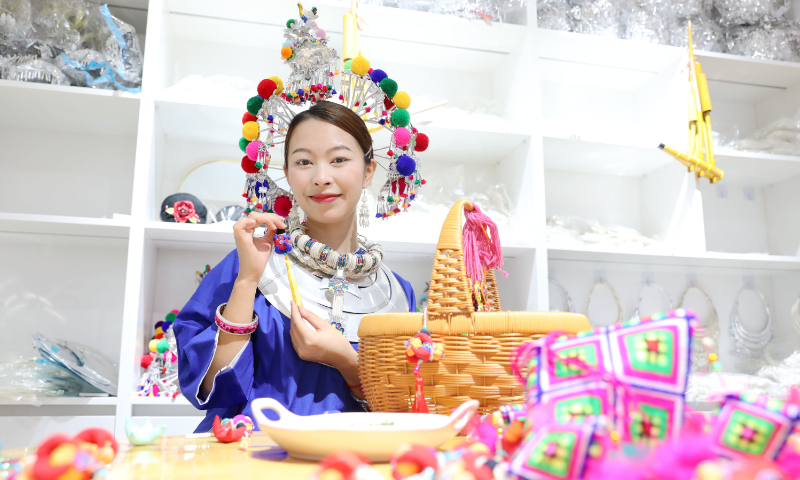
A young woman displays a traditional sachet, included in the county-level intangible cultural heritage list, in a clothing store in Guyi township, South China's Guangxi Zhuang Autonomous Region, on June 18, 2026. Photo: VCG
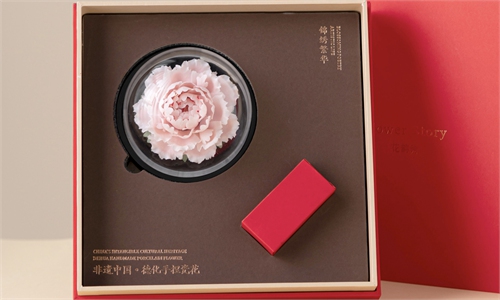
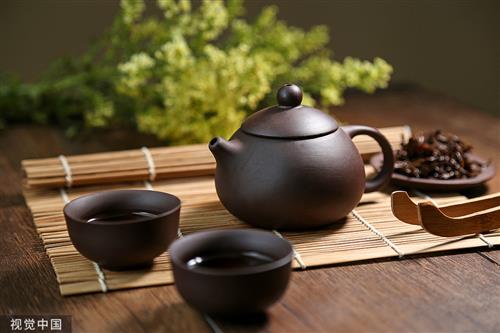
From hand-forged heritage silverware to ingenious bamboo weaving, China's diverse intangible cultural heritage (ICH) handicrafts have staged a remarkable comeback.
Once marginalized in remote villages and recorded in documentaries as cultural artifacts in need of preservation, the age-old traditional crafts have been revitalized by booming e-commerce.
The transformation is illustrated in a recent study report released by Taobao and Tmall, which followed the explosive growth of ICH-related consumption.
Rapidly growing market
Overall transaction volume of ICH handicrafts on the e-commerce super platforms has reached the 100-billion-yuan ($14.7 billion) market size in 2025, with more than 35,000 online merchants engaged in the business.
Last year, the number of certified ICH inheritor stores surged by 96.3 percent, with their sales jumping by 131.1 percent, according to the report sent to the Global Times on Thursday.
Li Shijie is the founder of Xiangruishi, a cultural heritage silverware brand on Taobao, which is rooted in the time-honored silver forging craft in Heqing, Southwest China's Yunnan Province.
Adopting traditional silver forging and gold-silver inlay techniques, Li created exquisite mixed gold-and-silver baby silverware gifts that stand out from a group of homogenized mass-produced products.
Since launching his Taobao store in 2019, Li has optimized product designs based on customer feedback, achieving consecutive sales growth during the past five years.
"True commercialization of intangible heritage is about uncovering the human spark within the craft, turning its inherent differences from industrial goods into strength. When we innovate with purpose, crafting both products and narratives that resonate with modern needs, we build a sustainable ecosystem where artisans are empowered to preserve legacy for generations to come," Li told the Global Times on Thursday.
Another example is the pony bamboo lantern, which rose to nationwide fame after appearing on the 2026 CCTV Spring Festival Gala in February. Designed by Xu Wuxia, a post-90s inheritor of bamboo weaving craftsmanship, the exquisite work brought the centuries-old intangible craft into the spotlight overnight.
Nicknamed the "bamboo weaver girl," Xu devoted herself to inheriting bamboo weaving by studying from master craftspeople after graduating from college. In 2024, she founded a studio on the outskirts of Hangzhou, East China's Zhejiang Province developing a series of cultural and creative products including coasters, fans, ornaments and lanterns, sold on China's major e-commerce platforms.
By integrating traditional craftsmanship with contemporary Chinese style and modern aesthetic concepts, her bamboo products have gained popularity among young people. During the 2025 Taobao Double 11 Shopping Festival, her sales soared 13 times year-on-year.
"Our strength stems from original designing. We develop new products based on market demand, creating groundbreaking items that fill gaps in the market. For example, the Green Snake Lantern and the Pony Lantern were not sold anywhere before we made them. The unique products have virtually no competitors," Xu told the Global Times on Thursday.
According to Taobao data, driven by youthful aesthetic preferences and modern lifestyle trends, four major ICH categories have witnessed rapid growth in sales during the past year, including ancient-style gold ornaments, handmade silverware, new Chinese-style costumes and bamboo crafts.
Favored by young people
The thriving ICH business is primarily fueled by young consumers and well-educated professional. Creators and artists born in the post-90s and post-00s account for 33 percent of heritage merchants, and 60 percent of them hold at least a bachelor's degree, according to the Taobao report.
Young consumers also dominate the ICH consumption market, contributing 43 percent to the total consumption sales. Customized and experience-oriented crafts are particularly popular, while booming DIY businesses and cross-cultural IP collaborations help expand the industry's development and market influence, according to the report.
Beyond e-commerce platforms, professional cultural institutions also help boost the commercialization of intangible cultural heritage.
"We are committed to discovering ambitious and innovative young heritage artisans and exploring new development possibilities for intangible cultural heritage. The cooperation between traditional heritage crafts and commercial brands creates mutual benefit and win-win growth," Pei Lifan, a representative of the Beijing-based Joint Laboratory of Digital Cultural Trade, a cultural promotion institution, told the Global Times on Thursday.
Since 2022, the institution has paired ICH artisans with global luxury brands including Burberry and Bulgari to carry out in-depth cross-cultural creative cooperation.
"Young people's interest in Chinese ICH has kept growing. Our work is to screen out heritage skills with high appeal and communication potential, upgrade and polish them based on public acceptance to adapt to modern market demand. Through international promotion, these traditional Chinese crafts are reaching young global audiences, realizing intergenerational inheritance and innovative development," Pei said.
Zhang Yi, CEO of iiMedia Research Institute, noted that the booming development of ICH business is a positive trend closely linked to China's upgraded consumption.
"Our research showed that spiritual and cultural consumption has become a core demand of the public," Zhang told the Global Times on Thursday. "China boasts huge untapped potential to integrate its profound cultural heritage with consumer markets, enabling the creation of diverse new business models."
The government's targeted funding and supportive policies for ICH protection, inheritance, exhibition and talent training also play an important role in enriching heritage development, cultivating professional ICH practitioners, exploring traditional cultural elements, and accelerating the commercialization of traditional crafts. These policy measures also help stimulate domestic consumption and inject strong impetus into economic development, said Zhang.
Strong institutional support underpins the industry's robust growth. Launched in 2006, China's special ICH protection fund has supported heritage protection projects, cultural exhibitions and professional talent training, laying a solid foundation for the sustainable development of traditional crafts, the Xinhua News Agency reported.
RELATED ARTICLES