Cold-War style rhetoric from Australian envoy to Japan lays bare strategic anxiety
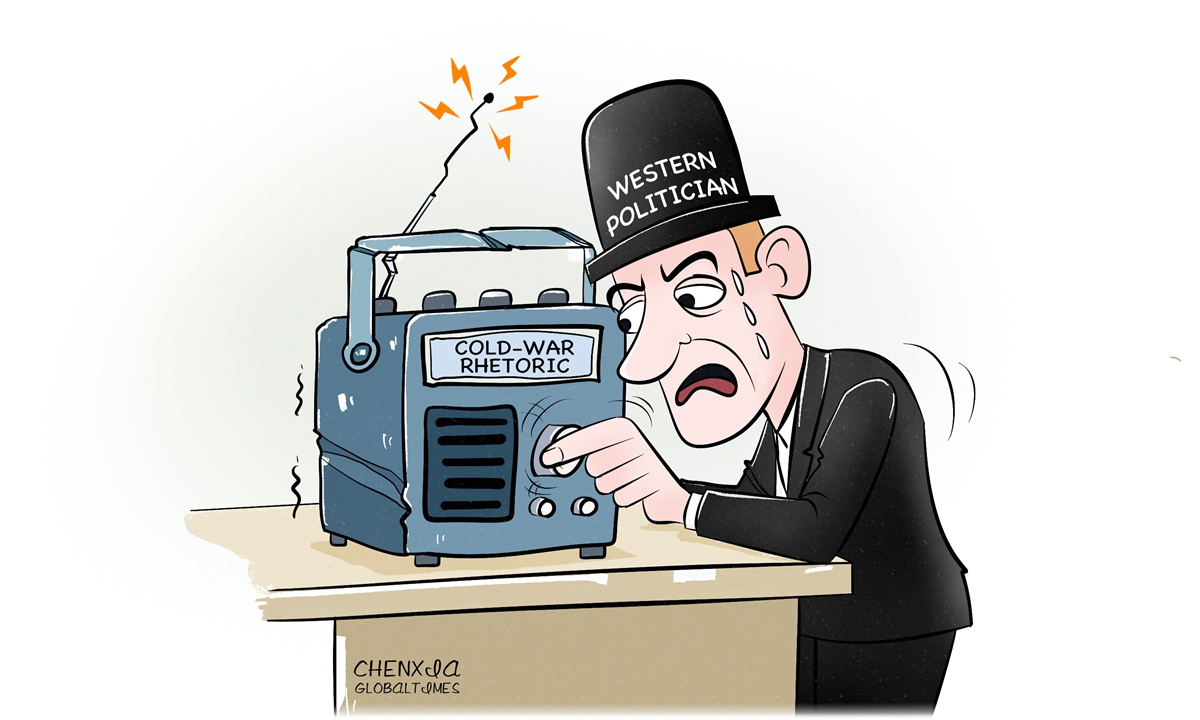
Illustration: Chen Xia/GT
What exactly drives the US and its allies in the Asia-Pacific region, a genuine commitment to regional peace and prosperity, or an anxious defense of their shrinking hegemonic shares? The recent remarks from Canberra's envoy in Tokyo speak volumes.
According to an article on the Australian Financial Review on Thursday, Australian Ambassador to Japan Andrew Shearer told an international conference in Tokyo that the US and its allies, or those so-called Western democracies, while struggling to respond to China's so-called military build-up and soft power influence across Southeast Asia and the Pacific islands, "are sort of gradually losing some of that contest."
When US allies like Australia frame their dealing with China primarily as a "contest" to be won or lost, they hold a deep-seated Cold War mentality that divides the world into rigid, adversarial blocs. At its core, the very vocabulary of "losing" and "winning" belongs to the theater of war, not the world of economic globalization and shared development.
The Cold War playbook from which such vocabulary derives is not merely misguided, it is obsolete in three fundamental respects. The first and most glaring obsolescence is the assumption that the Asia-Pacific still operates as a bipolar chessboard, where nations must choose sides between two contending ideological camps. This Cold War template assumes that regional countries are passive satellites awaiting alignment with either Washington or Beijing. Yet the reality on the ground could not be more different. The region has moved from "align or perish" to "diversify and thrive," and any framework that fails to recognize this pluralistic reality is not just outdated but willfully blind.
The second obsolescence lies in the issues that preoccupy the US and its allies versus regional countries. While the former fixates on regional hegemony, Southeast Asian and Pacific Island nations pay more attention to cooperation that would help solve urgent concerns such as rising sea levels and the digital infrastructure gap that leaves millions without access to the modern economy.
Finally, and perhaps most tellingly, the instruments through which the US and its allies seek to counter China are themselves relics of a bygone era. The preferred toolkit such as military alliance and arms sales are increasingly ineffective against infrastructure investment, digital connectivity, supply chain integration, and massive consumer markets. In other words, one cannot "outmaneuver" a railway with a destroyer, nor "outvote" a trade agreement with a decoupling policy.
Beneath the frantic rhetoric of "losing" lies not the confidence of the US and its allies, but a palpable strategic anxiety - born not from so-called China's campaign of military pressure and economic coercion, but from the growing realization that the US protective umbrella may no longer guarantee regional dominance. They cast China as the perennial "threat" not because China has changed, but because their own geopolitical certainties have crumbled.
US allies such as Australia are tuning a Cold-War radio to a multipolar frequency - and all they get is static. The transmissions of this era are no longer broadcast in the binary code of blocs and alliances, but in the polyphonic languages of diversified interests, overlapping partnerships, and fluid alignments. Yet Washington and its allies stubbornly twist the dial, expecting to hear the familiar hiss of winning versus losing, only to find that the world has long since switched channels.
Perhaps the most liberating realization for Canberra and other US allies would be this: Development is not a battle, and the Asia-Pacific is not a battlefield. To engage this region on its own terms is to abandon the comforting simplicity of winning and losing, and to embrace the reality of multipolar cooperation. That requires not just a policy shift, but a cognitive one - an admission that the Cold War lens has become a distorting mirror that reflects only Western anxieties, not regional realities.
RELATED ARTICLES