Zhejiang University-led joint team discovers catalyst-free plastic degradation method
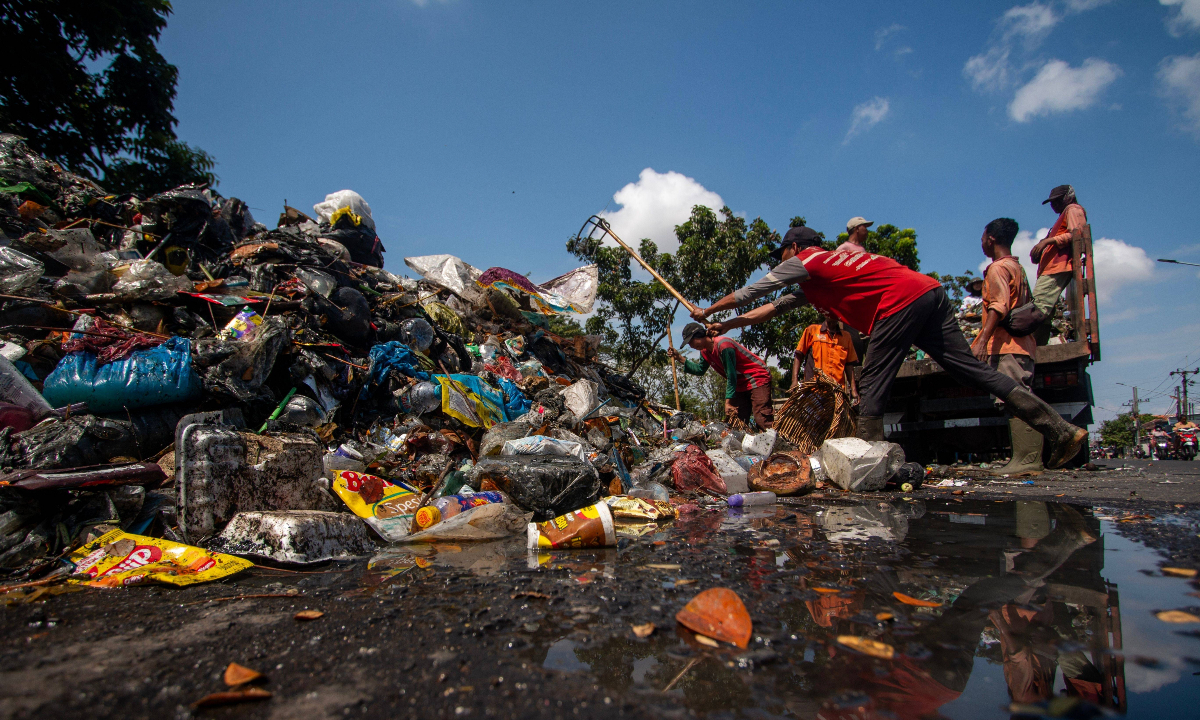
Environmental activists clean plastic waste from Kali Tebu River in Surabaya, Indonesia, on June 20, 2026. Photo: VCG
A joint study by Chinese and international scientists has developed a catalyst-free plastic degradation technology, paving the way for more efficient recycling and high-value utilization of plastic waste, the Science and Technology Daily reported on Thursday.
Using only water and oxygen, two of the most abundant and inexpensive substances on Earth, as the reaction medium, the research team efficiently converted waste polyethylene, polypropylene and discarded rubber tires into high value-added organic acids under mild conditions. The approach overcomes the traditional reliance on high temperatures, and complex chemical reagents, offering a new path for high-value plastic recycling.
The joint study by the research team led by Wang Yong, a professor from the School of Materials Science and Engineering, Zhejiang University, in collaboration with other researchers from domestic and overseas universities including Cardiff University and the University of Tokyo, was published in the international academic journal Nature on Thursday.
With global plastic production exceeding 400 million tons a year, improper disposal of plastic waste through landfills and incineration continues to fuel microplastic pollution and create long-term environmental challenges.
However, current chemical recycling technologies handle only about 9 percent of plastic waste and are hindered by reliance on costly catalysts, harsh reaction conditions, high energy consumption, expensive processing costs and limited large-scale implementation.
Initially, the plastic degradation research by Wang’s team was the same as that of many researchers in the field, which is to develop more efficient catalysts. However, a routine control experiment conducted by a researcher in Wang’s team unexpectedly revealed that polyethylene could degrade without a catalyst.
The research team initially suspected that the resultd might have been caused by an experimental error or by trace amounts of residual catalyst in the reactor. After dozens of repeated experiments, researchers confirmed that plastics can be effectively degraded without any added catalyst.
The team later uncovered tiny water droplet interface as the critical factor in the mechanism behind the degradation process. Tiny water droplets are formed when melted plastic is stirred into water. This produces a highly active “water-oil” interface, where reactive hydroxyl radicals arise spontaneously. Those radicals then function like molecular “scissors,” breaking the otherwise stubborn polymer chains into smaller, chemically useful fragments.
According to Wang, using only water and oxygen at temperatures above 100 C, researchers achieved complete polyethylene conversion without catalysts, leaving no microplastic residues and enabling full degradation and high-value recycling.
This discovery not only reshapes people’s understanding of plastic oxidation degradation but also offers a new technological route for plastic recycling, turning low-value plastic waste, which is expensive to process, into high-value chemical feedstocks, and converting an environmental burden into a valuable resource, according to the Science and Technology Daily report.
Global Times
RELATED ARTICLES