ARTS / CULTURE & LEISURE
As commercialization and politics overshadow the World Cup, can football still unite the world?
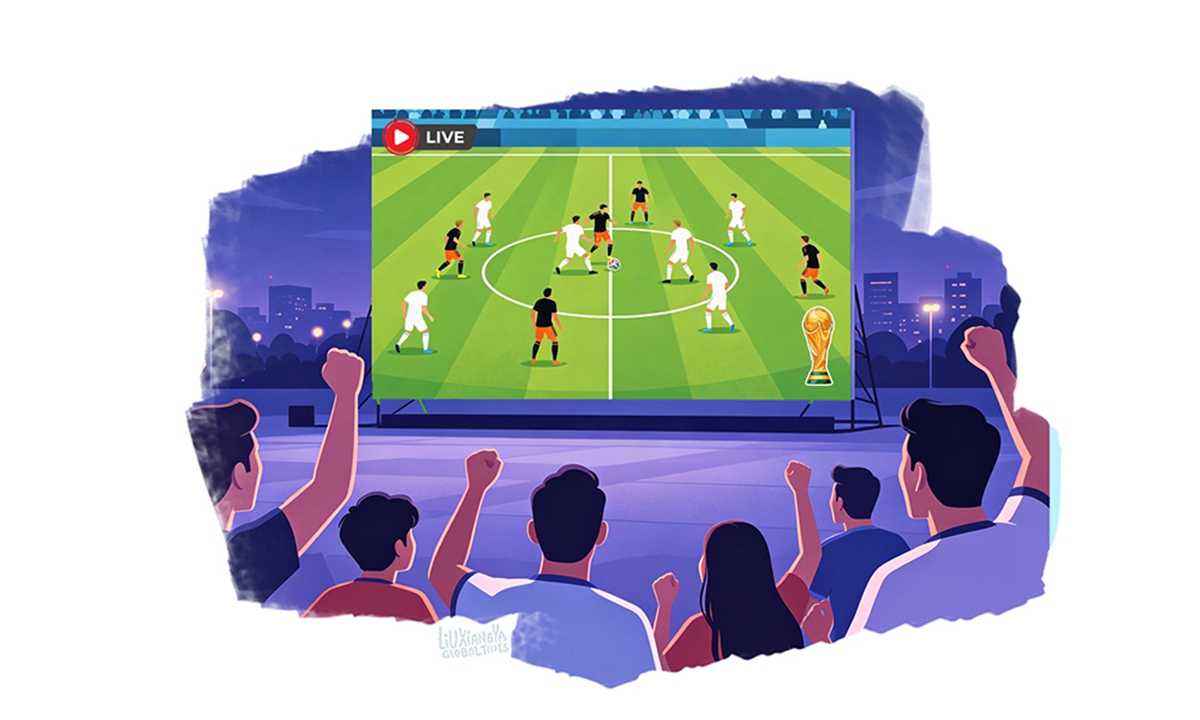
Illustration: Liu Xiangya/GT
As the 2026 FIFA World Cup draws to a close, attention should naturally be focused on football itself.Instead, the closing days of the tournament have become dominated by debates over the commercialization of the tournament, raising uncomfortable questions about whether the World Cup is drifting away from the ideals the world football governing body FIFA has spent years promoting.
For decades, FIFA has presented the World Cup as more than a sporting competition. "Football Unites the World" has become one of its signature messages. The slogan reflects an appealing vision that football can transcend politics and geography to bring people together through a shared passion. Yet the 2026 World Cup has repeatedly demonstrated how difficult that aspiration has become.
The latest flashpoint is FIFA's decision to stage the tournament's first-ever Super Bowl-style halftime show during the World Cup final, extending the traditional 15-minute interval to around 30 minutes.
FIFA and the local organizers have promoted the event as a global entertainment spectacle, while supporters argue that it can attract new audiences and generate additional funding for charitable initiatives.
Many football supporters, however, see something very different.
Unlike American football, where frequent breaks are built into the game's structure, association football has historically valued its uninterrupted rhythm. Momentum, tactical adjustments and emotional intensity often unfold continuously over the two 45-minute-long halves.
Extending halftime primarily for entertainment has prompted concerns that association football is increasingly being adapted to fit commercial expectations in the US rather than preserving the traditions that made it the world's most popular sport.
The halftime show is not the only change that has sparked debate.
Mandatory hydration breaks have been introduced throughout the tournament, officially to protect player welfare during extreme heat conditions. Player safety is unquestionably important, particularly after concerns over hot temperatures during previous competitions in North America.
The scheduled breaks also create additional commercial inventory for broadcasters and advertisers, soliciting criticism that questions whether commercial considerations are becoming inseparable from the game's sporting ones.
Commercial growth, of course, is not inherently a problem. Modern football depends on television rights, sponsorships and global marketing. The World Cup has evolved from a pure sporting event into one of the largest entertainment products on the planet. The problem arises when commercial innovation begins to invade the sporting experience itself.
Commercialization is only one side of the story. Equally damaging is the erosion of trust in how the tournament is governed.
The video assistant referee system was introduced to improve fairness by reducing clear refereeing errors. In many respects it has succeeded. Yet throughout this World Cup, several contentious decisions have reignited debates about consistency, intervention thresholds and subjective interpretation. Rather than ending disputes, technology has often shifted arguments from referees' eyesight to referees' judgment.
Debates over individual incidents have quickly evolved into accusations of institutional bias, political favoritism and even conspiracy theories. Whether those claims have merit or not is almost beside the point. The fact that so many fans from defeated teams in the knockout stage now instinctively distrust the governing body illustrates a growing credibility challenge for football's administrators.
FIFA's handling of US striker Folarin Balogun's suspension further complicated matters. After US President Donald Trump said he had contacted FIFA President Gianni Infantino concerning the case, FIFA allowed the automatic suspension to be served on probation, enabling Balogun to face Belgium. Whether or not the decision complied with FIFA regulations, the episode reinforced public suspicion that political influence could change sporting decisions.
Global sporting events' successful operations rely heavily on public confidence that every team competes under the same rules. Once that confidence is weakened, even if procedures are technically followed, the controversial decisions risk being viewed through a political rather than sporting lens.
The tournament has also demonstrated that geopolitics cannot simply be separated from football by declaration alone.
Iran's participation was overshadowed by visa complications, travel restrictions and even diplomatic tensions with the US affecting preparations before and during the tournament. Similar logistical challenges have affected supporters from different countries such as fans from DR Congo attempting to attend matches, with entry procedures varying depending on nationality and political circumstances. These realities highlight the practical limits of the idea that football exists in isolation from international politics.
FIFA has spent years promoting the World Cup as a force capable of uniting cultures, nations and political divides. The tournament still possesses that extraordinary potential. Millions of supporters continue to celebrate together regardless of language, race or nationality.
But slogans alone cannot create unity. Football will only continue to bridge cultures, languages and political divides in ways few other activities can, as long as supporters believe that the game itself comes first rather than anything else.
The author is a reporter with the Global Times. life@globaltimes.com.cn
RELATED ARTICLES