Baidu's Apollo Go to explore deploying autonomous vehicles in Kazakhstan, marking first Chinese self-driving service in Central Asia
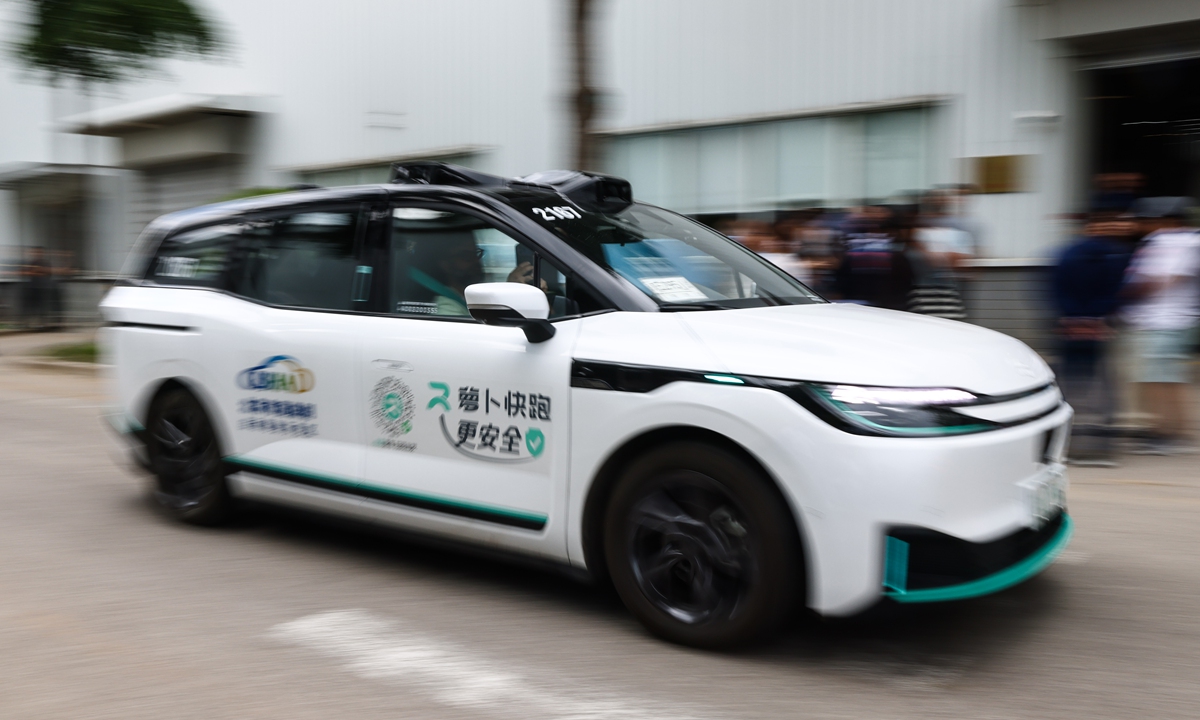
A self-driving car drives at the Baidu Apollo Park in Beijing on June 4, 2026. Photo: VCG
Baidu's autonomous ride-hailing service Apollo Go signed a Memorandum of Understanding (MoU) with Turlov Private Holding Ltd on Thursday on the sidelines of the World Artificial Intelligence Conference (WAIC) 2026. This marks the first entry of a Chinese autonomous driving company into Central Asia.
Under the partnership, the two parties will work together to explore bringing autonomous driving technology and services to Kazakhstan, Global Times learned from China's tech giant.
The signing ceremony took place in Shanghai, in the presence of Zhaslan Madiyev, Deputy Prime Minister and Minister of Artificial Intelligence and Digital Development of Kazakhstan.
The signing came against the background of the visit of Kazakh President Kassym-Jomart Tokayev to Shanghai. Tokayev is in China to attend the 2026 World Artificial Intelligence Conference and High-Level Meeting on Global AI Governance, according to the Xinhua News Agency on Thursday.
Kazakhstan views its relations with China as the top priority of its foreign policy, said Tokayev, when he met the Chinese leader in Shanghai on Thursday. Tokayev noted that Kazakhstan looks forward to maintaining close high-level exchanges with China and strengthening practical cooperation in various areas, including trade, investment, transportation, energy, agriculture and the digital economy, Xinhua said.
This partnership adds to the expanding global footprint of Apollo Go. As of April 2026, Apollo Go has provided more than 22 million cumulative rides to the public, including 3.2 million fully driverless rides in the first quarter of 2026 alone with weekly rides peaking at over 350,000 in March.
As of May, Apollo Go's global footprint has spanned 27 cities, including Hong Kong, Dubai, and Abu Dhabi. Its fleets have accumulated over 330 million autonomous kilometers globally, more than 220 million of which are fully driverless.
Global Times
RELATED ARTICLES