Giant boulder as big as multi-story building collapses in Chongqing landslide with risks of secondary rockfall looming
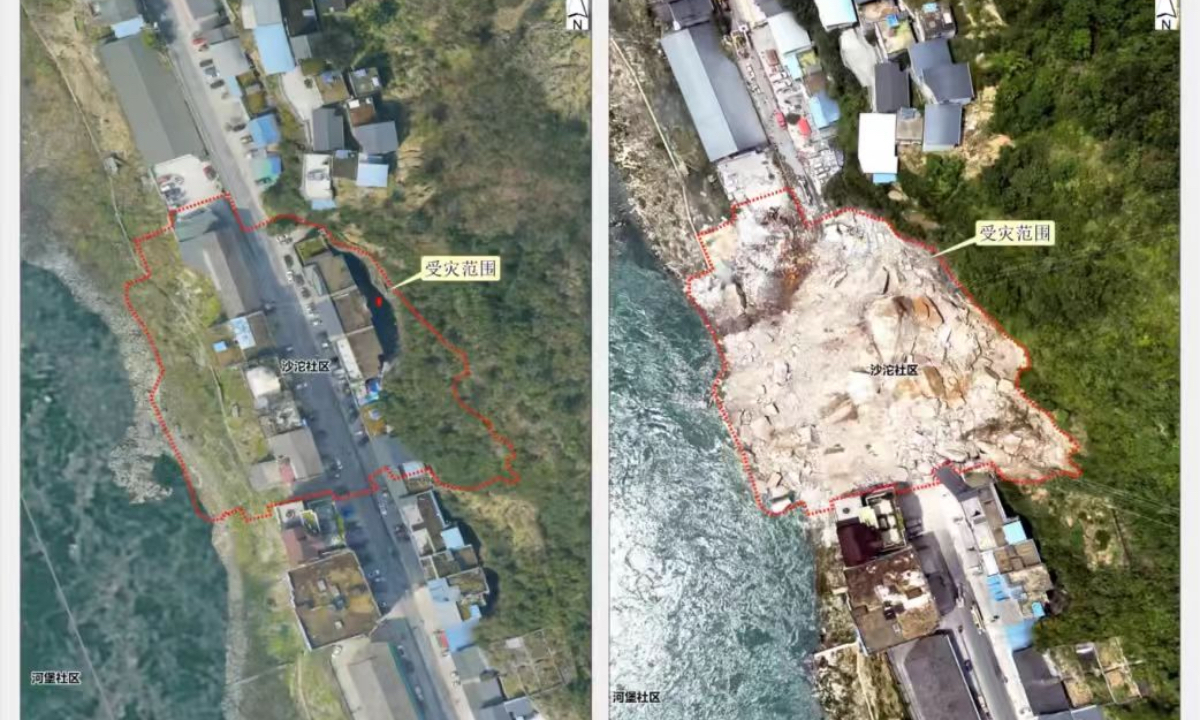
Photo: Screenshot from CCTV News
Geological assessment of the large-scale landslide in Pengshui county, Southwest China’s Chongqing municipality showed that the collapsed area measured about 60 meters long, 30 meters high and 10 meters thick, with a total volume of around 18,000 cubic meters, including a single fallen rock of 3,000 cubic meters, similar to the size of the nearby house.
Wang Chuanjun, director of the Pengshui County Bureau of Planning and Natural Resources, said that unstable rock blocks remain scattered on the top and both sides of the collapsed cliff, and the area still faces potential risks of further collapses under extreme weather conditions such as heavy rainfall and prolonged high temperatures, CNS News reported.
The landslide happened on Friday morning. As of Friday night, eight people were killed and 34 were still missing, according to Xinhua News Agency.
Following the landslide, local authorities immediately activated the highest-level geological disaster emergency response and a Level III flood control emergency response, launching rescue operations, risk inspections and relocation efforts. More than 1,100 nearby residents were safely evacuated, including over 60 people from the core area of the collapse, according to CCTV News.
Peng Di, a community grid worker, told CCTV News that she noticed falling rocks during a routine inspection and immediately recognized the danger. "The rocks were hitting the steel sheds, making loud banging sounds," she said. "We decided to evacuate all residents first. We ran door to door, asking everyone to leave their homes and move to a safe area."
Peng said she and her colleagues kept returning to check for more residents after evacuating one group.
"We were the last ones in the group. Then the houses suddenly collapsed," Peng said.
The Ministry of Natural Resources conducted an emergency video coordination meeting on Friday to deploy response efforts, assess risks and provide support for rescue operations in Pengshui, CCTV reported. The ministry also prepared satellite remote-sensing comparison images and three-dimensional visual models showing the area before and after the disaster for use by the frontline rescue command center.
CCTV News reported that about half of the mountain slope in the core collapse area had already fallen. The largest fallen rock is comparable in size to the nearby houses, with a volume exceeding 3,000 cubic meters and an estimated weight of tens of thousands of metric tons.
Rescue operations are currently being carried out on one side of the giant rocks. As teams move deeper into the area, they may face risks from potential rock instability and sliding. After completing searches around the outer areas, the rescue forces might drill holes into the large rocks, use small amounts of explosives to break them into smaller pieces, and remove them to allow rescue efforts to continue, according to CCTV News.
Rescuers on site told CCTV that surrounding slopes remain unstable, with drones detecting multiple cracks in nearby areas. To ensure the safety of personnel, slope monitoring radar systems have been installed at several elevated points to provide real-time observation. If abnormal movement is detected, alarms will be triggered immediately and rescuers will evacuate.
Currently, rescue teams are conducting on-site assessments and preparing for the arrival of heavy machinery, which will be used alongside manual rescue efforts.
Rainfall continued in Pengshui from the night of Friday to the morning of Saturday, with the maximum 24-hour precipitation exceeding 192 millimeters at Longtang monitoring station, making rescue operations more challenging. Rescue teams are monitoring deformation of the collapsed area and formulating scientific rescue plans to prevent secondary disasters, per CCTV News.
Water resources authorities forecast that some small and medium-sized rivers in southeastern Chongqing could see rising water levels from July 18 to 19, with a few potentially exceeding warning levels. River conditions across the municipality are expected to remain generally stable from July 19 through 21.
Global Times
