Nation is a pace-setter in embodied intelligence, humanoid robotics: Jiang Lei, chief scientist at humanoid robotics innovation center
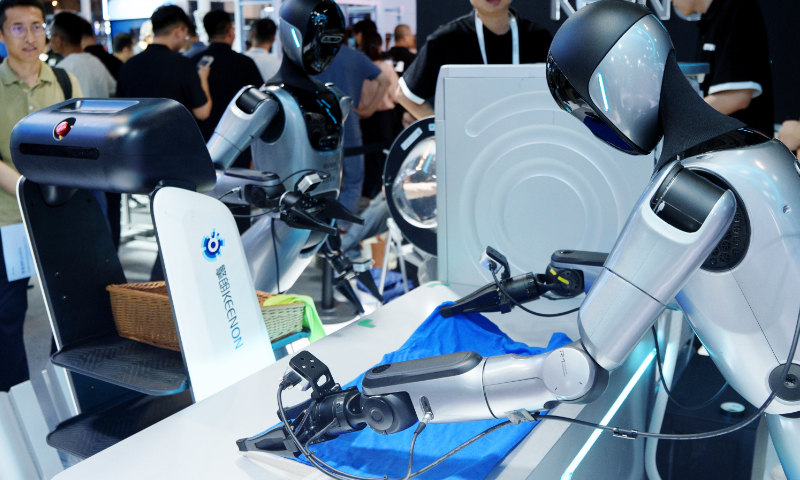
A humanoid robot performs at the 2026 World Artificial Intelligence Conference (WAIC) in Shanghai, on July 18, 2026. Photo: VCG
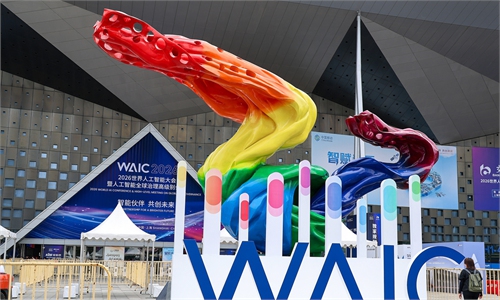
The 2026 World AI Conference (WAIC) in Shanghai points to an important transformation in China's AI landscape: the country's embodied intelligence and humanoid robotics are transitioning from virtual environments into real-world deployment that positions China as a global pace-setter.
In the past, high-tech industries and frontier technologies often originated in Silicon Valley, followed by radiating innovations elsewhere.
But humanoid robotics has a distinct characteristic - its global influence radiates from China. Whether they are AI model developers or research institutions, they hope to purchase Chinese robots for research and use them for factory-floor testing.
This suggests that China is evolving from a manufacturing base into an indispensable node of the world's robotics innovation chain. I believe we need to have an open and inclusive mindset and continuously encourage Chinese robotics companies to expand global presence.
This global push is already yielding tangible results in the world. The shift from "made in China" to "innovated in China" is visibly accelerating beyond borders, with China's neighboring markets proving particularly receptive. Across Asia, Chinese embodied intelligence solutions are walking into partners, commercial deployments, and technology exchanges.
For example, China's AI cooperation with ASEAN members is deepening through both institutional and commercial channels. The China-ASEAN Countries Artificial Intelligence Application Cooperation Center was inaugurated in 2025 to strengthen the foundation for AI development and provide open-source services.
Beyond government-level frameworks, Chinese enterprises are actively expanding into Thailand, Malaysia, and other ASEAN markets. In a recent development, Shanghai-based robotics teams conducted multiple technology roadshows in South Korea, underscoring demand for China's embodied intelligence solutions.
The technological architecture of humanoid robotics rests on four interconnected pillars: hardware and software manufacturing, embodied intelligence large models, datasets, and training facilities.
China has been a pace-setter in intelligent manufacturing, dataset construction, and training infrastructure. A critical driver of this progress is China's steadfast commitment to open-source and open-weight AI development.
By embracing openness rather than proprietary lock-in, the industry is enabling the rapid deployment of humanoid robotics across diverse scenarios. Meanwhile, the country is accelerating efforts to formulate application standards for humanoid robots, creating regulatory clarity necessary for large-scale industrial adoption.
On the socioeconomic implications of intelligent automation, the outlook is constructive rather than alarmist. The consensus among Chinese industry leaders is that AI and robotics will not lead to mass unemployment, but rather redirect workers across sectors such as sanitation, chemicals, and textiles from heavy physical labor toward knowledge-intensive and white-collar roles.
Given China's vast home market, where a significant portion of the population remains engaged in physically demanding occupations, automation is viewed as a mechanism for industrial upgrading and productivity enhancement.
As drivers of new quality productive forces, AI and robotics are catalysts for industrial transformation, efficiency gain, and manufacturing model modernization. As the sector matures, the emphasis is shifting from AI as a tool for scientific elites toward AI as an enabling technology for ordinary workers - a transition that is expected to be socially beneficial and economically expansionary.
From an investment and strategic perspective, China's embodied intelligence ecosystem offers a differentiated value proposition. The combination of world-class manufacturing capabilities, open-source model development, comprehensive training infrastructure, and proactive standard-setting creates a vertically integrated environment that is attracting both domestic and international capital.
While some Western countries may maintain advantages in pure software innovation, China is well positioned to reshape the physical application layer of AI. With millions of factory floors, logistics centers, and service scenarios generating real-world deployment data, the country possesses an unparalleled edge for refining embodied intelligence at scale.
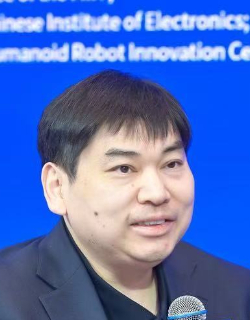
Jiang Lei, chief scientist at Shanghai-based National and Local Co-Built Humanoid Robotics Innovation Center Photo: Courtesy of Jiang Lei
This article is based on an interview by the Global Times with Jiang Lei, chief scientist at Shanghai-based National and Local Co-Built Humanoid Robotics Innovation Center. bizopinion@globaltimes.com.cn
RELATED ARTICLES