India-Japan rifts over delayed high-speed rail expose ‘depletion of trust, imbalance of interests’: Chinese expert
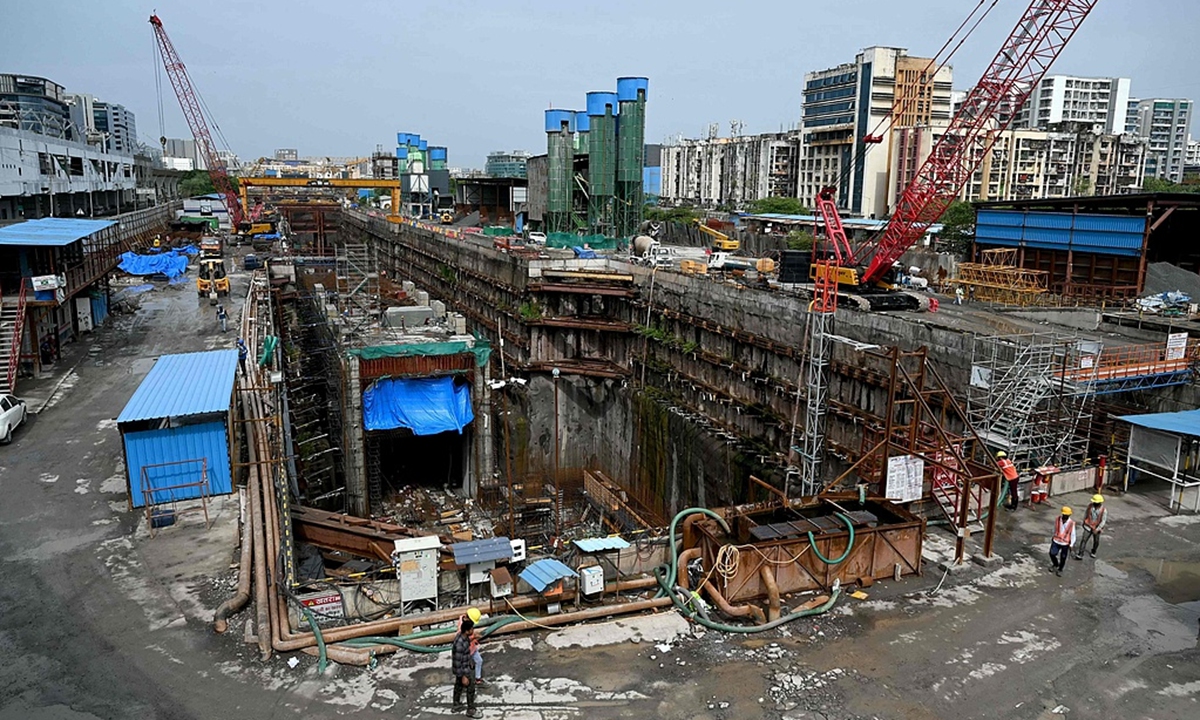
Workers are seen at the construction site of the Ahmedabad-Mumbai high-speed bullet rail project in Mumbai on June 25, 2026. Photo: VCG
As Japan and India renew their rifts over India's first high-speed rail project, a joint initiative between the two countries, the Indian side has rejected accusations by Japan, saying the project is progressing well, after Hideki Makihara, a former Japanese minister of justice and Liberal Democratic Party lawmaker who previously worked on the project, publicly criticized senior Indian officials for "utterly absurd" acts of backtracking promises and seeking personal gains.
Japanese business magazine Tokyo Keizai issued a report on July 14 titled "Prime Minister Takaichi's visit yields no result; Indian high-speed rail fails again," saying that Japan was excluded from the crucial signaling system of the project.
Makihara, citing the report, posted on X on July 15 that "The Shinkansen project in India is something I was involved with myself. What stood out in international meetings and negotiations was the sheer recklessness of the Indian side, over and over," he wrote, adding that "They just don't keep promises, no matter what. Even if they make a promise, they flip it right away. They keep pushing their own self-interest right up to the very end."
He also criticized the Indian minister overseeing the project, calling the individual "awful," adding "I feel 100 percent that the reason this hasn't moved forward is entirely on the Indian side."
Indian Ministry of External Affairs spokesperson Randhir Jaiswal dismissed the remarks on Friday, saying that the remarks were "an individual opinion" that is "at considerable variance with facts," NDTV reported. Jaiswal said the discussions between India and Japan on the ambitious bullet train project are progressing well and the first section will be opened in 2027.
The 508-kilometer Mumbai-Ahmedabad High-Speed Rail corridor is India's first bullet train project, connecting the financial capital, Mumbai, with Ahmedabad, according to NDTV. According to the cooperation framework, Japan provides financial aid, core technologies and engineering instructions.
Tokyo Keizai revealed more details on the rifts of the plagued cooperation. India's domestic contractor has squeezed Japan's participation in construction, while the costs of the train that went beyond Indian expectations led to Japan's exclusion from the signaling system. The signaling system was reportedly given to Germany's Siemens while India claimed it never received Japan's quote.
An Indian statement that the project will use domestically produced trains also triggered discussions in Japan. A Japanese railway engineer said in an article in Tokyo Keizai that India violated the agreement in 2015, yet the Japanese government remained silent. The signaling system would be incompatible with Japan's E10 train that was set to be delivered in 2030 that was previously contracted to supply the rail route.
Qian Feng, director of the Research Department at Tsinghua University's National Strategy Institute, told the Global Times on Sunday that the crux was not about technologies, but about trust and balance of interests.
The two sides signed multiple agreements, yet the delayed implementation has consumed mutual trust. Japan looks to long-term cooperation and market access when it promises technological transfer and loans, while India hopes to take advantage of Japan's money and technology to boost its own tech system and manufacturing.
The gap exists from the very beginning, and when trust was depleted, the flagship project has fallen into repeated bargaining, Qian said.
The real challenges of international engineering cooperation are not the project itself, but in systems and implementation. If there is a wide gap between the spirit of contract and local institutional environments as well as administrative efficiency, even the most sophisticated technologies and the most favorable financing terms can hardly be rolled out as scheduled, Qian added.
RELATED ARTICLES