Japanese media downplay impact of declining Chinese tourists, 'attempt to whitewash losses suffered by various sectors in Japan': Chinese expert
By Published: Jul 20, 2026 05:35 PM

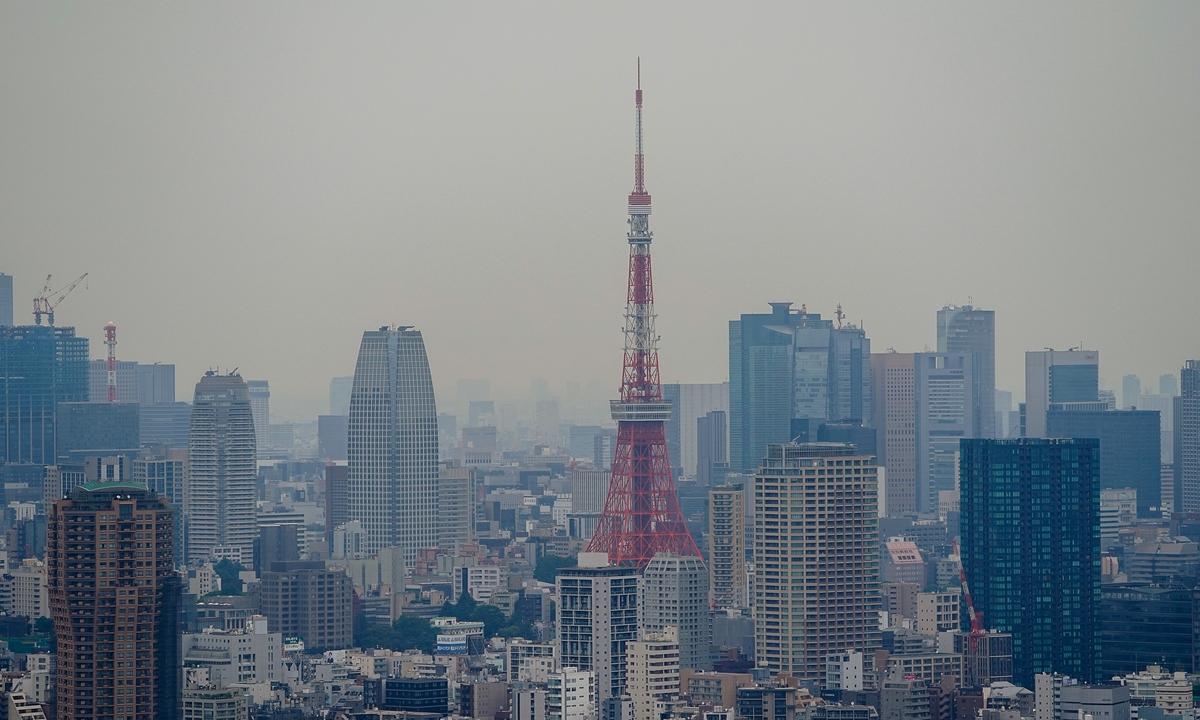
A general view of Tokyo Photo: VCG
Japan released the latest official data on inbound tourism for the first half of the year, which showed the number of Chinese visitors to Japan dropped by nearly 60 percent year-on-year.
Facing continued decline in Chinese tourists to Japan, certain Japanese media outlets claimed on Monday that the reduction in Chinese visitor could still strengthen Japan's tourism sector. However, Chinese experts and tourism industry insiders have dismissed the argument as an attempt to "whitewash" the losses suffered by various sectors in Japan, arguing that the scale and spending power of Chinese tourists are difficult to replace with visitors from other countries.
In analyzing Japan's inbound tourism data for the first half of 2026 (January to June), Toyo Keizai Online, a major Japanese business news website, said on Monday that the decline of foreign visitors to Japan - down 2 percent year-on-year - was largely attributed to the drop in Chinese tourists.
This marks the first decline in the number of foreign visitors to Japan in the first half of a year in five years, according to NHK.
Visitors from China totaled only 2.06 million in the first half of the year, a year-on-year decrease of 56.4 percent. Chinese tourists accounted for 9.8 percent of all inbound visitors to Japan, the lowest level since 2003, the Japanese media report said.
However, the Japanese media outlet listed several arguments claiming that the decline in Chinese tourists could still strengthen Japan's tourism industry, including attracting more visitors from other Asian regions, expanding global promotion, and diversifying tourism resources.
The decline of Chinese tourists has had a real and tangible impact on Japan's tourism industry. However, from the reactions of some Japanese media outlets, certain views are clearly influenced by a right-wing stance, turning a blind eye to the losses and even deliberately downplaying the impact while portraying the situation in a more favorable light, an industry representative from a Chinese tourism agency who preferred not to be identified told the Global Times on Monday.
"Chinese tourists represent a large and substantial market. No matter which country they visit, they typically account for a significant share of inbound visitors," he said, noting that Chinese tourists also have a strong driving effect on consumption.
Therefore, in addition to neighboring countries and regions such as Southeast Asian countries and South Korea that actively seek to attract Chinese visitors, European and American countries, particularly European nations, as well as destinations such as New Zealand, are also making efforts to attract Chinese tourists, the industry representative said.
In covering the sharp decline of the Chinese tourists to Japan, some Japanese media outlets including Asahi Shimbun have been avoiding the fundamental reason - the provocative remarks that Japanese Prime Minister Sanae Takaichi made on the Taiwan question.
NHK, citing an expert, claimed that the tourism sector is entering a "mature phase", as travel costs have risen significantly, and the growth rate of global travel demand is no longer as strong as it was before the COVID pandemic. In the future, the proportion of repeat visitors is expected to increase, and tourism products and services will need to be gradually adjusted accordingly.
However, the Japanese media reports did not expound on the fundamental reason behind of the sharp decline of Chinese tourists to Japan.
Regardless of how Japanese media try to explain the situation, they need to acknowledge one fact: the decline in overall visitors to Japan is directly linked to the sharp drop in Chinese tourists. The overall 2 percent decrease in inbound visitors in the first half of 2026 corresponds with a nearly 60 percent year-on-year decline in Chinese tourists, showing a clear connection between the two, Da Zhigang, a research fellow at the Institute of Northeast Asian Studies of the Heilongjiang Academy of Social Sciences, told the Global Times on Monday.
"The Japanese government and relevant industries are in fact well aware of these realities. The importance of the Chinese tourist market cannot simply be replaced by an increase in visitors from other countries," Da said, noting that therefore, the key to genuinely addressing this issue lies in improving China-Japan relations.
RELATED ARTICLES