China-made prefabricated substations win favor with global clients
By Published: Jul 20, 2026 09:13 PM

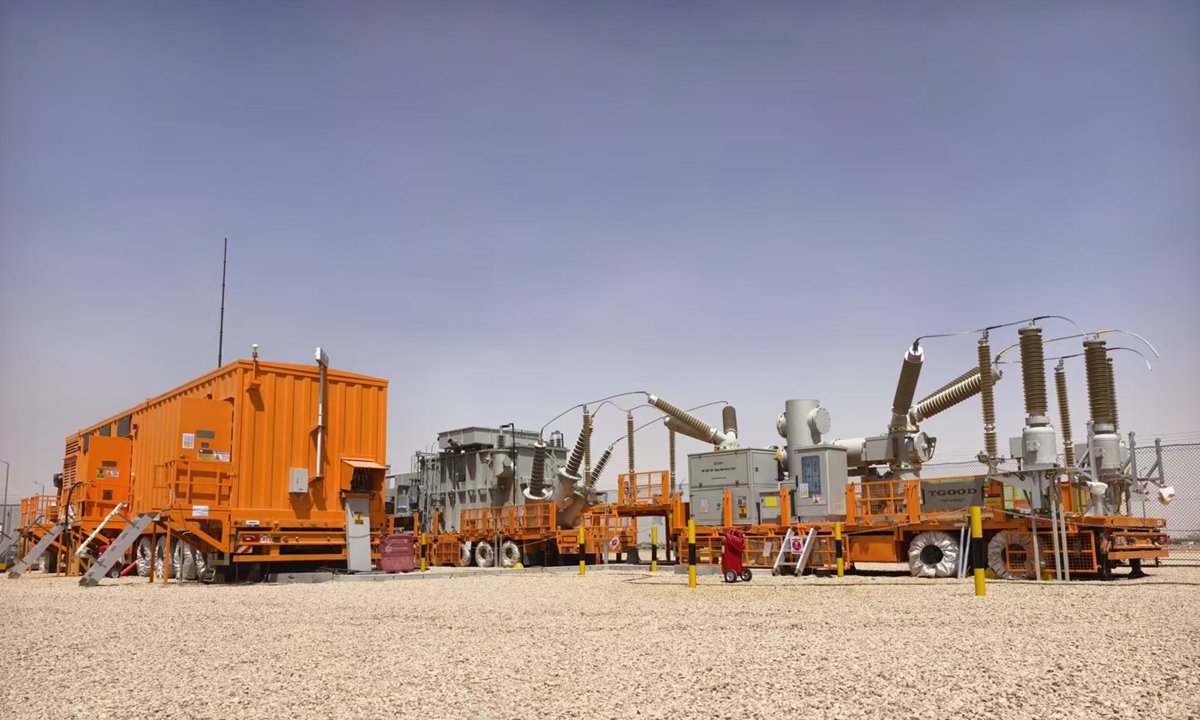
Prefabricated modular units of a substation project in Saudi Arabia Photo: Courtesy of Qingdao TGOOD Electric Co
Sustained growth in demand for computing power amid an unprecedented global AI euphoria has boosted exports of Chinese electronic products. While China-made prefabricated residential buildings are gaining popularity overseas, large prefabricated electrical equipment such as substations is also drawing growing interest from overseas users, the Global Times learned.
A company representative from Qingdao TGOOD Electric Co told the Global Times on Monday that the company's products in the Middle East including Saudi Arabia have received favorable feedback from customers because of sharply reduced project cycle. The company said its overseas project deliveries rose 30 percent in the first half of 2026.
In one case, the company's 400-kilovolt prefabricated substation has been successfully energized for a client based in a Middle East country. The facility consists of four independently functioning but coordinated prefabricated cabins, which were assembled from 24 standardized functional modules. Its design, manufacturing, assembly and test were all completed in China.
After being shipped to the overseas project site, prefabricated modular units were assembled and connected like LEGO building blocks. Compared with conventional substations, which require extensive civil construction and on-site commissioning, the prefabricated modular approach significantly shortened the construction period.
The conventional construction of a substation usually takes between 18 months and two years to complete. By contrast, the project took less than six months to go through the entire process, from order placement and production to seaborne transport, on-site installation, commissioning and energization, the representative said.
The TGOOD manager said its strong overseas growth was supported by two major factors. First, the expansion of global data centers has led to a sharp rise in demand for transformers, batteries and prefabricated substations. Also, Chinese companies' strengthened competitiveness in helping develop regional standards and rising international recognition.
Previously, adapting a complete product system to overseas standards could take one to two years. Through standards coordination and targeted supplementary certification, the process can be shortened to a few months, saving more than 10 million yuan ($1.4 million) in costs each year, the manager said.
Materials provided by TGOOD to the Global Times showed that the company recently gained supplier qualification from Saudi Electricity Company for high-voltage prefabricated substations rated at 380 kilovolts.
The company has secured projects in Saudi Arabia and Australia, reflecting an expansion of its overseas customer base and the application scenarios of its prefabricated power equipment.
In the first half of 2026, the export value of electrical equipment from East China's Shandong Province, a manufacturing powerhouse, reached 26.73 billion yuan, up 9.3 percent year-on-year. Exports of substations and transformers exceeded 7 billion yuan, the CCTV News reported.
These electrical products are mainly exported to markets including the EU, the Middle East, Africa and South Korea, the report said. Exports of high-voltage, high-capacity power transformation equipment and prefabricated substations have continued to rise, emerging as a new driver of foreign trade growth.
Sun Chuanwang, a professor at the School of Economics at Xiamen University, told the Global Times on Monday that the surge in orders for China's prefabricated substations is the result of a confluence of global market demand, China's secure domestic industrial chain, and the mutual recognition of international standards.
"Homegrown prefabricated substations, characterized by their modular design, rapid scalability, and resilience against sandstorms, corrosion, and moisture, are highly effective in meeting the construction timelines of AI data center parks in Europe, America, and Southeast Asia, while also addressing the grid modernization and energy development needs of countries in the Middle East and Africa," Sun said, adding that China's supply chain advantage gives domestic companies an edge in cost and delivery overseas competitors cannot match.
By seizing opportunities arising from AI development and new energy industries, sectors such as electronics, specialized equipment, general-purpose equipment, automobiles, and electrical machinery have contributed more than 50 percent to China's industrial economic growth in the first half of this year, an official with China's Ministry of Industry and Information Technology said on Monday.
RELATED ARTICLES