ARTS / CULTURE & LEISURE
Conservation expert’s decades-long efforts preserve China’s earliest books, revealing buried stories
Saving ancient texts from time
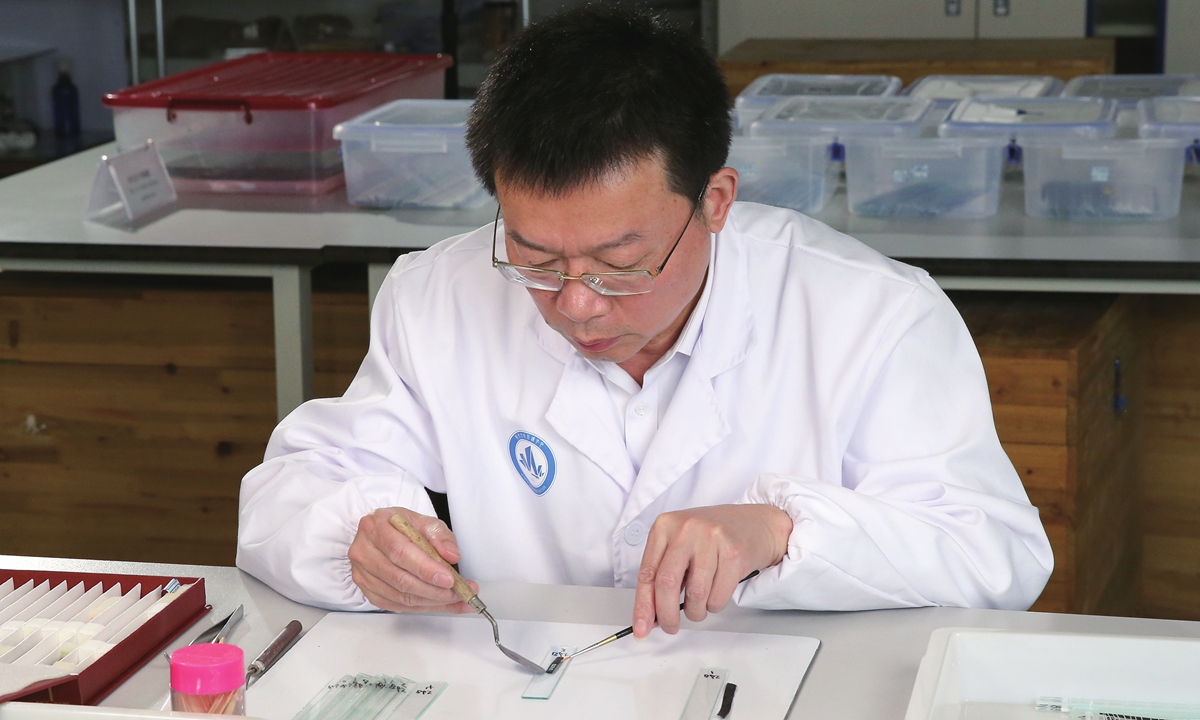
Restoration specialist Fang Beisong Photo: Courtesy of Fang Beisong
Long before paper transformed the way people recorded history, ancient Chinese wrote on strips of bamboo.Bamboo or wooden slips, or Jiandu, each containing a narrow vertical column of dozens of characters, can be classified as China's earliest form of books. They used to be the most important surfaces for writing before the invention of paper. One bamboo slip, or even a character on it, might offer vital clues to help solve an archaeological puzzle, thus revealing an unknown episode of history, according to the Xinhua News Agency.
But before historians can read them, someone must first save them.
For more than three decades, Fang Beisong, a revered bamboo slip repair expert, at the Jingzhou Conservation Institute in Jingzhou, Central China's Hubei Province, has been doing exactly the same thing.
"My greatest pride," Fang said, "is that among the countless bamboo slips and wooden tablets I have restored, not a single one has been damaged or lost."
Fang Beisong's fingers rest on a jiandu slip as he repairs a set of these historic relics. Photo: VCG
Reviving ancient voicesTrained in analytical chemistry, Fang has worked as an antiquity conservation professional since 1988. He has spent more than 30 years developing techniques for restoring jiandu, some of China's most fragile cultural treasures.
Thanks in large part to Fang's work and that of his colleagues, more than 80 percent of the country's excavated waterlogged bamboo slips have been restored to a decipherable state.
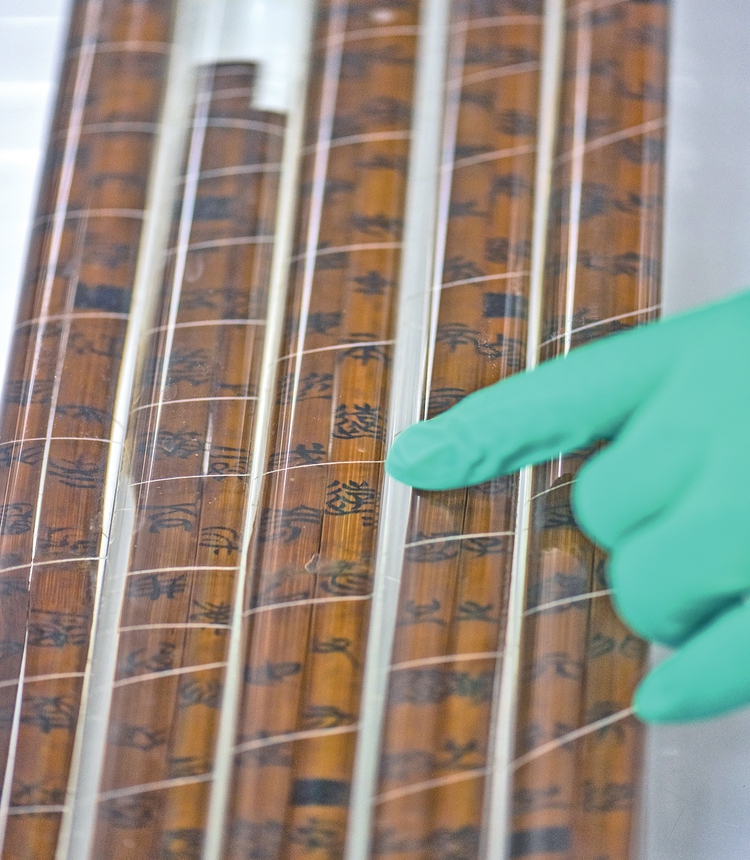
Bamboo slips are transported to Jingzhou from archaeological sites across the country. Each fragile strip is carefully sandwiched between two glass plates, tied with fine threads and stacked in layers while being immersed in distilled water for protection.
Some severely deteriorated bamboo slips are too fragile to withstand long-distance transportation. In such cases, the Jingzhou Conservation Institute sets up workstations near excavation sites and sends conservators there to carry out preliminary restoration and sorting before the slips are moved. Fang spends at least half of each year on the road, traveling from one excavation site to another to help rescue newly unearthed bamboo slips.
Over the past three decades, Fang has restored more than 100,000 bamboo slips. From the tomb of the Marquis of Haihun in East China's Jiangxi Province to the Zoumalou site in Changsha, Central China's Hunan Province, his pioneering decolorization and dehydration techniques have helped preserve some of China's most fragile historical records.
Restoring a single bamboo slip is a process involving more than 20 steps, including cleaning, decolorization, dehydration, reinforcement, shaping, sealing and packaging.
"I have to use extremely gentle movements during cleaning. Otherwise, the inscriptions themselves may be damaged," Fang said.
Beside each basin, enlarged infrared scans - displayed on computer or mobile phone screens - reveal ancient characters hidden beneath centuries of decay. Guided by these images, conservators gently sweep away tiny particles of dirt with soft brushes, ensuring that every stroke cleans the bamboo surface without disturbing the ink.
It is painstaking work that demands immense patience. Even an experienced conservator can only clean about two bamboo slips a day.
"Decolorization and dehydration are the key steps in bamboo slip conservation," Fang noted.
Years ago, he witnessed newly excavated Qin (221BC-206BC) bamboo slips, originally light in color, turn black after exposure to air. As oxidation set in, the characters on their surfaces gradually became blurred. Finding a way to restore their original appearance became one of the early challenges.
Restoring the color of bamboo slips requires removing the effects of oxidation without damaging the bamboo fibers or the ink. For months, Fang tested different chemicals and concentrations on blank bamboo strips and pieces of wood. After repeated experiments, he identified sodium dithionite as the best option - effective at restoring the original color while causing minimal harm to the fragile surfaces.
When blackened bamboo slips are gently immersed in a sodium dithionite solution, the dark color gradually fades, revealing the natural color of the bamboo once again, almost as if time itself is being reversed.
But restoring their color is only the first step. Even after decolorization, waterlogged bamboo slips remain extremely fragile. Fang later developed a dehydration method that replaces the water trapped inside the bamboo with a more stable substance, helping the slips survive for longer periods of time.
After years of experiments and hundreds of trials, Fang found that cetyl alcohol was an effective material for the process.
The two techniques developed by Fang remain among the main methods used today to conserve waterlogged bamboo slips.
"Bamboo slips are carriers of history and culture," Fang said. "I believe that through the efforts of cultural relic conservators, more chapters of history hidden for centuries will continue to be revealed."
Digital afterlife
On a table in the restoration laboratory in Jingzhou rests a set of bamboo slips from the ancient Chinese mathematical text Jiujiushu, unearthed in the city in 2023. Dating back approximately 2,300 years, it is the earliest known physical multiplication table ever discovered.
For Fang, however, preserving cultural relics is about more than safeguarding their physical form.
"Fundamentally speaking, no cultural relic can survive forever," he said. "Today's conservation technologies can only slow down the aging and disappearance of these objects."
Moreover, when displayed in a museum, an ancient bamboo slip can be difficult to fully appreciate without interpretation.
That is why Fang emphasized that digital technology will play an increasingly important role in cultural heritage preservation.
Digitizing bamboo slips allows their images and textual information to be preserved for the long term, while digital archives can support academic research, educational programs and public exhibitions. Multimedia displays also offer visitors new ways to explore ancient texts beyond the limitations of physical artifacts. The restoration of bamboo slips is a race against time. Digital technology is now giving conservators new ways to rescue, preserve and pass on these fragile records of history, noted Fang.
RELATED ARTICLES