WAIC wraps up with $3.01 billion in expected deals
Conference showcases China’s AI advances, open-source efforts and growing global cooperation
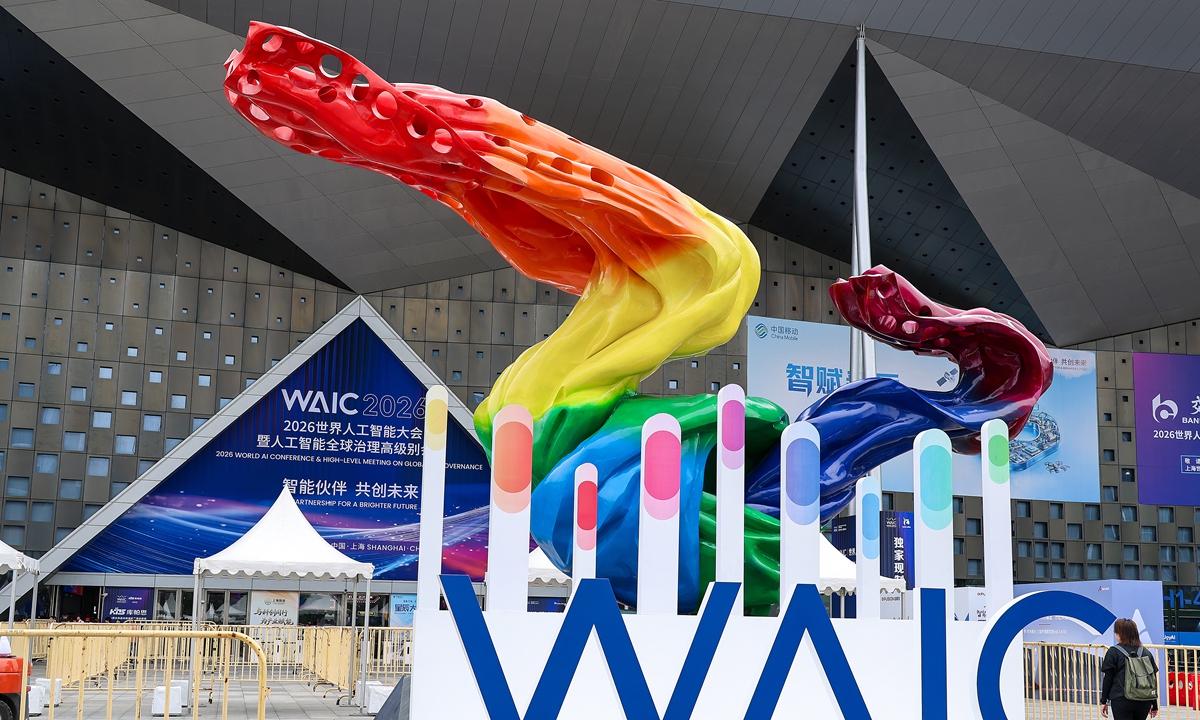
This photo shows the street installation for 2026 World Artificial Intelligence Conference in Shanghai, which is set to open on July 17, 2026, bringing together more than 1,100 companies and over 3,000 exhibits. Photo: VCG
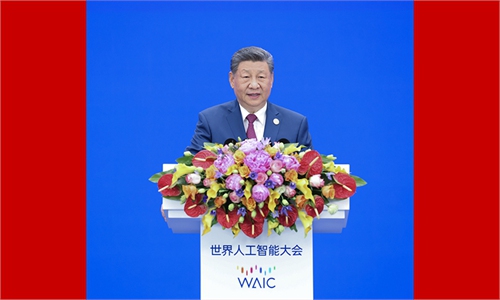
The 2026 World AI Conference (WAIC) and High-Level Meeting on Global AI Governance concluded in Shanghai on Monday, with intended procurement deals expected to reach about 20.36 billion yuan ($3.01 billion), up about 25 percent year on year, China Central Television (CCTV) reported. Observers said the conference underscored China's commitment to open and inclusive AI development, pointing to its self-developed computing infrastructure, the global opening of advanced AI products and applications such as Kimi, and initiatives promoting equitable access to AI as key factors boosting international cooperation.
Asked to share more information of the recently-concluded 2026 World AI Conference and High-Level Meeting on Global AI Governance that has continued to draw global attention as a new platform for global AI exchanges, Chinese Foreign Ministry spokesperson Lin Jian on Monday said that there are five major achievements and highlights of this year's conference, including setting a clear direction for AI global governance and making major progress in establishing the World Artificial Intelligence Cooperation Organization (WAICO).
Yan Yijun, vice president of MiniMax, told the Global Times that openness is essential to making AI widely accessible. Open competition, he said, drives stronger models and lowers costs, allowing more businesses, developers and users to benefit from technological progress. He added that independent innovation and international openness reinforce each other, enabling AI to create greater value for people around the world.
At the WAIC, participants expressed strong expectations for enhanced international cooperation and coordinated governance on artificial intelligence.
"The time or the era of exclusive club-like governance is over," said Ke Gong, Executive Director of the China Institute for the New Generation Artificial Intelligence Development Strategies and former principal of Nankai University, calling for broader participation in global AI governance. "We need engineers to translate the diplomatic consensus and government rules into reality, into solutions."
For Wan Sie Lee, Cluster Director of AI Governance and Safety at Singapore's Infocomm Media Development Authority (IMDA), building practical platforms and initiatives is key to advancing global AI safety. "It's through these platforms, these initiatives happening on the ground... creating the relationships that will help us advance some of these concerns around AI safety in the world."
A balance between domestic efforts and international coordination is also needed, according to Sam Daws, Senior Advisor to the Oxford Martin AI Governance Initiative and Founding Director of Multilateral AI. "Realistically, I think some things can be done only nationally, and some things need an international dimension."
Openness vs barriers
Beyond discussions on global AI governance, new AI products emerged as another major focus of the event.
A wide range of innovations spanning computing power, models and applications were showcased, including domestically developed computing hardware from companies such as Moore Threads and Iluvatar CoreX, as well as 100,000-card supercomputing clusters. General-purpose AI models such as Kimi and embodied intelligence products, including humanoid robots and AI solutions in education and healthcare, also drew attention.
These products demonstrated how AI is moving "out of the cloud and into everyday life", forming a complete ecosystem covering computing power, models and real-world applications, experts noted.
While these advances have received broad international recognition, some Western media outlets and US officials have hyped the competition between China and the US in AI.
US Federal Reserve Chair Kevin Warsh, for example, said that the US is in a "fight" with China for dominance in AI, echoing calls in Washington to maintain US leadership in the field, media reported. Meanwhile, publications such as The Economist have argued that China's open-source AI approach is a potential "trap", claiming that embracing China is risky.
Regarding such concerns, Chinese Foreign Ministry spokesperson Lin Jian previously said that the development of AI bears on the well-being of all humanity. All parties should work to narrow the digital and smart technology gap, hold on to the bottom line of security, improve global governance, and jointly develop AI as an open and inclusive technology for good and for all. China opposes drawing lines along ideological differences and conducting technological blockades. China stays committed to coordinating both development and security and is ready to share experiences with all to elevate the level of AI innovation worldwide.
On Monday, while introducing the achievements and highlights of the conference, Lin reiterated that as a responsible major country, China is always committed to providing international public goods relating to AI. China is ready to work with various parties to take a people-centered approach, develop AI for the positive and for good, and join hands to build a just and equitable system for global AI governance so as to ensure that AI truly promotes shared prosperity and benefits whole humanity.
Liu Gang, chief economist of the Chinese Institute of New Generation Artificial Intelligence Development Strategies, told the Global Times on Monday that the essence of a responsible major country's strategy lies in providing international public goods rather than seeking exclusive dominance. China's open-source practices in AI are in line with China's other initiatives such as the Belt and Road Initiative and the Global Development Initiative, all of which reflect a vision of global governance based on extensive consultation, joint contribution and shared benefits, Liu said.
He noted that this approach stands in sharp contrast to attempts by certain countries to maintain technological dominance through a "small yard, high fence" strategy. Reducing the two different approaches to merely "great power competition," he said, not only misinterprets China's development goals but also underestimates the independent judgment of countries in the Global South.
The expert noted that the biggest challenge for developing countries in the AI era is being left out of technology standard-setting and access to key resources, and that China's inclusive AI initiatives aim to help more countries share the benefits of technological progress.
Liu said the different AI approaches taken by China and the US reflect two distinct visions of global governance. While some countries seek to maintain advantages through closed-source models and technological barriers, China advocates open-source development and turning AI advances into global public goods.
RELATED ARTICLES