Harvard financial aid probe by DOJ reflects growing scrutiny of China-related academic co-op; 'chilling effect' could undermine exchanges: expert
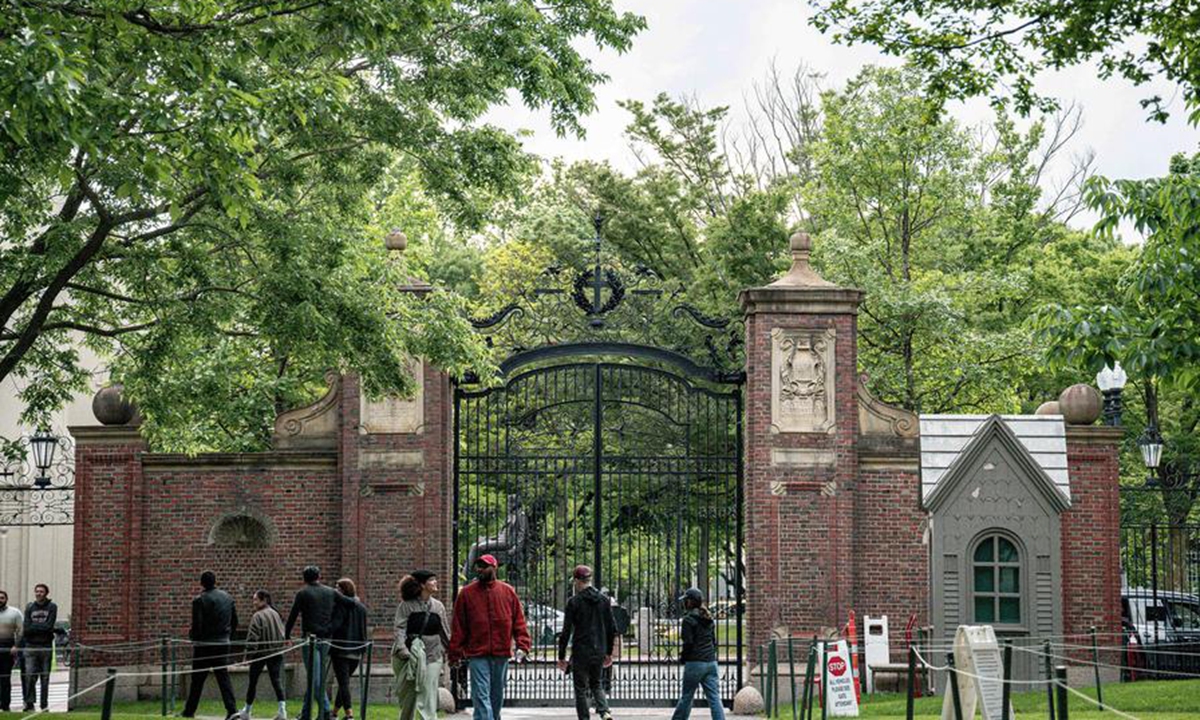
This photo taken on May 24, 2025 shows a view of the Harvard University campus in Cambridge, Massachusetts, the US. Photo: Xinhua
The US Justice Department has reportedly opened a review into Harvard University's China-based financial aid programs, examining whether financial aid funded by Chinese donors discriminates against US students. A Chinese expert said the investigation reflects growing scrutiny of China-related academic cooperation in the US and warned that politicizing education could create a chilling effect on bilateral academic cooperation and undermine confidence in bilateral exchanges.US Justice Department officials announced the new review on Monday, claiming Harvard's foreign funding disclosures "raised concerns" about possible discrimination against US students. The investigation is aimed at Harvard's "China-based financial aid programs," the Justice Department said, according to a report from the Associated Press (AP).
The agency claimed Chinese donors have given money to Harvard to support financial aid programs limited to students from certain countries. That restriction could amount to illegal discrimination based on country of origin, the department said. The agency did not specify which scholarship programs are being targeted and emphasized it "has not reached any conclusions," per AP.
As of press time on Tuesday, the university had not responded to a request for comment from the Global Times. However, the AP cited a written statement from Harvard saying that Harvard "does not unlawfully discriminate on the basis of race, ethnicity, or national origin in allocating financial aid."
Rather than an isolated incident, the investigation is part of Washington's broader and growing scrutiny of university ties with China, as topics such as academic collaboration, student visas and foreign donations are increasingly viewed through the lens of national security and strategic competition, Sun Chenghao, a research fellow at Tsinghua University's Center for International Security and Strategy, told the Global Times.
Although the Justice Department has not reached any conclusions or identified specific programs targeted by the probe into China-linked financial aid programs, the move reflects a broader trend of politicizing and over-stretching security concept in education in the US, Sun said.
The AP report also said the latest investigation into Harvard "adds to the barrage of federal inquiries the Trump administration has opened in its battle against the Ivy League school."
Meanwhile, The Harvard Crimson reported that the investigation opens "a new playing field" in the Trump administration's yearlong pressure campaign. It also noted that Harvard's ties to China have been "a frequent target" of the administration and its allies in Congress.
Sun noted that in the short term, such investigations will undoubtedly raise compliance costs for US universities engaging with China, deepen concerns among Chinese students and scholars, and erode confidence in normal educational exchanges. With Washington's probes into China-related research, visa policies and foreign funding on the rise, this policy climate risks creating a chilling effect, exposing even routine academic collaboration to greater political risk.
A spokesperson for the Chinese Embassy in Washington told media that China-US education cooperation is mutually beneficial. China maintains that normal education and academic exchange should not be disrupted for political purposes.
Sun said that educational cooperation is an important bridge for promoting mutual understanding, and is among the most resilient aspects of China-US relations. Despite current challenges in bilateral ties, both sides should safeguard channels for educational and academic exchanges rather than allowing political factors to interfere with normal cooperation.
An open, non-discriminatory and mutually beneficial international education environment benefits not only China and the US, but also global innovation and talent development, Sun said.
RELATED ARTICLES