ARTS / CULTURE & LEISURE
‘Museum fever’ sweeps China during summer holiday season
Measures aim to curb scalping, improve service
By Published: Jul 21, 2026 09:05 PM

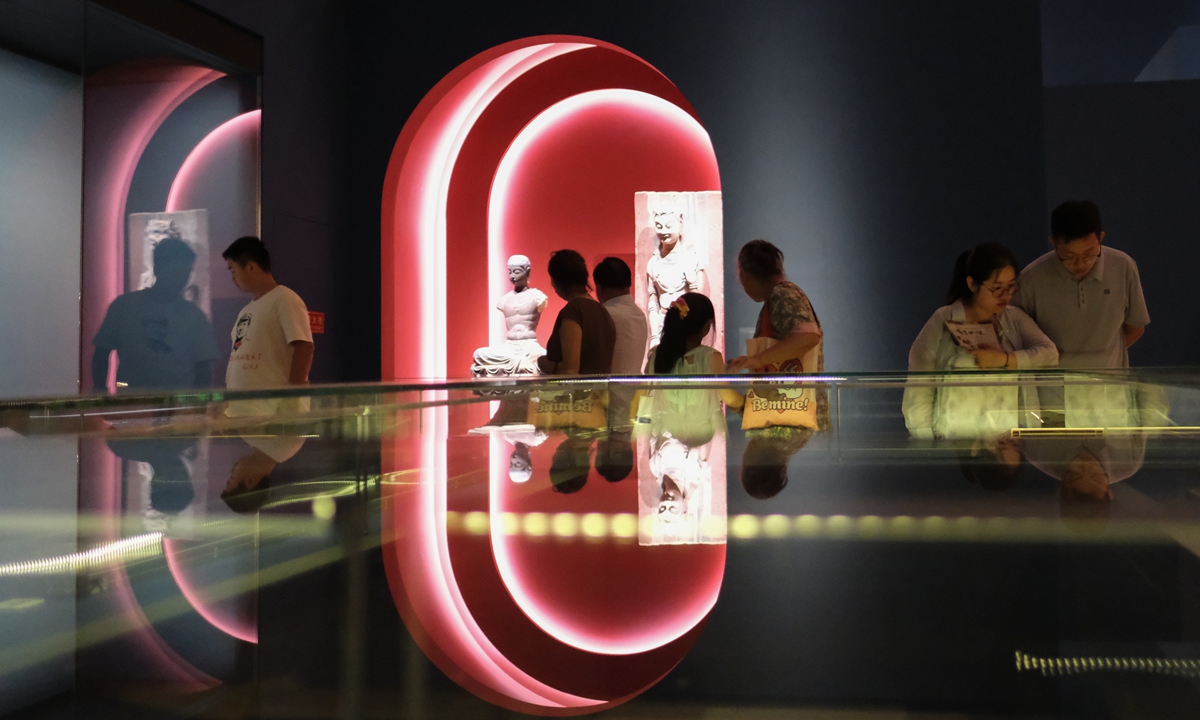
Parents and children visit an exhibition of Dunhuang culture, best represented by the Mogao Grottoes, dating back to the 4th century, at the Hunan Museum in Changsha, Central China's Hunan Province on July 21, 2026. Photo: VCG
During the summer holiday, popular cultural venues across China such as the National Museum of China are once again seeing surging visitor demand, with tickets hard to get and long lines forming at entrances. To respond to this "museum fever" and help museums improve their services, the National Cultural Heritage Administration (NCHA) issued a notice on Monday, encouraging venues with the capacity to cancel entry reservation limits during the holiday period. The notice also called for relevant departments to crack down on ticket scalping and illegal reselling.The notice emphasized that museums should manage reservations according to the actual situation at each site. For facilities that have enough capacity and conditions to stagger visits out, reservation requirements should generally be lifted. For sites that do need to keep reservations in place, the process should be simplified, with easy access across online and offline channels, including traditional options like in-person and phone bookings. The notice also called for better coordination of security checks, ticket verification, and guided tours to reduce visitor waiting times.
With the summer heat in mind, the notice instructed museums to provide cooling equipment and emergency medicines inside their venues to protect both visitors and frontline staff. Museums are also encouraged to launch in-depth, engaging exhibitions and to design high-quality cultural programs suitable for all age groups. Institutions are also urged to continue developing "smart museums" by using technologies like virtual reality and artificial intelligence to enrich online exhibitions and expand digital education content.
Many museums in China have already made adjustments based on their own conditions. For example, the Nanjing City Wall Museum in East China's Jiangsu Province has allowed walk-in visits without reservations since June 5. Individual visitors can enter with their ID after security checks. To meet high summer demand, the museum has extended its hours to 8 pm every Friday, Saturday, and Sunday from July 3 to August 30, Xiao Fahua, a deputy director of basic operations at the museum, told the Global Times on Tuesday.
During these extended hours, visitors have more time to explore a new summer exhibition featuring the legacy of handcrafted porcelain from Jingdezhen, the porcelain capital of China. This display, which opened this summer, showcases 290 relics - drawn from over a decade of archaeological work and overseas discoveries - to give a comprehensive look at Yuan Dynasty (1279-1368) blue-and-white porcelain as a treasure of Chinese civilization.
To break the traditional "look but don't touch" rule with relics, the exhibition introduced a "touch the porcelain" area starting July 7. Visitors can physically touch samples of porcelain shards with different surface textures and decorative patterns selected from the collection of the Nanjing University of the Arts.
Night tours at museums have also grown rapidly, with many places now offering nighttime visits and even overnight stay programs.
At the Chengdu Natural History Museum in Southwest China's Sichuan Province, the highly popular immersive overnight experience will continue this year. Nighttime transforms the museum, offering a distinct charm compared to daytime visits. A museum staff member told the Global Times that there are three exploration routes designed for children. Exhibition halls become exclusive science classrooms, and static fossils and specimens are turned into "clues" within stories. The activities encourage kids to observe, experiment, and tackle challenges together, making natural science fun, interactive, and memorable.
By transforming museums into 24-hour destinations, institutions can better accommodate surging summer crowds, spreading out attendance and offering a richer, more varied use of their space, Zhang Peng, a cultural researcher and associate professor at Nanjing Normal University, told the Global Times.
According to the NCHA, China had 7,188 registered museums, more than 91 percent of which were free to enter, by the end of 2025. In 2025 alone, museums hosted 45,000 exhibitions and recorded 1.56 billion visits. Sun Jiashan, a cultural critic at the Beijing Federation of Literary and Art Circles, noted that "museum fever" can be fueled even further. He said that digital culture and technology can unlock new ways for museums to engage the public - for example, animating precious relics with digital tools to create lively and engaging images, which vastly improves their appeal and reach.
RELATED ARTICLES