ARTS / CULTURE & LEISURE
Global tourists explore Chinese innovation by Shenzhen tech tours
Touching the future
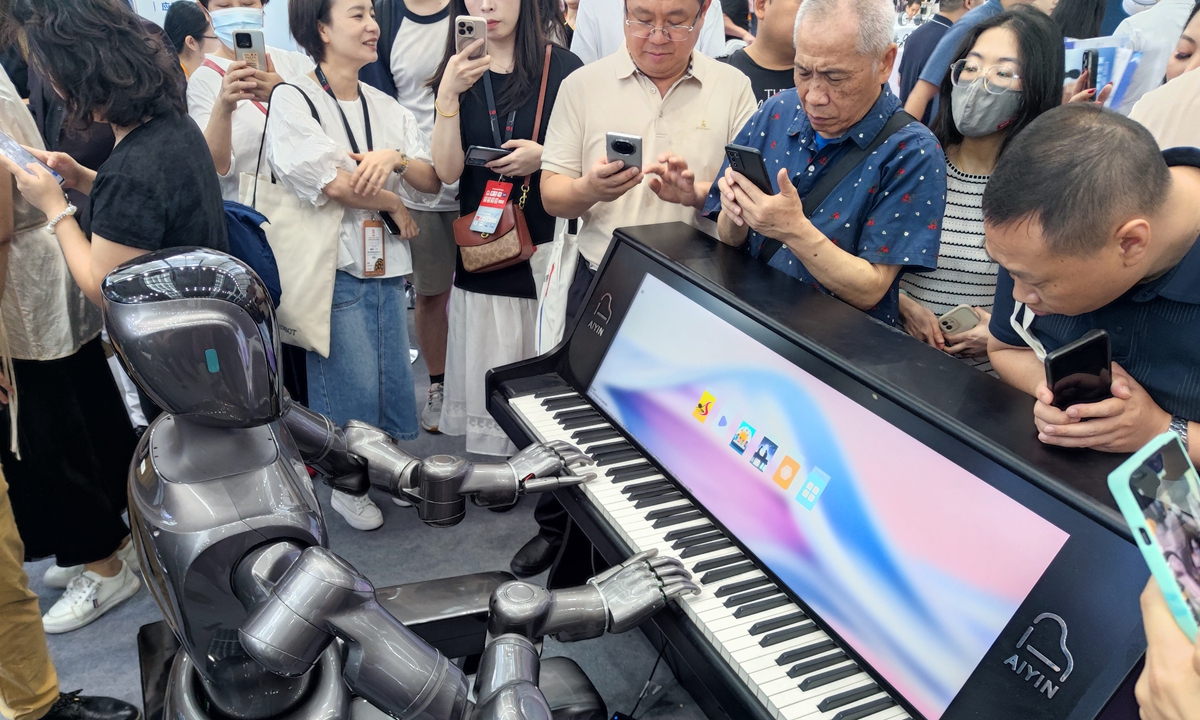
People watch a humanoid robot play the piano in Shenzhen, South China's Guangdong Province. Photos: VCG
Skipping traditional sightseeing, a growing number of overseas travelers are flocking to Shenzhen, South China's Guangdong Province, for a new kind of travel experience, one that offers a glimpse into the technologies shaping humanity's future.
AI assistants, service robots, autonomous driving and cutting-edge consumer electronics have turned the innovation city into a tourist attraction.
"Last year, I spent around 15 days each month receiving these kinds of technology tour groups from abroad. Since April this year, the number has increased noticeably, and I receive such groups around 20 to 25 days each month. The proportion of family travelers is also rising. Many overseas parents are specifically bringing their children here so they can experience cutting-edge technologies firsthand," local tour guide Miaomiao told the Global Times.
"Visitors come from all over the world, including Switzerland, the US, Australia, Russia, Oman and South Africa. Many of them reach out after seeing the videos I post on Facebook or Instagram about Shenzhen tech tours," said Miaomiao, who has been working as a tour guide for over 20 years in Shenzhen.
Shenzhen, once a small fishing village, has transformed into one of China's most dynamic and innovative cities. It is home to more than 2,200 AI companies and boasts a comprehensive AI industry chain that spans from smart chips and algorithm frameworks to large models and software-hardware applications.
The city stands as a leading manufacturing base for unmanned aerial vehicles, producing 70 percent of China's consumer drones and 50 percent of its industrial drones.
The itinerary for international tourists includes visiting the Shenzhen Science & Technology Museum, the flagship stores of tech companies such as Xiaomi, Huawei and DJI, the world's first "Robot 6S Store," where visitors can watch daily humanoid shows, try robot-made coffee, and rent or customize robots for personal or business use, as well as Huaqiangbei, one of the world's largest wholesale markets for electronic products, Miaomiao noted.
China currently offers unilateral visa-free entry to nationals of 50 countries. Meanwhile, nationals from 55 countries can now utilize the 240-hour visa-free transit program to enter China via 65 designated ports. China's border inspection agencies handled a record 369 million inbound and outbound crossings in the first half of 2026, up 10.8 percent year on year, Xinhua reported.
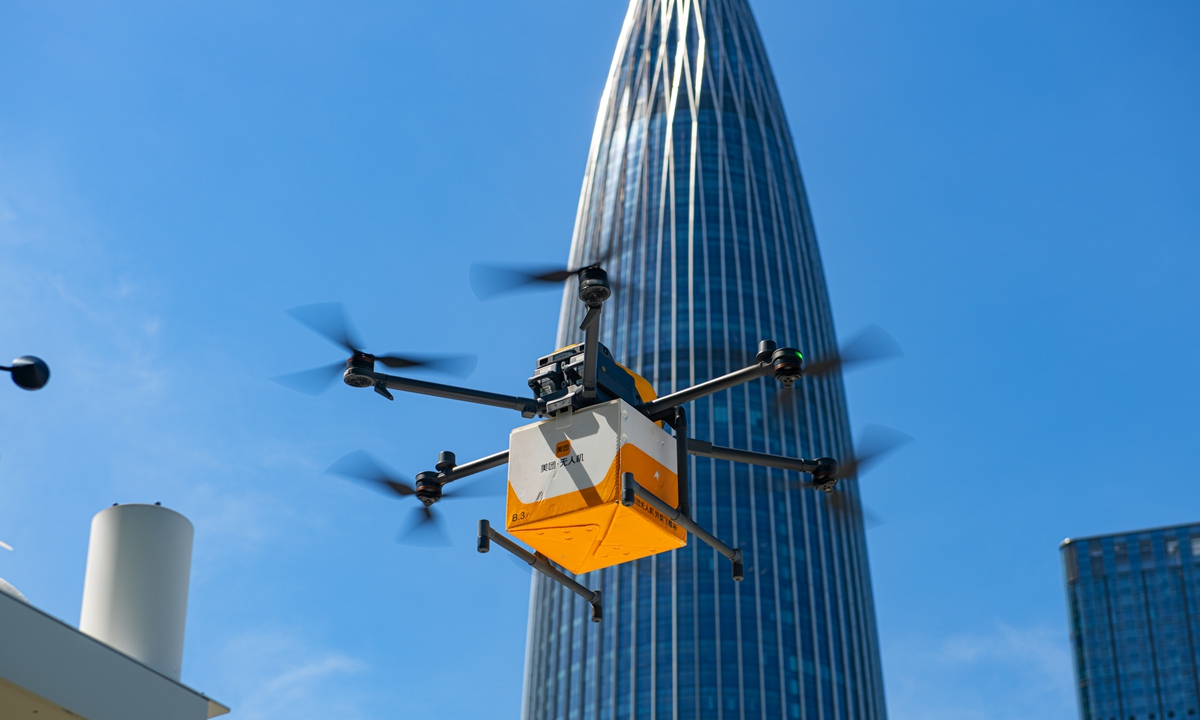
A drone delivers a food order in Shenzhen.
Extraordinary paceDuring an international tour group's visit to the headquarters of China's leading new energy vehicle manufacturer BYD in July, German blogger Thomas Derksen was impressed with the flash charging test on BYD's second-generation Blade Battery, which can be fully charged in nine minutes.
Miaomiao noted that many foreign visitors share a similar deep impression: Shenzhen moves at an extraordinary pace when it comes to developing and commercializing new products.
An idea that starts as a concept can often become a prototype, go through rounds of refinement, and enter mass production within just a few weeks. In their home countries, they say, the same process often takes months or even longer, she said.
The rapid commercialization is rooted in Shenzhen's strategic focus on high-end innovation, such as embodied intelligence, while leveraging the broader manufacturing capabilities of the Guangdong-Hong Kong-Macao Greater Bay Area.
Take Shenzhen's Longgang robotics industrial park as an example. Research & Development teams work upstairs, mold makers and component suppliers are just downstairs, while nearby factories can assemble, test and refine products almost immediately. Engineers, suppliers and manufacturers can sit down together to solve problems on the spot, avoiding the back-and-forth of remote communication and dramatically speeding up product development, said Miaomiao.
For many foreign visitors, this tightly knit industrial ecosystem, where an idea can move from design to production in the same neighborhood, is one of the most eye-opening aspects of Shenzhen's innovation model, she said.
In March 2025, Shenzhen's Longgang district established China's first dedicated AI and robotics administration, a regulatory body designed to break down departmental walls and provide one-stop coordination ranging from industrial planning and ecosystem building to investment services and safety management.
The smart life
Another Shenzhen tourist guide, Loria, from Central China's Hunan Province, told the Global Times that some of her overseas customers come through travel agencies, while others find her via global travel platforms and social media.
Before coming to Shenzhen, many foreign visitors had only watched videos of drones delivering takeout and autonomous taxis navigating city streets. Seeing and riding these technologies in person, they are often struck by the pace of China's innovation and by the fact that these once futuristic concepts have already become part of ordinary people's daily lives in Shenzhen, said Loria.
The city is systematically transforming its urban fabric into an AI testbed by making use of autonomous delivery vehicles and robot janitors. The Shenzhen Intermediate People's Court has launched China's first AI model for judicial proceedings.
Loria noted that she remembered one foreign visitor who was unable to walk. After putting on an exoskeleton-assisted device and walking again, he was moved to tears. Meanwhile, some European visitors said that, due to safety concerns and regulatory restrictions, drone food delivery would be difficult to widely adopt in their home countries in the near future.
From family tours to businessmen seeking fresh opportunities, Shenzhen tech tours have reshaped foreign visitors' understanding of China's technological development, allowing them to witness firsthand a fast-moving innovation ecosystem where ideas can quickly evolve into products that transform daily life.
RELATED ARTICLES