‘Nuclear energy’ or ‘nuclear weapons’? What is China and the US’ AI competition really about?: Global Times editorial
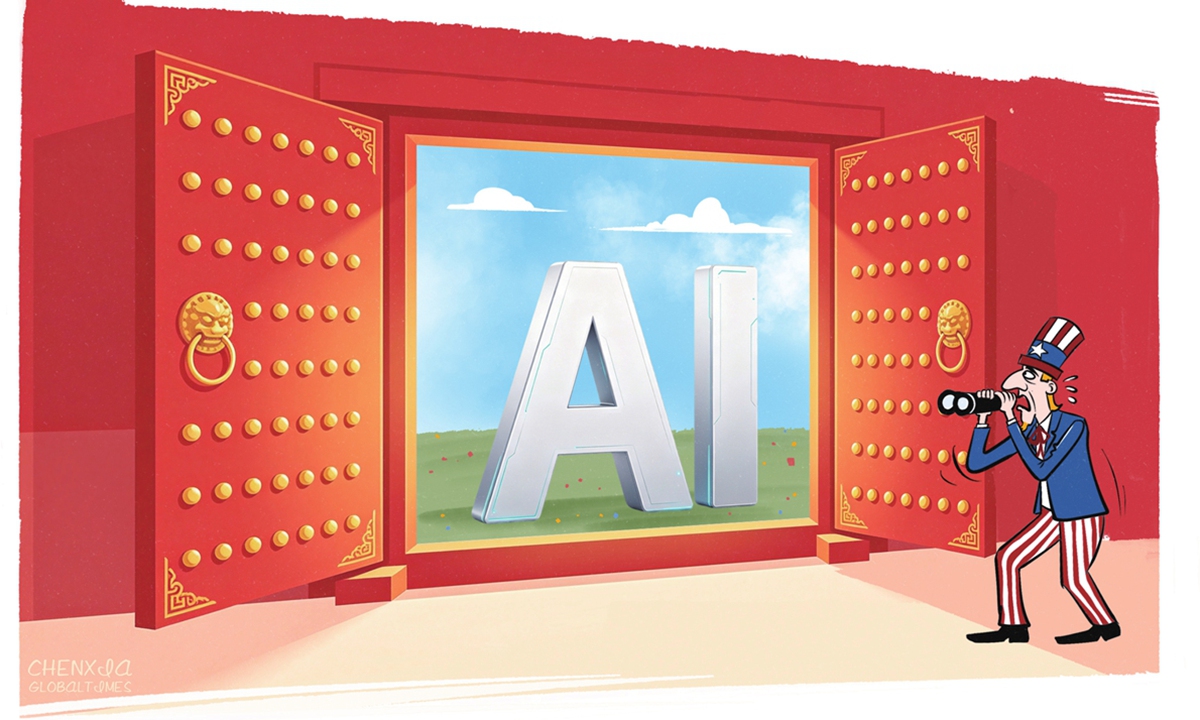
Illustration: Chen Xia/GT
The divide between "nuclear energy" and "nuclear weapons" reflects the different paths China and the US have taken in AI development, which ultimately stem from fundamentally different ways of thinking. History shows that an exclusive, zero-sum mind-set is ultimately unsustainable. The US' technology restrictions have failed to contain China's progress, while leaving Washington caught in a dilemma: easing restrictions risks strengthening a competitor, yet closing itself off risks international isolation.
Recently, discussions surrounding the China-US artificial intelligence (AI) competition have been heating up around the world. A commentary article recently published by The New York Times said the US views cutting-edge AI as "nuclear weapons" - a force with "an immensely destructive form of power that requires a careful and jealous watch" - while China treats AI more like "nuclear energy," a "lower-risk technology" that can be "shared and commercialized." This is an interesting analogy. Although it may not be entirely precise, it still captures the differences between China and the US in their approaches to AI in terms of security, development, governance and their broader visions of the world.
Viewing AI as "nuclear weapons" essentially places technology entirely within the framework of geopolitical confrontation. Some people in the US and other Western countries believe that advanced AI will give those who control it overwhelming advantages in military, economic and intelligence capabilities. Therefore, they argue that the US must maintain its lead at all costs, strictly prevent the outflow of technology, and treat any potential competitor seeking to catch up as a threat to be contained. This technological Cold War mentality has driven Washington's export controls on advanced chips, repeated tightening of access to frontier AI models, and growing suspicion - or even hostility - toward open-source ecosystems.
However, the most dangerous aspect of the "nuclear weapons" analogy lies in its exclusivity. It assumes that security can only be achieved through technological monopoly, that another country's advancement necessarily means one's own loss, and that the ultimate form of technological competition is for one side to completely defeat the other. Such zero-sum logic once maintained a balance of terror during the nuclear age, but in the AI era, the speed of technological diffusion far exceeds that of nuclear technology. AI models can be replicated and retrained at relatively low cost. Trying to manage AI with Cold War-era thinking will only push the world toward greater division and confrontation.
By contrast, viewing AI as "nuclear energy" represents a different vision of development. Nuclear energy carries enormous risks, but humanity has not abandoned it; instead, it has chosen to manage those risks through international standards, technological cooperation and safety regulation, turning it into a usable source of clean energy. China's understanding of AI is similar: technology itself is neutral, and risks depend on how it is used. The most effective way to manage risks is not to build an "iron curtain" around technology, but to encourage broader participation in governance, make technologies more transparent and subject to scrutiny, and allow rules to evolve through wider application and practice.
For this reason, China has consistently sought to serve as a provider of international public goods in the field of AI, emphasizing that AI development should not be a solo performance by any single country, but rather a symphony of global cooperation. Behind this position lies a clear understanding of how technological progress works: monopolies may preserve a short-term advantage, but only openness can sustain long-term innovation. The decision by Chinese models such as Kimi K3 to embrace open source is not because China fails to recognize the strategic value of technology. On the contrary, it is precisely because China understands that the true power of technology lies in being used and improved by more people, while enabling more people to benefit from it.
At its core, the divergence between these two approaches stems from fundamentally different ways of thinking. One side views AI as a strategic asset to be monopolized and a tool for geopolitical competition. The other sees it as a public good that should be shared and used for the benefit of all humanity, advocating shared security through cooperation, openness in development, and multilateral governance. It is this fundamental difference in perspective that has led China and the US down sharply different paths on AI. History shows that an exclusive, zero-sum mind-set is ultimately unsustainable. The US' technology restrictions have failed to contain China's progress, while leaving Washington caught in a dilemma: easing restrictions risks strengthening a competitor, yet closing itself off risks international isolation. Meanwhile, China's open-source AI models have quietly become part of the forefront of global AI research and industrial development. This reflects the inherent ecological advantage that open systems enjoy over closed ones.
This contrast has also prompted a growing number of Western elites to reflect on whether they had misjudged China. They once dismissed China's embrace of open source as merely a tactical expedient. Yet DeepSeek, Kimi, and a growing lineup of Chinese foundation models continue to be released as open source for the global community. They also assumed China was incapable of producing genuine innovation. Yet a growing number of AI talents trained in China are making their mark at the world's leading universities, research institutions, and technology companies. Faced with this reality, it is no surprise that media outlets such as Switzerland's Neue Zurcher Zeitung have called on the West to wake up and take China seriously.
So how should China and the US, as the world's two leading powers, approach AI in a way that truly benefits humanity? China does not deny that AI poses risks. On the contrary, it stresses the importance of strengthening risk awareness and ensuring AI remains safe and controllable. But managing risk does not mean setting up a new "Iron Curtain." A truly responsible approach is to uphold a people-centered vision that ensures AI is developed for the common good, making it a powerful engine for shared prosperity and common security. China has already demonstrated this commitment through concrete actions. It hopes the US can also move beyond its "nuclear weapons" mentality and join the rest of the world in embracing openness and cooperation.
RELATED ARTICLES