IN-DEPTH / IN-DEPTH
At Long March starting place, a young guide keeps alive the revolutionary spirit of pioneers from the ‘Red Army village’
Pines still stand tall
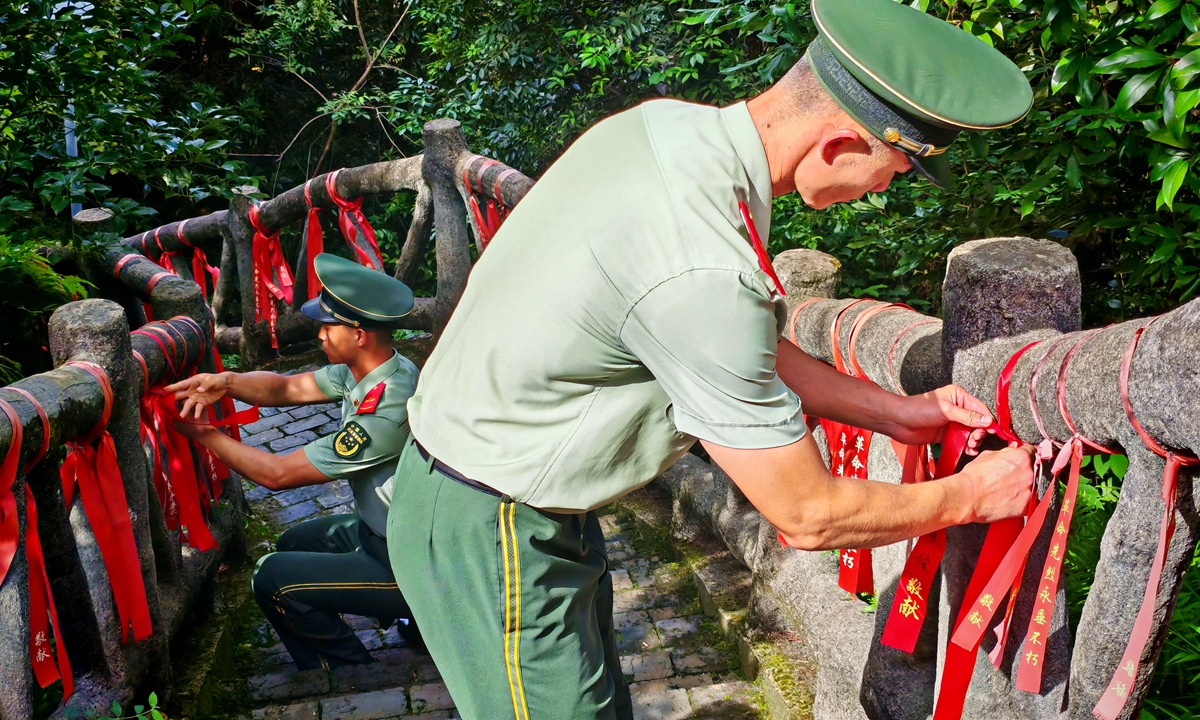
Two Armed Police officers from the Ruijin squadron tie red silk ribbons on the handrails of a hill path behind Huawu village to pay tribute to the revolutionary martyrs on July 9, 2026. Photo: Liang Rui/GT
Editor's Note:
The Long March was a military maneuver carried out by the Red Army (forerunner of the People's Liberation Army) from 1934 to 1936 that laid the foundation for the eventual victory of the Communist Party of China (CPC).
This epic feat in human history gave rise to the enduring Long March spirit - a priceless source of inspiration for the Chinese nation. It embodies unwavering commitment to the fundamental interests of the Chinese people and the nation, steadfast ideals and convictions, courage in the face of overwhelming hardships, independence and a pragmatic approach to solving problems, strict discipline and unity, and a deep reliance on the people. The Long March spirit is an essential component of the CPC's revolutionary heritage and broader spiritual lineage. It has become deeply woven into the fabric of the Chinese nation and continues to inspire generations of Chinese people to overcome challenges and strive for new victories.
Each generation has its own "long march," and they should proceed in their own way.
The year 2026 marks the 90th anniversary of the victory of the Long March. To explore its historical significance and enduring relevance, the Global Times launches the series "Journey: when post-90s meets 90th anniversary." Through personal memories, the descendants of Long March veterans reflect on the original ideals of the marchers and pose questions to today's youth. The post-90s respond with their own stories tied to the Long March spirit.
The first installment focuses on Huawu village in Ganzhou city, Jiangxi Province, the departure point of the Long March, where 17 young men planted pine trees in 1934 before heading to war. Through the stories of a post-90s volunteer guide, a 90-year-old descendant, and the Chinese People's Armed Police Force Ruijin squadron's 77-year red tradition, the article shows how the Long March spirit endures in this revolutionary base.
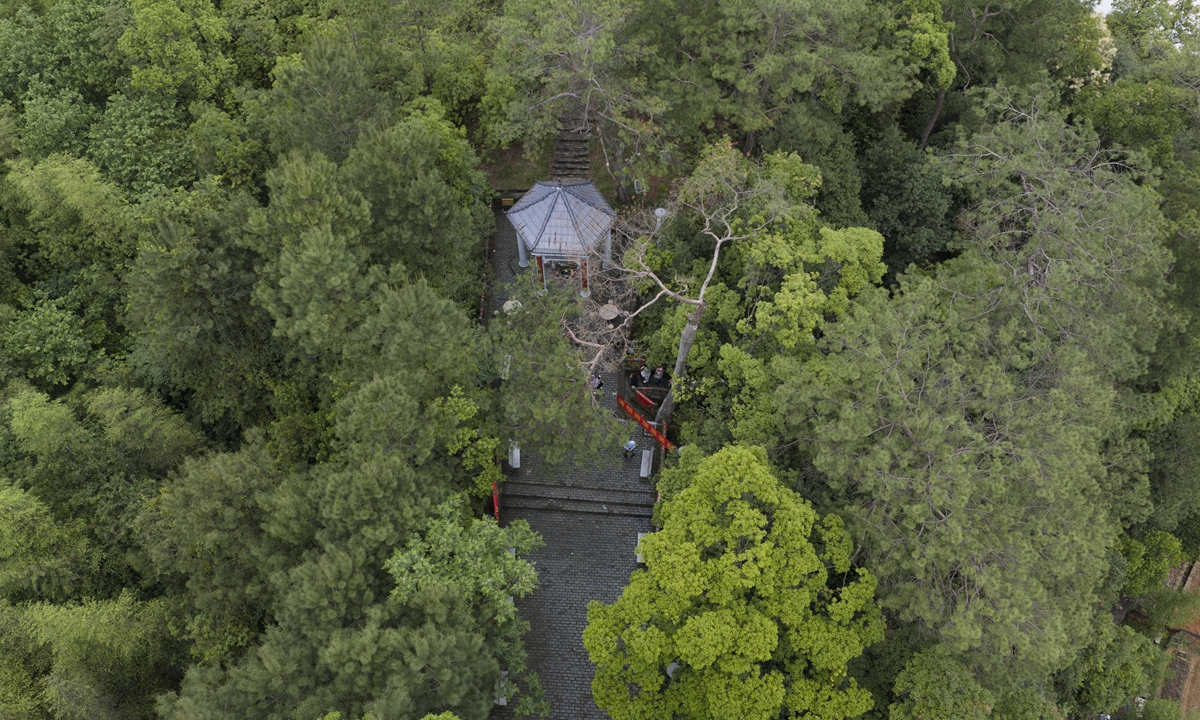
An aerial view of pine trees planted on the hill behind Huawu village Photo: Courtesy of Xu Shucan
"In 1934, Huawu village, home to only 43 households, devoted all its manpower and material resources to support the revolution. Seventeen passionate young men answered the call to expand the Red Army. They resolutely bid farewell to their hometown and marched toward the battlefield of the Long March."
Cui Liguang, a post-90s soldier with the Ruijin squadron of the Chinese People's Armed Police Force's Ganzhou detachment, serves as a voluntary red tour guide. He emotionally recounted these glorious yet arduous years while the squadron was organizing officers and soldiers to visit Huawu for on-site teaching.
"On the eve of their departure, they collectively planted pine trees on the hill behind the village, using the green pines to declare their aspirations and pledging their original mission to the nation," Cui told the Global Times.
The 17 pine saplings have now grown into towering trees. But all 17 brave warriors sacrificed their lives along the Long March route.
The forerunner of the People's Republic of China, the Provisional Central Government of the Chinese Soviet Republic, was founded in Ruijin in 1931. Ruijin, located at the junction of East China's Jiangxi Province and East China's Fujian Province, is known as the "red capital" and the "cradle of the republic," as well as the departure point of the Central Red Army's Long March, according to the Xinhua News Agency.
And Huawu, widely known as the "Red Army village," has become a spiritual pilgrimage site for people from all walks of life because of the heroic stories behind these pine trees. How have the seeds of ideal conviction and the genes of red tradition been passed down from generation to generation in Ruijin? The Global Times reporter came here to explore the answer to this question.
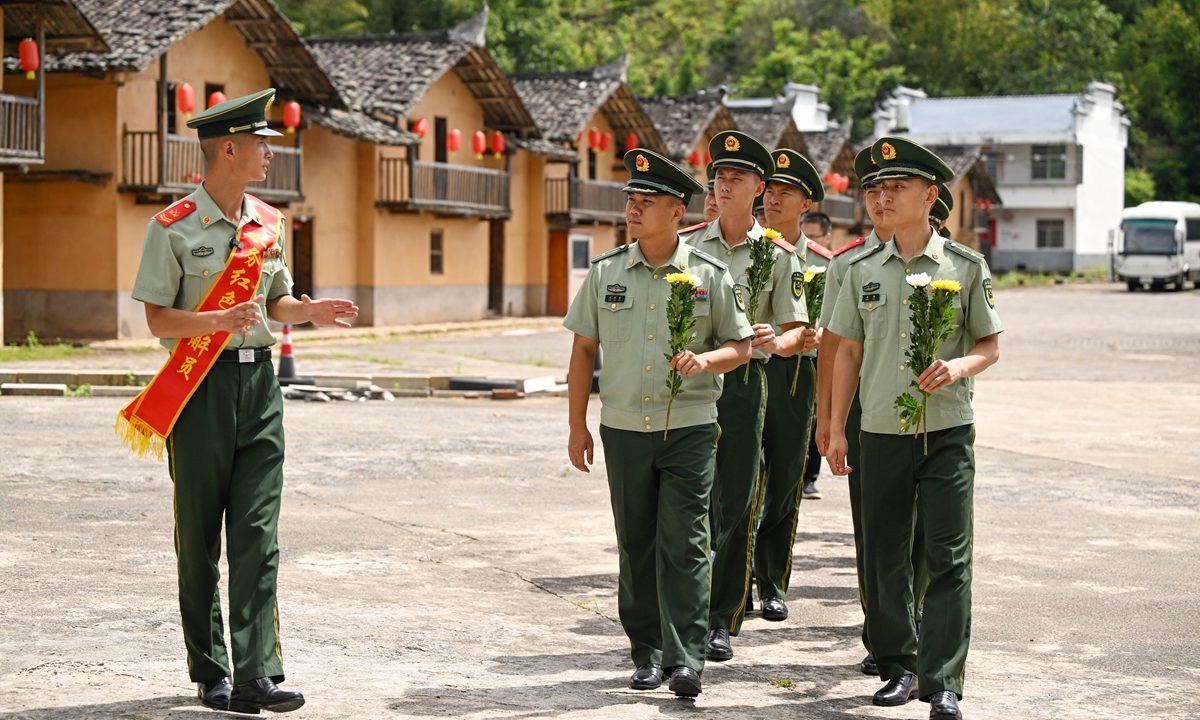
Cui Liguang, a post-90s soldier with the Ruijin squadron, explains the story of the 17 pine trees to officers and soldiers in Huawu village on July 6, 2026. Photo: Courtesy of Xu Wei
Newly grown pine tree
Initially, Cui never thought about becoming a red tour guide.
When this young soldier first arrived at the Ruijin squadron in 2018, he had only one thought on his mind: improve his military skills. At that time, in his view, running fast and shooting accurately were the complete proof of being a good soldier.
"I was too hard on myself - pushing for extreme strictness and constant tension in my squad," Cui told the Global Times.
"The squadron leader noticed my state of mind, talked with me and encouraged me to learn how to give explanations at the local red tourism sites," Cui said. "I felt it wasn't suitable for me."
When Cui first followed the veteran guide to study at various historical sites, he would always find excuses to slip away and rest in the pavilion. The veteran guide did not criticize him. Instead, in the pavilion, he shared his own story - from a soldier who spoke unclearly to becoming the squadron's top red tour guide, and then willingly transferring to the cooking squad to prepare meals for his comrades.
Cui was touched by these stories, so he decided to give it a try. Through practice, his mindset shifted further.
Early on, once while at the Shazhouba scenic area, he explained to tourists the story of Mao Zedong leading soldiers and civilians to dig the well. Halfway through, a tourist asked, "Why did Chairman Mao choose to work in Shazhouba at that time? Where did the other leaders live?" Cui was momentarily speechless. Seeing the slight disappointment in the tourist's eyes, his face burned with embarrassment.
From then on, he made up his mind. He devoured books, visited old sites and consulted experts, filling thick notebooks. As his knowledge deepened, so did his understanding.
Among all the stories he encountered, none left a stronger impression than that of Hua Chongyi from Huawu. Hua Chongyi set out on the Long March at age 13 - the youngest among the 17 young men from Huawu. Two years later, news of his sacrifice arrived; he never returned.
"I was just starting junior high at age 13. I can hardly imagine how much determination and inner struggle it would have taken for me at that age to pick up a gun and fight the enemy," he said.
He gradually realized that historical facts alone could not fully convey the meaning of the Long March. What truly touched people was the spirit behind those stories, the ideals that enabled ordinary young people to make extraordinary choices.
Today, many fellow soldiers say his tours no longer simply recount historical events; they bring history to life by connecting personal stories with the enduring values they represent.
Through years of practice, Cui also came to understand why his squadron commander had encouraged him to become a guide in the first place.
"The Long March spirit is not something that belongs only to history," he said. "Guarding the people, fulfilling our duties and staying true to our original aspiration are how we continue that journey."
At the many red sites in Ruijin, voluntary red tour guides like Cui are active, standing like newly planted green pines on the sentry posts of the new era.
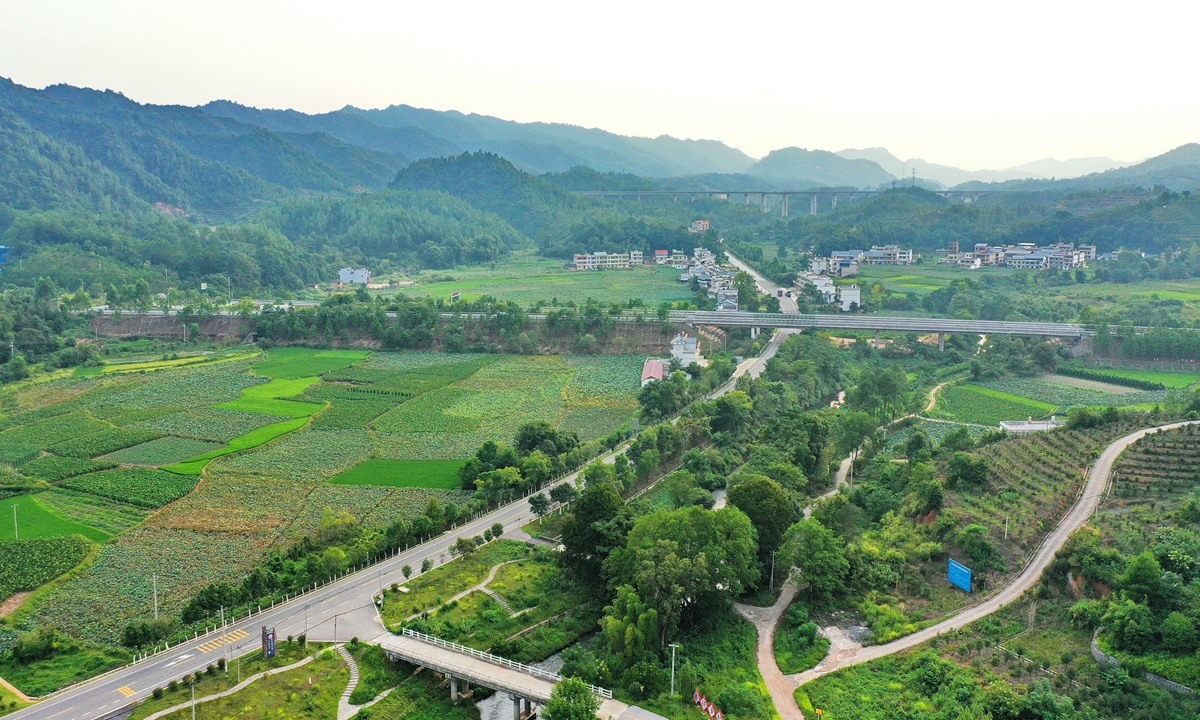
An aerial view of Huawu village in Ruijin, Jiangxi Province Photo:VCG
Dialogue across generations
Today, only a handful of descendants of the 17 young men who left Huawu for the Long March still live in the village. Most are now well into their nineties. Whenever Cui visits them, he finds himself wondering the same question: What do they think when they compare the hardships of their youth with the peaceful and prosperous life people enjoy today?
Ninety-year-old Hua Picai often stops for a long time in front of a sturdy green pine halfway up the hill behind Huawu. On the stone tablet at the base of the tree is inscribed: "Hua Taosheng, born in 1917, joined the Red Army at age 14. In October 1934, he followed the main force on the Long March and sacrificed his life en route."
Although not his biological father, Hua Taosheng became Hua Picai's father under the Hakka tradition of continuing the family line of a fallen relative.
The Global Times learned from Hua Picai that his biological father often used to tell him that when the Kuomintang forces pressed men into service, everyone hid. But when the Red Army arrived, young people volunteered to enlist. "I've also heard this story many times," Hua Sheng, Hua Picai's son and the Party chief of Huawu village, told the Global Times. "I came to see the CPC as the people who stood closest to ordinary families."
Every Qingming Festival - a traditional Chinese occasion for honoring ancestors and paying tribute to the dead - Hua Sheng, Hua Picai and the villagers hang red paper, light red candles and tie red silk under the trees. This faith, soaked into their bloodline, led Hua Sheng to aspire to join the CPC from a young age.
When asked what he would say if those young men who planted the pine trees could return today, Hua Picai replied: "On behalf of my father and myself, I would like to tell them: We joined the revolution so that future generations could live better lives. Today, that wish has come true."
For Hua Picai, however, the conversation with history does not end there. What matters most is whether younger generations can carry forward the qualities that sustained their predecessors - perseverance, self-discipline, integrity and a willingness to put others before themselves.
Collective inheritance
As a living testament to this city's revolutionary spirit, the Ruijin squadron has provided its answer through 77 years of unwavering action.
According to the squadron, the 129 revolutionary sites in Ruijin serve as the most vivid teaching materials for the squadron's education and an inexhaustible treasure trove of spiritual wealth for officers and soldiers. For every new recruit, the first sip of water is from the well in Shazhouba, and the first class is a micro-lecture on the Long March spirit.
On July 1, the 105th anniversary of the founding of the CPC, the squadron camp was bustling. The squadron's Party branch was commended by the Central Military Commission as an advanced grassroots Party organization.
However, during a celebration meeting organized that afternoon, squadron leader Liu Zhenxing "poured cold water" on the expectant soldiers. "We cannot just see achievements. Only by foreseeing and solving 'potential problems' can we maintain our advanced nature forever."
At Liu's initiative, the celebration meeting became a meeting to expose shortcomings and reveal flaws. Everyone stood up to point out problems and offer suggestions for the squadron.
They carry forward the fine tradition of their predecessors of widely soliciting opinions and mass supervision, insisting on handling sensitive matters fairly, justly and transparently, and integrating mass supervision throughout the entire cycle of daily management, training, duty performance and logistical support, according to the squadron.
They have also regularly completed tasks such as security duty and flood relief. Many officers and soldiers have stepped forward to provide emergency aid to people with accidental injuries or sudden illnesses. Local residents have praised them, saying, "That same team from back then is still here."
"Ninety-plus years have passed. Today, we in Huawu live happy lives. If our predecessors are watching, I am sure they are delighted that their spirit has been passed down from generation to generation. I believe it will continue to be passed on, one generation after another," said Hua Sheng.
Cui has transformed from the reckless newcomer who led his squad without regard for consequences into a mature young man who calmly thinks through difficulties.
"It is red history that has tempered my character. The Long March spirit is the entrepreneurial history of our Party. It is like a lighthouse, illuminating us young people," Cui said.
RELATED ARTICLES