IN-DEPTH / IN-DEPTH
Immersive ‘red tourism’ with emotional resonance redefines history connection on Long March’s 90th anniversary
Charging into history

Tourists participate in the immersive experience activity "follow the commander to attack the county town" at a red tourism area in Yinan County, Linyi, East China's Shandong Province. Photo: Courtesy of Yan Jisuo
At 11:30 am, the valley at Loushan Pass echoes with the sharp sound of a bugle charge.
Battle flags whip in the wind as over 100 actors storm out of the trenches, followed by tourists in unified gray-blue Red Army uniforms, shouting as they rush up the slope. Gunfire and explosions erupt continuously, filling the air with the acrid smell of smoke grenades.
Chen Muyang, a 30-year-old visitor, suddenly felt a lump in her throat as she was running. Not from fear, but from a thought flashing through her mind: "This is exactly how the Red Army charged back then, except they had no smoke effects. For them, it was all real."
This is a daily scene at the Loushan Pass scenic area in Zunyi, Southwest China's Guizhou Province. The immersive experience project "follow the commander to attack Loushan Pass" recreates the smoky battlefield of how the Red Army secured an important victory in 1935 during the Long March. Visitors don military uniforms and immerse themselves in history under the guidance of non-player characters.
According to the China Military, the official news website of the Chinese People's Liberation Army, the battle of Loushan Pass was the Red Army's first major victory during the Long March. In 2026, marking the 90th anniversary of the Long March victory, this project unexpectedly became a viral hit on Chinese social media platforms. On short-video platform Douyin, videos of tourists charging uphill routinely garner tens of thousands of likes.
In China, "red tourism" is now shifting away from static visits like reading panels and listening to lectures toward "immersive theater." Some netizens even call these projects "the most suitable cosplay for Chinese people."
Across the country, new red tourism experiences centered on participation and emotional resonance are redefining how people connect with history, some scenic area managers told the Global Times.
'I was part of history'
"Knives out!" This was the caption on a highly popular Douyin video of the Loushan Pass project that Chen came across.
In the video, gunfire thundered and smoke filled the air as tourists charged up the hill with rifles. Inspired by the passionate atmosphere, Chen immediately decided to drive from Chongqing to experience it herself.
After watching the performance from a viewing platform, Chen entered the scenic area, changed into a military uniform, adjusted her cap and received a prop rifle. "The gun was heavier than I expected," she told the Global Times. "The atmosphere hit me instantly."
The real immersion began when the "commander" appeared. An actor playing a Red Army officer stood before the formation, first explaining the safety rules and the itinerary in detail. Then, as other actors delivered rousing pre-battle speeches in authentic dialects, all of the visitors listened intently.
As the group advanced along the mountain path, the first "blockade line" suddenly appeared. Fireworks and explosions erupted, with deafening gunfire coming from all directions. Visitors instinctively ducked and followed the commander's orders to push through quickly. After breaking through, the team continued along the trail. Publicity teams with clappers appeared along the roadside, chanting rhythmic verses to boost morale.
Chen said the walk wasn't tiring, but the tension kept building. "You knew a 'battle' was coming, but you didn't know when. The anticipation was agonizing."
The real fight then began. Visitors were split into two groups and led along different routes into the battlefield. Gunfire intensified, explosions detonated near their feet and thick smoke made it hard to see.
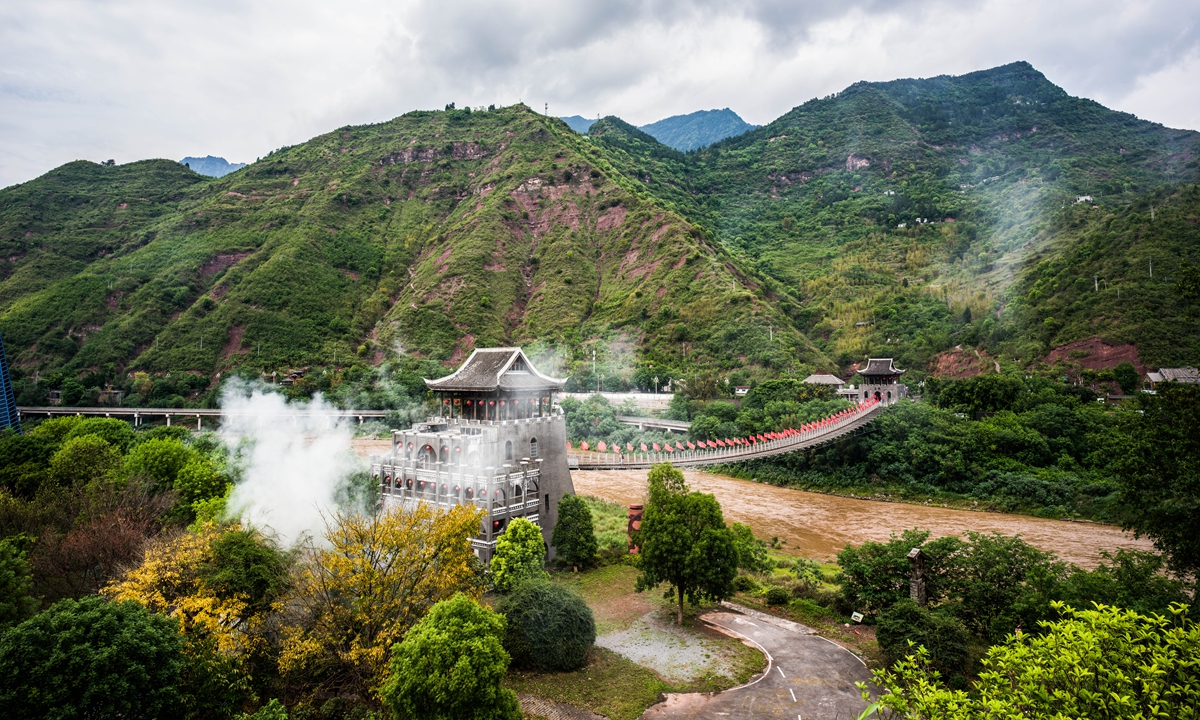
A view of the Tucheng Ancient Town in Zunyi, Southwest China's Guizhou Province, where numerous revolutionary sites are preserved Photo: VCG
Halfway up the slope, Chen gasped for breath. Leaning against a rock and watching others push on, a thought struck her: "We're already this exhausted under modern conditions. Carrying rifles, wearing straw sandals and starving, how did the Red Army do it?"
That thought pierced her heart.
Finally, amid earth-shaking battle cries, the team captured the "enemy" position at Loushan Pass. Actors playing captured warlord soldiers were escorted out, and the visitors erupted in cheers. Loushan Pass has been taken.
Chen said the 40-minute experience was more unforgettable than any history book she had read.
"In school, the Long March spirit felt distant, just an exam point. But that afternoon in the valley, I felt I was part of history, close to the people whose names are in our textbooks," Chen said.
Thousands of visitors like Chen come every day during peak season. Yao Dihua, operations director of the company managing the scenic area, told the Global Times that participants include young people from other cities, parents with children, nostalgic middle-aged and elderly visitors, and corporate team-building groups.
According to Yao, the scenic area also offers other immersive Long March experiences. Visitors put on Red Army uniforms, shoulder rifles and retrace the grueling route: breaking through the first blockade line by blasting bunkers, crossing mountains, ambushing enemy sentries and breaking through heavy fire outside Zunyi to achieve victory, all while embodying the spirit of unity, mutual assistance and fearlessness in the face of hardship.
Additional activities include cooking Red Army-style meals over open fires and making traditional straw sandals. Once essential footwear during the Long March, straw sandals symbolize the unity between the military and civilians, as well as the resilience of ordinary people supporting the revolution. By handcrafting a pair themselves, visitors personally connect with this revolutionary legacy and help pass on the "straw sandal spirit" to future generations, Yao said.
Product speaks to the times
Yao noted that his team had been experimenting with immersive formats for 20 years, but audience interest was low back then. In recent years, as social trends shifted, people of all ages have become more open to such experiences.
In Zunyi, a former revolutionary base, immersive experiences now let visitors engage with history in a more direct and profound way.
Policy support is also strengthening. In March, the General Office of the Communist Party of China Central Committee and General Office of the State Council issued opinions on revitalizing old revolutionary bases, encouraging integrated cultural-tourism development, cross-regional collaboration, premium routes and improved infrastructure.
Yao said that in the traditional red tourism, many young people enter memorial halls and don't know how to connect with the exhibits. Knowledge is objective, but emotion is subjective. You can't force someone to feel moved.
What if visitors become the extras? The "follow the commander to attack Loushan Pass" originally focused on watching large-scale performances. After adding immersive elements in May 2025, it quickly became a phenomenon, exploding in popularity in 2026, Yao said.
"Key design elements include strong ritual, high-density sensory stimulation, and the power of collective action. These precisely address contemporary needs: authentic physical experiences to counter digital virtuality, and the desire to be emotionally drawn into history rather than be lectured," said Yao.
Similar immersive experiences are also emerging across the country. In Ganzhou, East China's Jiangxi Province, a large-scale red cultural tourism epic about stories of the Long March starting point has been performed over 619 times, attracting more than 338,500 viewers, according to the Ganzhou radio and television station. In Honghu, Central China's Hubei Province, an immersive project has transformed 81 revolutionary historical sites into a vast open-air theater without walls, according to the Jingzhou Daily.
In Linyi, East China's Shandong Province, a similar "follow the commander to attack the county town" experience reenacting the Chinese People's War of Resistance Against Japanese Aggression has also gone viral.
According to Yan Jisuo, deputy general manager of Linyi tourist attraction, most visitors are young people or families with children. Some foreign tourists have also taken part. "We occasionally see interpreters assisting them. Although they may not fully grasp every detail, they generally understand the storyline and have given positive feedback," Yan told the Global Times.
Yan added that despite the activity's high physical demands, elderly tourists, including one visitor in a wheelchair, have also actively participated.
"We previously received a 90-year-old veteran from Southwest China's Sichuan Province, who is our oldest participant to date," Yan said. "He fought in the War to Resist US Aggression and Aid Korea (1950-1953) and spoke highly of our project. He said, 'You have done an excellent job. Young people today need to experience this so that they understand the sacrifices made during wartime.'"
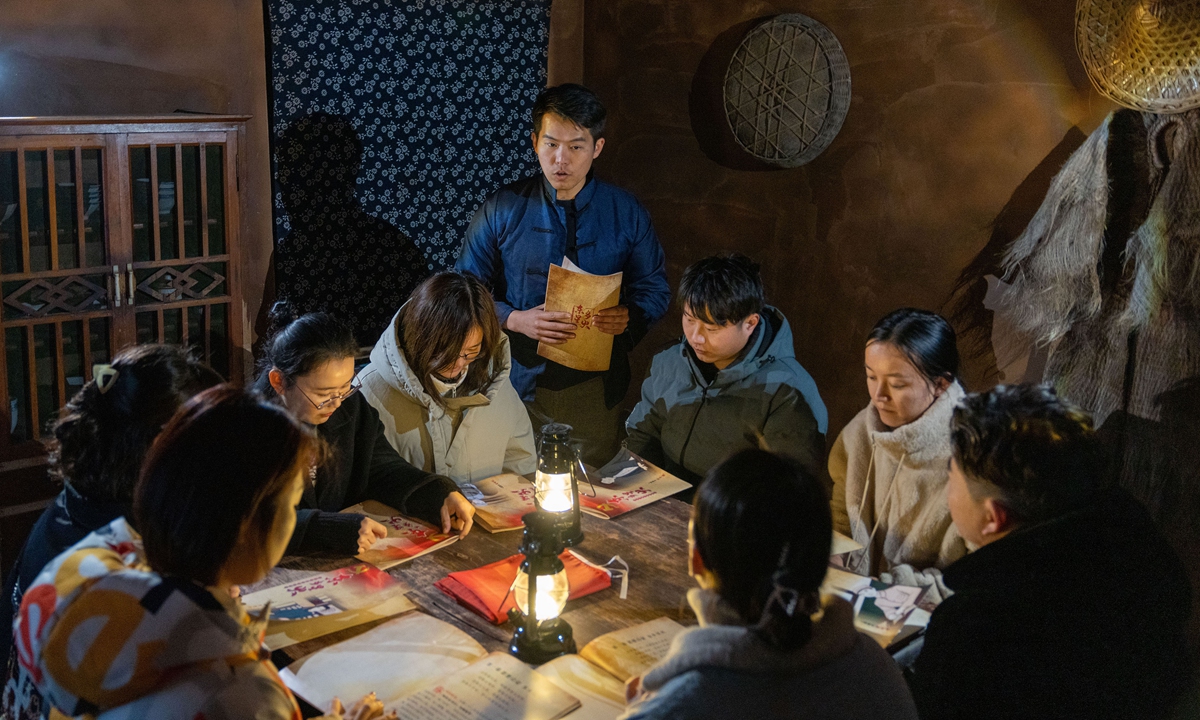
People experience an immersive red-themed activity "Jubensha" at a red tourism attraction in Feidong County, Hefei, East China's Anhui Province. Photo: VCG
Balancing entertainment and serious education
Despite widespread acclaim, some have expressed concern that entertainment elements might undermine the solemnity of revolutionary history. Yan explained that, leveraging the region's rich revolutionary cultural heritage and its advantages as a film and television production base, their professional team has ensured the historical accuracy of both the storylines and the special effects.
Yan noted that the tourist area is located in Yinan County, one of the important birthplaces of revolutionary spirit, and has been a classic red tourism destination for 16 years. Many anti-war films and TV productions have been filmed on site.
"Between immersive experiences and solemn history, we have our own principles to maintain the right balance," Yao said.
When updating the project, the team spent considerable time on historical research, verifying the routes of the charges, the organization of the Red Army units, the enemy's firepower deployment and even the details of uniforms, all in an effort to achieve historical accuracy. For live combat performances, over 100 real guns and artillery pieces used during that era are employed. Each performance fires more than 500 rounds of ammunition and over 100 shells, with a cast of more than 200 people.
Yao also noted that the scenic area has created over 130 local jobs, 35 of which went to impoverished households, with more than 500 performances held annually. He believes this represents a form of passing on the red spirit that also benefits the people.
These immersive red tourism projects continue to evolve. Yao revealed that in celebration of the 90th anniversary of the victory of the Long March, the scenic area will plan special events, including enhanced visual effects for battle scenes, expanded cultural interaction and more photo-worthy installations.
"Our ultimate goal remains to let visitors feel, through the experience, that this is not a game, it is a chapter of history worth remembering," Yao said.
Every day, gunfire echoes through Loushan Pass valley. New groups of visitors don props, join the ranks and follow the "commander" through the smoke-filled "battlefield."
"I think the deepest value of immersive red experiences is that they allow everyone to become a 'feeler of history.' And feeling is often the first step toward true understanding. This approach is making better red education possible," Chen said.
RELATED ARTICLES