Yet after "losing vision," a Global Times reporter found that even familiar smells became strangely elusive.
Jasmine, red dates… Scents once instantly recognizable at that moment hovered on the tip of the tongue, unnamed.
This is not a real cafe, but a simulated one inside the Guangming Experience Hall in Ji'nan, East China's Shandong Province - a space designed to immerse visitors in life without sight.
Guangming literally means "light" or "promising" in Chinese, among others.
The hall has drawn widespread attention across Chinese social media platforms lately. Spread across 600 square meters, it features 12 carefully designed scenarios. Guided by trained facilitators, each group of visitors completes everyday "tasks" entirely without vision - from identifying food to recognizing carved characters.
By 2023, China had a total of 85.914 million people living with disabilities, accounting for 6.34 percent of the population, including more than 17 million people with visual impairments, according to the latest data cited by the Xinhua News Agency.
In recent years, media reports have suggested that China's efforts to support the visually impaired have gone beyond policy frameworks and smart-device development. Increasingly, attention has also been placed on human-centered initiatives - programs that foster dignity, participation, and emotional understanding, rather than focusing solely on material assistance.
As part of this broader landscape, grass-roots initiatives like the Guangming Experience Hall represent a form of "reverse experience," inviting sighted people to step briefly into the world of people living with disabilities. By replacing observation with participation, these efforts aim to build a more immediate and lasting bridge of empathy.
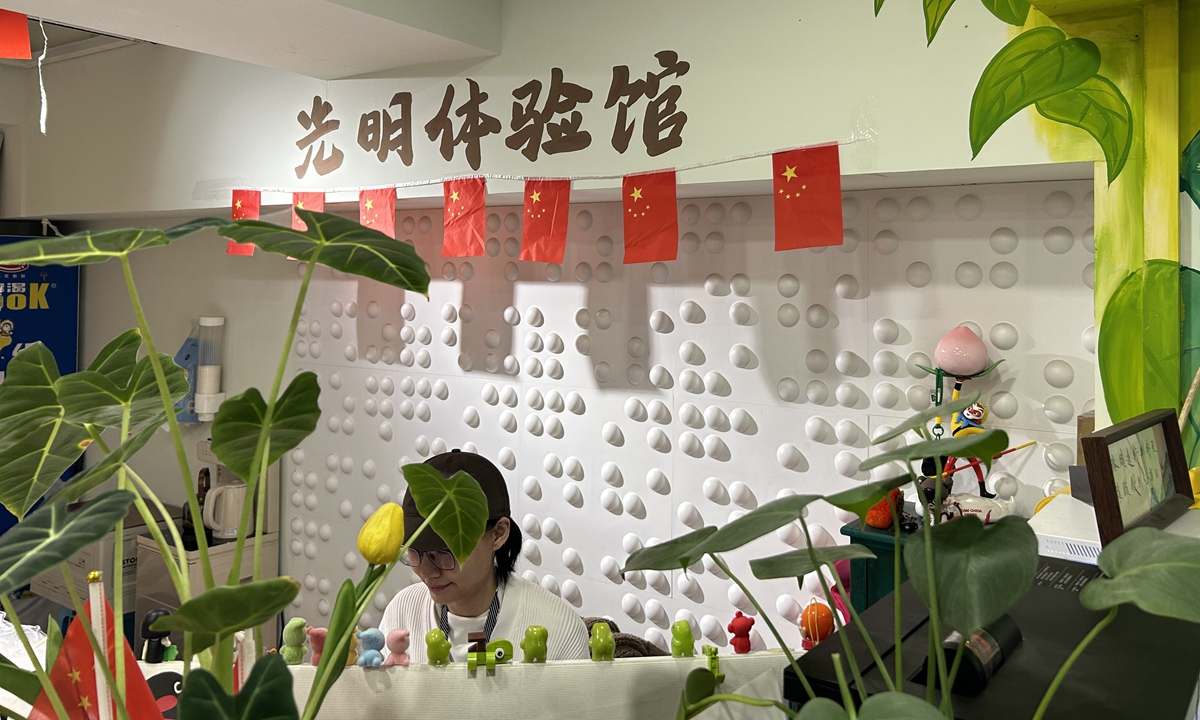
Picture taken on January 2, 2026 shows the reception area of the Guangming Experience Hall. The background wall is decorated with Braille dot-pattern designs. Photos: Liang Rui/GT
Losing sight, losing certainty
"Everyone lives a different life and stands at a different point along their journey," Liu said in her opening remarks. "Trust me, I'll bring you something unexpected."
With that being said, a one-hour journey into darkness began.
Once inside the curtained space - meticulously light-proofed - everything went black. Only the faint red dots of ceiling-mounted cameras reminded the eight participants, including the Global Times reporter, that they were still being watched over, and that this blindness was temporary.
Each participant was given a white cane and instructed to rely on it to detect obstacles. Although reassured that there were no dangerous or frightening elements, the reporter found herself instinctively bending forward in the first few minutes, gripping the cane tightly and sweeping it wider than instructed, as if exaggerated movement could create a sense of safety in a world without visual anchors.
The scenes shifted continuously: Riding the subway, grocery shopping, sitting in a cafe…
One setting stood out - a simulated "tourist attraction." Narrow winding alleys from Ji'nan's old city, a small bridge over a lotus pond, and a pavilion centered around an engraved stone stele. These spaces shared a defining feature: No tactile paving, due to their design.
What would normally be leisurely and enjoyable became disorienting. Visitors stumbled forward, tracing handrails, walls, and benches, inching their way through the environment.
"I never imagined I could get stuck inside a pavilion," a woman said with a nervous laugh.
Through it all, Liu moved with ease, constantly attentive to everyone's condition.
"You're incredibly skilled," one male participant remarked. "Even in total darkness you move so confidently. Are you wearing high-tech glasses? Can I try them when we go outside later?"

Liu Suwei, a 25-year-old guide at the Guangming Experience Hall Photos: Liang Rui/GT
Only after exiting did the group learn the truth: Liu herself is visually impaired. That hour-long experience was simply her everyday life.
"My vision problems started when I was in the third grade," Liu told the Global Times. "I was sitting in the front row when I realized I could no longer clearly see characters I used to recognize."
After examinations in Beijing, she was diagnosed with macular degeneration.
The condition causes central vision loss, while peripheral vision becomes blurred and distorted. Over time, vision gradually deteriorates and may eventually lead to complete blindness.
After her diagnosis, Liu continued attending mainstream schools. By 2021, however, her vision had declined rapidly, making it difficult to continue working in the education sector she had trained for. She spent over a year at home and obtained a disability certificate.
In 2023, accompanied by her father, she attended a job fair and applied to become a guide at the Guangming Experience Hall.
During the experience, Liu's awareness of participants' movements relied entirely on what she calls "senses beyond sight."
"In the subway scene, I knew a man had mistaken a seat for a step and climbed onto it," she explained. "I could tell because the sound source suddenly became higher."
The center currently employs six guides, all with varying degrees of visual impairment: One with Level I impairment, two with Level II, and three with Level III.
"They may not be able to see the world," a public-service video playing at the exit of the hall announced, "but they hope the world can see them."
"I believe that stepping closer - truly experiencing their world - can bring about change," Huang Lei, founder of the Guangming Experience Hall, told the Global Times.
A family member's loss of sight planted the seed for his decision to create the space.
"Honestly, it hasn't been easy," Huang admitted. "We revised the experience routes more than 100 times to ensure safety and meaningful engagement for visitors of different ages, genders, and heights. Finding the right partners and guides, and balancing public welfare with sustainability, these are constant challenges."
Encouraging feedback, however, has kept the team going.
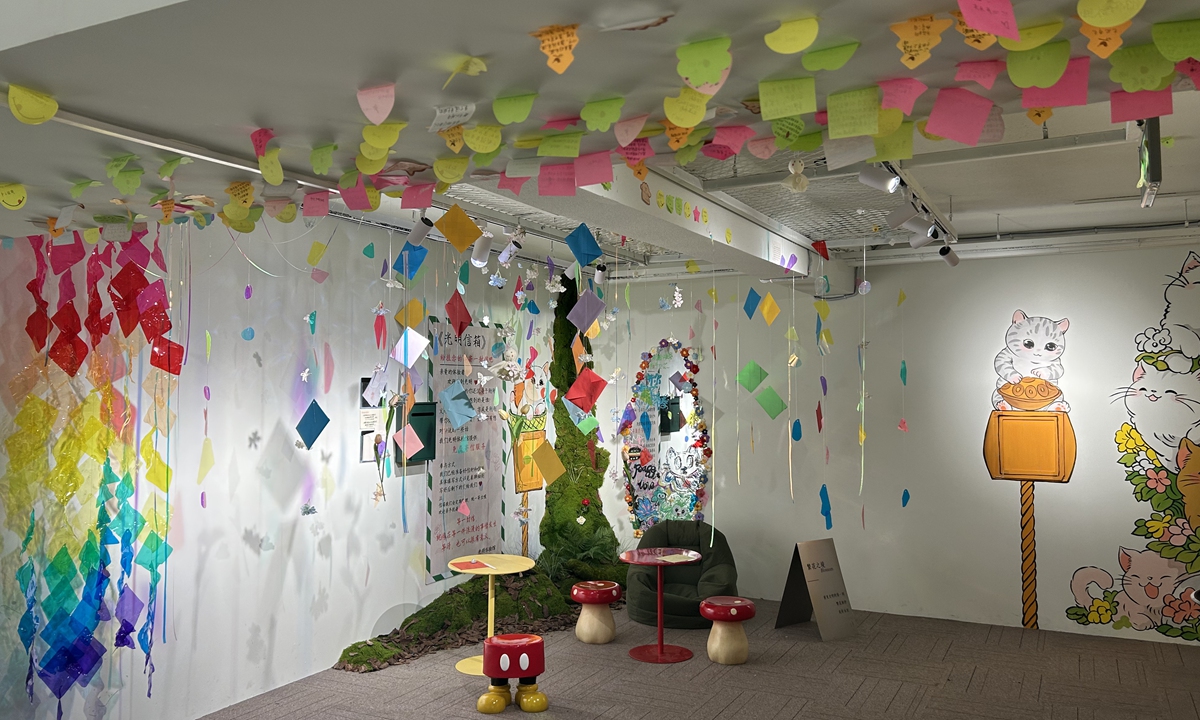
A picture taken on January 2, 2026 shows that stationery and envelopes are available at a corner of the Guangming Experience Hall for visitors to record their experiences. Photos: Liang Rui/GT
Conversing with 'them'
One particularly memorable moment for Liu involved a senior high school girl who barely spoke during the experience. When she learned afterward that Liu was visually impaired, the girl broke down in tears.
"She told me about her academic pressure, strict parents, and loneliness at school," Liu recalled. "She said the experience made her realize that being able to see her family, her friends, and the beauty of the world is already a form of happiness."
For Zhang Yanyan, co-founder and first sighted staff member at the hall, working alongside the guides has reshaped her understanding as well.
One day, tasked with escorting three guides onto a crowded bus, Zhang informed the driver loudly that they were visually impaired. Passengers immediately stood to offer seats, and the driver promised to remind them when it was time to get off.
"At first, I thought everyone was so kind," Zhang said. "But later, the guides told me they would rather miss their stop or stand the whole way than have their disability announced to everyone. That's when I learned: Before helping, always ask whether help is needed, and how."
By welcoming student groups, the hall has helped many children learn what tactile paving is, and encouraged them to remind their parents not to block it. "I believe this awareness spreads outward," Huang said. "From one person to another, creating a ripple effect."
The hall opened in January 2024. By January 2026, when the Global Times paid a visit, it had received 28,610 visitors.
Another story that stayed with Huang involved a couple from Malaysian capital of Kuala Lumpur. The wife, diagnosed with a genetic condition, had been told she might lose her sight entirely within three to five years. Her husband brought her to China so he could experience her future world alongside her. Initially reluctant, the wife eventually took his hand, and together they completed the experience.
"They told me it gave them courage. Not just understanding, but the strength to face what lies ahead together," Huang said.
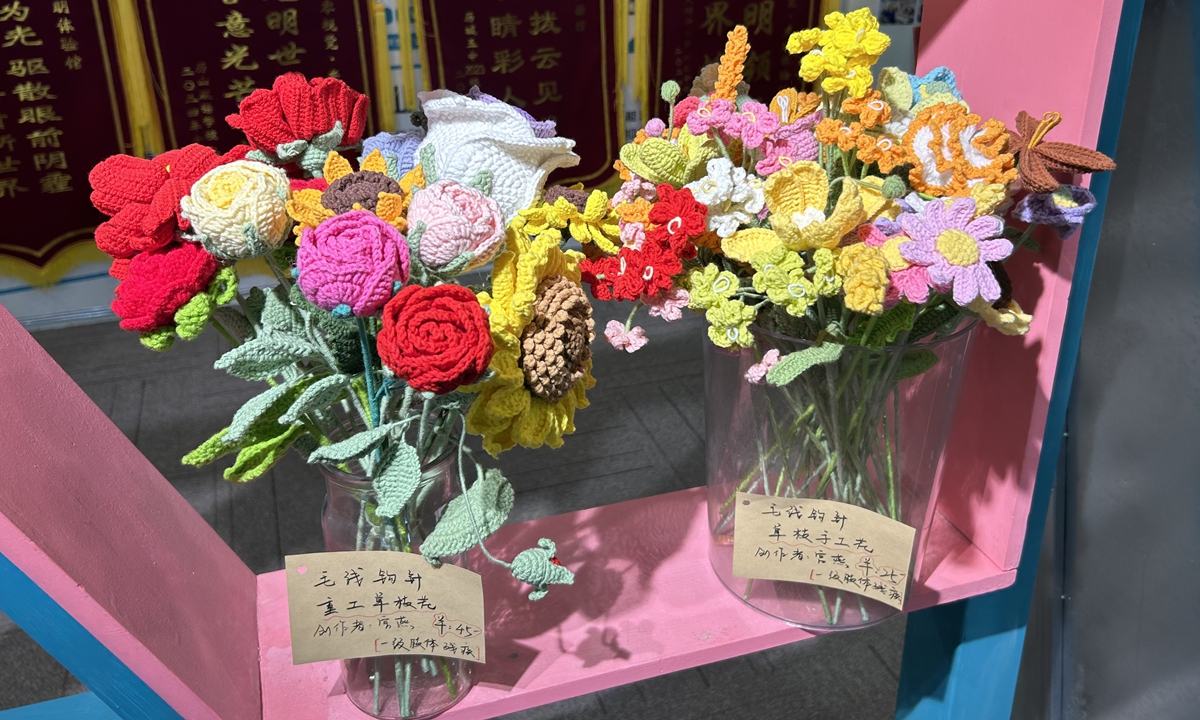
Flowers handmade by people with disabilities are displayed for sale in the Guangming Experience Hall. Photos: Liang Rui/GT
The hall is neither the first nor the last of its kind. Such initiatives continue to serve as vital bridges of empathy, helping society come closer through shared experiences rather than distant sympathy.
Founded in Germany, Dialogue Social Enterprise promotes global inclusion for people living with disabilities through immersive exhibitions and workshops in over 170 cities worldwide.
In late 2011, the "Dialogue in the Dark" immersive exhibition entered the Chinese mainland. In Shanghai, Chengdu in Southwest China's Sichuan Province, and Shenzhen in South China's Guangdong Province, the immersive exhibition "Dialogue in the Dark" offers blindfolded experiences to the public, promoting inclusive development for people with disabilities.
According to Xinhua, in June 2025, the China Braille Press hosted a one-minute blind-life experience in Beijing. Visitors entered a 60-square-meter inflatable cabin to briefly experience the world of the visually impaired. A participant later volunteered for related charitable activities, such as donating books to blind children.
In December 2025, the United Nations hosted an event in Beijing where participants ordered services using sign language and written communication, experiencing firsthand how deaf individuals navigate daily life and work, highlighting the importance of inclusive communication channels in public services and workplaces.
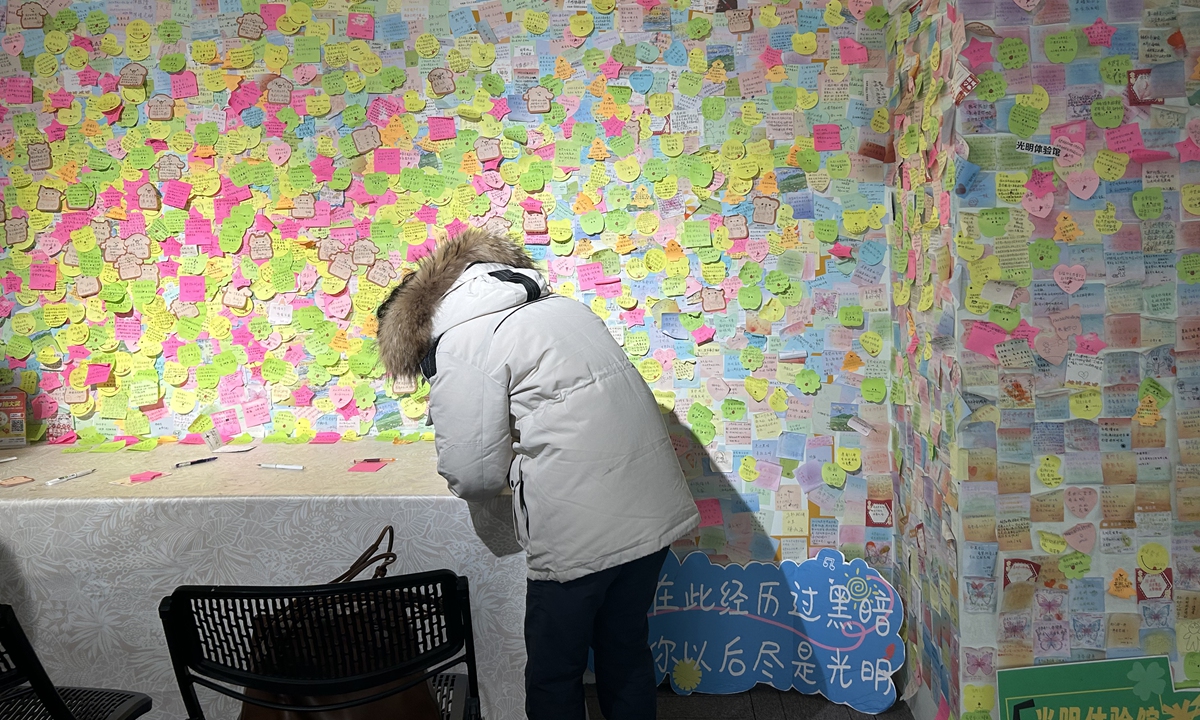
A visitor writes a message in the Guangming Experience Hall on January 2, 2026. Photos: Liang Rui/GT
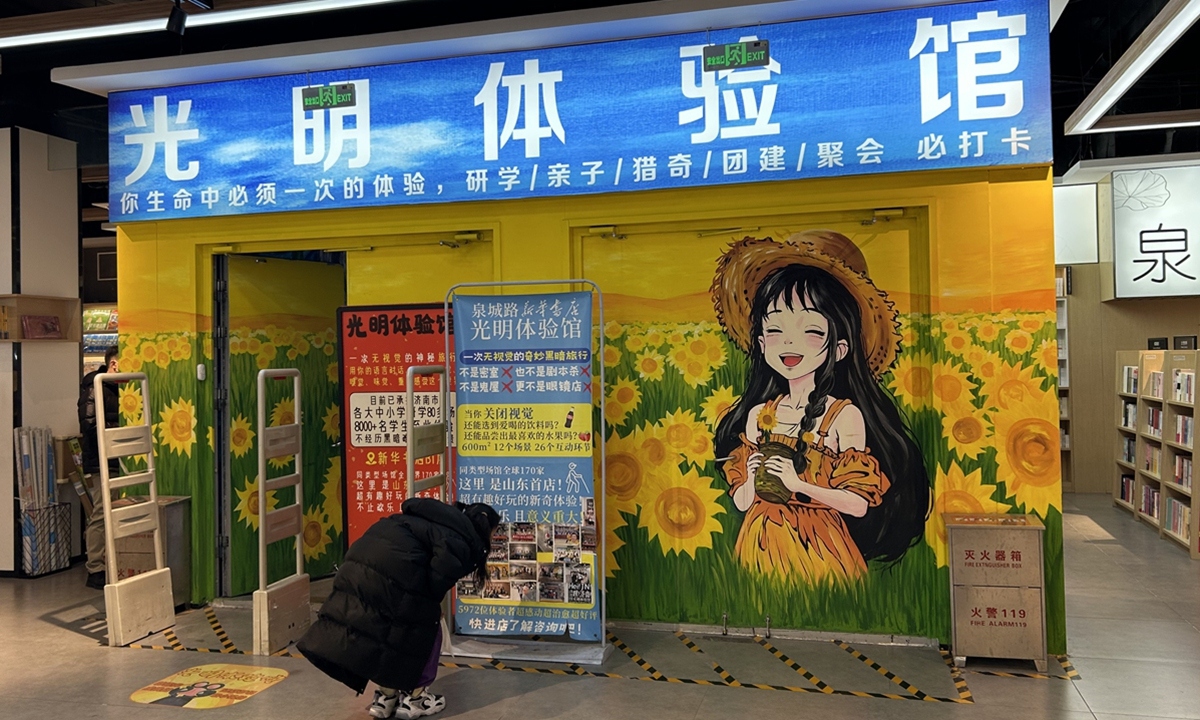
A visitor reads an introduction board at the entrance of the Guangming Experience Hall on January 2, 2026. Photos: Liang Rui/GT
Building social understanding bridges
Huang said that while public awareness continues to grow, the Chinese government has also made significant progress in developing accessible infrastructure and protecting the diverse rights of persons with disabilities, creating a favorable environment.
China's Barrier-free Environment Development Law, which took effect on September 1, 2023, expanded the beneficiaries of accessibility from people living with disabilities and senior citizens to all members of society with accessibility needs. Accessibility, once seen as a "special provision," is now framed as a shared public good, shifting the focus from "whether it exists" to "whether it works well," according to a People's Daily article published in November 2025.
While public debate around accessibility design, use, and maintenance has increased, this reflects growing awareness and participation rather than contradiction, Shao Lei, director of the Institute for Accessibility Development at Tsinghua University, was quoted as saying by the People's Daily article.
The State Council - China's cabinet - has released eight Five-Year Plans for disability development, alongside targeted policy documents aimed at refining responsibilities and implementation across sectors, Xinhua reported in December 2024.
After obtaining her disability certificate, Liu said her community regularly checked in on her work and life. Through training programs organized by disability federations, she discovered career paths beyond traditional assumptions, from computer skills to audio narration and audiobook recording.
In recent years, the Guangming Experience Hall has also collaborated with local governments and disability organizations, enabling guides to participate in public events such as marathons.
Efforts to bridge the digital divide are also underway. As smart devices become ubiquitous, many visually impaired individuals face information barriers. Policies promoting accessibility upgrades for apps and websites have helped address this gap. China's rapidly advancing digital technologies are not only expanding opportunities domestically, but also contributing to more inclusive digital environments globally, said Xinhua.
Against this backdrop of institutional progress and social engagement, the Guangming Experience Hall is preparing for another surge of visitors as the Spring Festival approaches.
"I believe these policies and social initiatives are quietly reshaping public attitudes," Huang said. "Prejudice doesn't disappear overnight, but slowly, deeply, change happens."
Feeling the darkness