China, ASEAN push for cooperation, COC progress amid Philippines-provoked frictions
Manila’s provocative moves undermine its ASEAN rotating chair credibility: expert
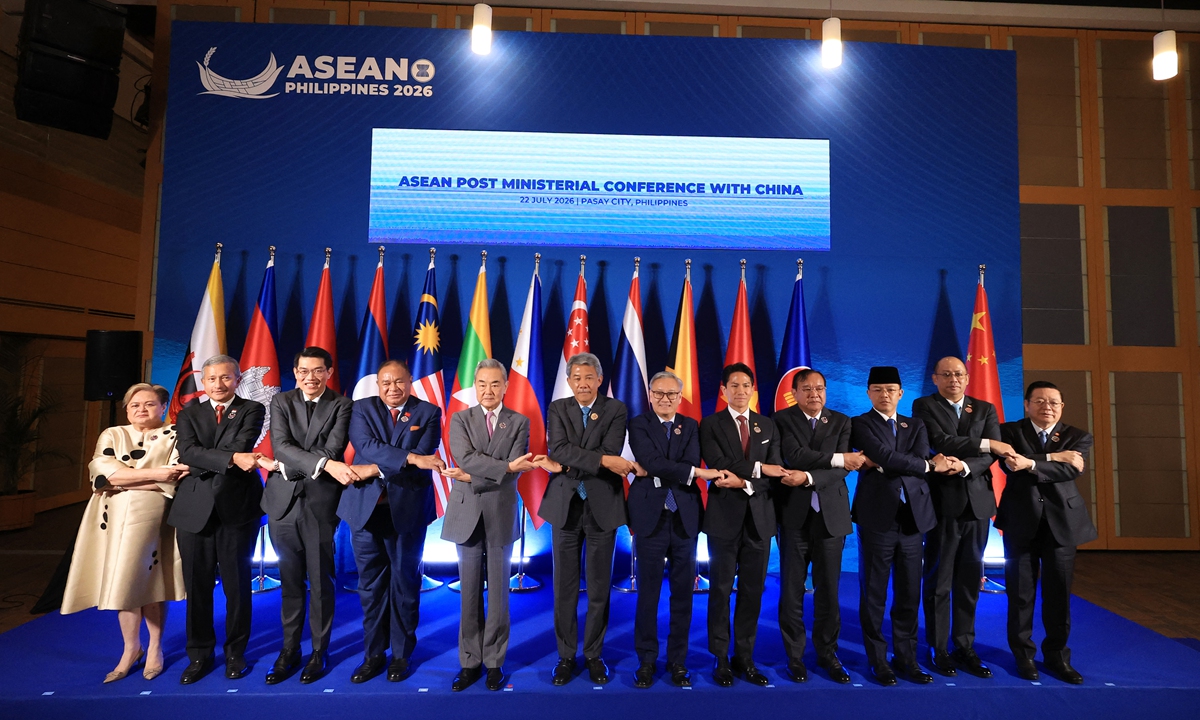
Chinese Foreign Minister Wang Yi poses for a group photo with ASEAN foreign ministers during the ASEAN Post Ministerial Conference with China on the sidelines of the ASEAN Foreign Ministers' Meeting in Manila on July 22, 2026. Photo: AFP
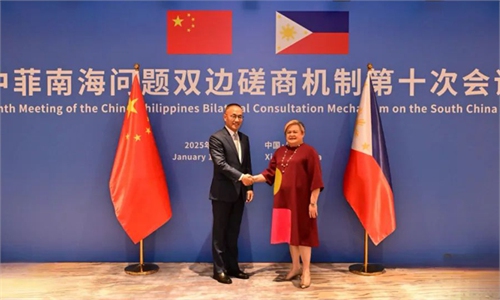
Facts have proven that allowing external forces to meddle in regional affairs and deliberately hyping up maritime disputes will only reduce the Philippines to a pawn manipulated by others, Chinese Foreign Minister Wang Yi said here on Wednesday. Wang, also a member of the Political Bureau of the Communist Party of China Central Committee, made the remarks during his meeting with Philippine Foreign Affairs Secretary Ma. Theresa Lazaro in Manila, the Philippines.The 59th ASEAN Foreign Ministers' Meeting and related meetings are being held in Manila, Philippines. The series of events drew particular attention as Manila attempted to seize the diplomatic spotlight with its latest provocation infringement near China's Ren'ai Jiao. Chinese experts noted that as ASEAN's rotating chair for this year, Manila's relevant moves mismatch its status, adding that at successive ASEAN diplomatic gatherings, a handful of countries keep hyping South China Sea issue with similar tactics in a bid to undermine China-ASEAN relations.
Firm position
The China-Philippines relations now stand at a crossroads, and it falls to the Philippine side to make correct, rational decisions about the path ahead, Chinese Foreign Minister Wang said on Wednesday.
On the eve of China-ASEAN Foreign Ministers' Meeting, the Philippines deliberately provoked an incident in the South China Sea. On Monday, as the China Coast Guard conducted routine patrols in waters adjacent to Ren'ai Jiao, crew members from rubber boats dispatched by the Philippines' illegally grounded vessel assaulted Chinese law-enforcement officers using paddles, long poles and other tools. Chinese side issued repeated verbal warnings and took countermeasures in response.
The US subsequently made groundless accusations that China had acted provocatively and taken "dangerous and aggressive" moves against the Philippine personnel.
Earlier this month, the Philippines, in collusion with 13 external countries including the US, hyped the 10th anniversary of the illegal "South China Sea arbitration award."
When commenting on Australian Foreign Minister Penny Wong's concern on Tuesday over China's conducts in the South China Sea, Chinese Foreign Ministry Spokesperson Lin Jian pointed out that relevant countries turned a blind eye to the sheer facts of the Philippines' infringement activities and provocations, made groundless accusations against China, and rehashed "the South China Sea Arbitral Award," which is illegal, null and void.
Relevant countries are not parties in the South China Sea, and are in no position to interfere in the maritime issues between countries concerned. Apparently, whenever something happens at sea, the same few countries immediately point their fingers at China regardless of who exactly is at fault, Lin added.
According to Xu Liping, director of the Center for Southeast Asian Studies at the Chinese Academy of Social Sciences, at successive ASEAN diplomatic gatherings, a handful of countries keep hyping South China Sea issue with similar tactics in a bid to undermine China-ASEAN relations. Certain non-regional nations also attempt to exploit the South China Sea issue to contain China.
"As ASEAN's rotating chair for this year, Manila's relevant moves mismatch its status," said Xu, "By roping in outside forces to stir up trouble in the South China Sea and stoking bloc confrontation, the Philippines runs counter to ASEAN's collective interests."
Removing disruptive factors
This year marks the 35th anniversary of the establishment of dialogue relations between China and ASEAN, as well as the fifth anniversary of the establishment of the China-ASEAN Comprehensive Strategic Partnership.
According to ASEAN's official news release, during ASEAN Post-Ministerial Conference with China on Wednesday, diplomats reviewed progress under the ASEAN-China Comprehensive Strategic Partnership (CSP), discussed its future, and exchanged views on regional and international developments of common concern.
Highlighting the fifth anniversary of the CSP this year, both sides reaffirmed their commitment to further strengthening cooperation across the three pillars of the ASEAN Community, including through the implementation of the ASEAN-China Plan of Action (2026-2030).
Wang on Tuesday held talks with ASEAN Secretary-General Kao Kim Hourn. During the meeting, Wang said that as the most important anchor of stability in the region, China stands ready to strengthen cooperation with the ASEAN.
On the South China Sea, Wang described it as a shared home for regional countries. He said South China Sea issues should not become a stumbling block to China-ASEAN relations, according to Xinhua News Agency.
Wang said certain forces within the Philippine military and maritime law enforcement ranks have deliberately provoked incidents in the South China Sea to serve the interests of external forces, undermining the process of improving China-Philippines relations as well as peace and stability in the South China Sea.
China stands ready to work with ASEAN to remove disruptive factors, accelerate consultations on the Code of Conduct (COC) in the South China Sea, jointly foster a new narrative of peace, stability, cooperation and friendship in the South China Sea, and keep the initiative on South China Sea issues firmly in the hands of regional countries, said Wang.
According to the Xinhua News Agency, Kao spoke highly of ASEAN-China relations and the outcomes of practical cooperation between the two sides, adding that China is ASEAN's most important comprehensive strategic partner, with the two sides having established 65 cooperation mechanisms.
Kao noted that ASEAN looks forward to closer strategic alignment with China, adding that ASEAN is ready to work alongside China to jointly uphold regional peace and stability and make important contributions to development and prosperity in the Asia-Pacific region.
"Against the backdrop of intensifying geopolitical competition, regional countries share the consensus to uphold peace, stability, cooperation and development," said Xu, "China and ASEAN have put in place comprehensive cooperation mechanisms and fostered robust foundations for cooperation."
2026 also marks the 50th anniversary of the signing of the Treaty of Amity and Cooperation in Southeast Asia (TAC). China was the first major country to accede to the treaty.
The ASEAN Secretary-General acts in the collective interests of ASEAN, and his statements mirror the position of most ASEAN nations, said Xu. Against the broader trend of expanding China-ASEAN cooperation, provocations by individual countries are doomed to fail, the expert added.
RELATED ARTICLES