China’s shipbuilding industry sees stellar growth in first 6 months, with new orders growing 173.1%
By Published: Jul 23, 2026 10:47 AM

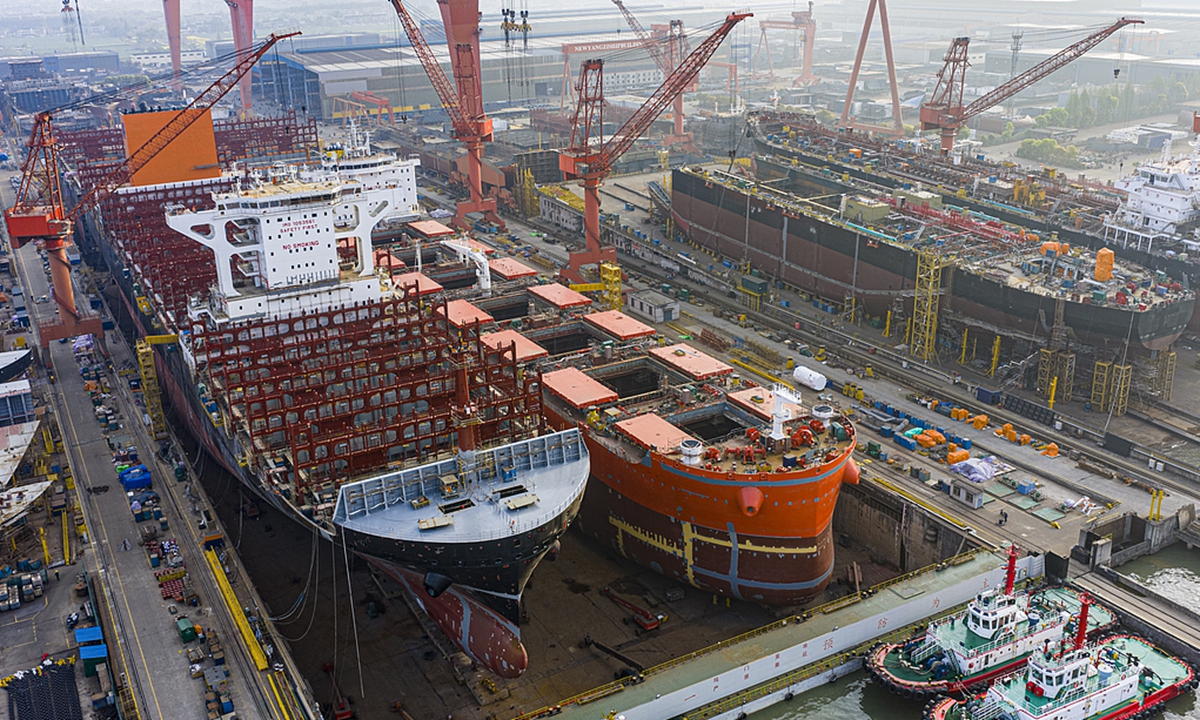
A view of a shipyard of Jiangsu New Yangzi Shipbuilding Co in Taizhou, East China's Jiangsu Province, on April 6, 2026. Photo: VCG
China's shipbuilding sector posted strong growth across three major indicators in the first half of 2026, maintaining a leading share of the global market, data from the Ministry of Industry and Information Technology (MIIT) showed on Thursday.
The country's shipbuilding output reached 36.5 million deadweight tons (DWT), up 51.2 percent year-on-year and accounting for 62.2 percent of the global total, the data showed. Shipbuilding output is a gauge of China's shipbuilding capacity, according to CCTV News.
New orders, a measure of market competitiveness, totaled 121.06 million DWT, surging 173.1 percent year-on-year and representing 82.3 percent of the global market.
As of the end of June, the sector's orders on hand, an indicator of the sector's long-term stability, stood at 363.25 million DWT, up 54.9 percent year-on-year. This figure accounted for 71.2 percent of the global total.
CCTV News reported that China maintains its global lead with market shares exceeding 80 percent for three mainstream vessel types - dry bulk vessels, container ships and crude tankers. This shows that Chinese shipyards have the ability to perform final assembly and construction for all types of ships and that green, low-carbon vessels have become a key focus for the transformation and upgrading of China's shipbuilding industry.
The stellar first-half growth of the three core indicators, which built on the robust trend in the first quarter, is a testament of the market competitiveness of China's shipbuilding industry amid increasing global volatility, Chinese analysts and industry insiders said.
Amid the situation in the Strait of Hormuz and the crunch in global crude supply, demand for certain vessels, such as oil tankers, has seen a sudden rise and Chinese shipyards were able to swiftly capitalize on these market dynamics due to their shipbuilding capacity, ability to innovate and the country's whole-chain advantages that offer low-cost and high-quality solutions, an industry insider told the Global Times.
The growth in quantity has been coupled with an improvement in quality, with fresh progress and records set by shipyards.
China delivered the world's first 41,800-ton bidirectional sailing self-discharging ship Wontanara in East China's Jiangsu Province on Tuesday. Setting multiple world records, the vessel will be deployed in the waters off Guinea in West Africa to serve the massive Simandou Iron Ore Project.
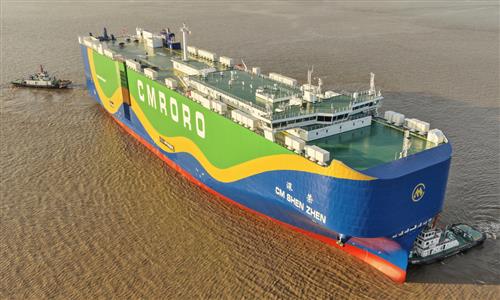
On the same day, the world's first 10,000-vehicle-class car carrier equipped with a photovoltaic power generation system was delivered to a South Korean enterprise by a shipyard in Guangzhou, South China's Guangdong Province, the Science and Technology Daily reported. Powered by both conventional fuel and liquefied natural gas, the vessel is the fourth 10,000-vehicle-class car carrier delivered by China.
In recent years, the capabilities of Chinese shipyards have advanced significantly, and through a series of measures including setting up joint ventures with foreign shipyards, introducing advanced technologies and strengthening internal management, the qualitative gap with the most advanced shipbuilders in Japan and South Korea has been greatly narrowed, Steven Wang, an industry insider of seaborne trade, told the Global Times on Thursday.
With constant upgrades, industry-leading and large-capacity shipyards emerged along China's coastlines, and became the main choices of global buyers, Wang said.
Notably, Wang said that one Chinese company designed a large carrier vessel of 80,000 DWT that can switch between the roles of a container ship and a dry bulk cargo vessel, reflecting a level of innovation unseen before.
Analysts said that as the global shipping industry places greater emphasis on green and environmental protection, China's shipbuilding sector will continue to play a vital role as a high-quality supplier as China's manufacturing industry pushes for further upgrades toward high-end, intelligent and green development.
In terms of exports, vessels destined for overseas markets accounted for 94 percent of total shipbuilding output during the January-June period, according to CCTV News. Such vessels also accounted for 93.4 percent of all new orders and 92.1 percent of orders on hand during the period. Export value reached $31.62 billion.
Bian Yongzu, a financial expert and executive deputy editor-in-chief of Modernization of Management magazine, told the Global Times on Thursday that the robust performance of the Chinese shipbuilding sector during the first half continued to demonstrate the sector's comprehensive competitiveness globally.
"As an industry that is capital- and technology-intensive, requiring extensive technological applications, management expertise, work force strength and design capacity, the sector's continued advance reflects the continued improvement of the Chinese manufacturing sector," Bian said.
The data was announced as a number of US lawmakers are reportedly searching for ways to tackle China's rapid rise in commercial shipbuilding and restore America's diminished commercial fleet, according to the South China Morning Post on Thursday.
Bian said imposing tariffs or other restrictive measures in the sector will only disrupt the global supply chain and could harm the US' interests and will not improve the US shipbuilding industry.
"China's progress in shipbuilding was achieved over decades and by embracing global supply chains, and it is not something that can be affected by artificially putting up trade barriers," the expert said.
RELATED ARTICLES