FCC votes to bar devices with components from Chinese firms in a ‘protectionist escalation’ that risks US interests: Chinese experts
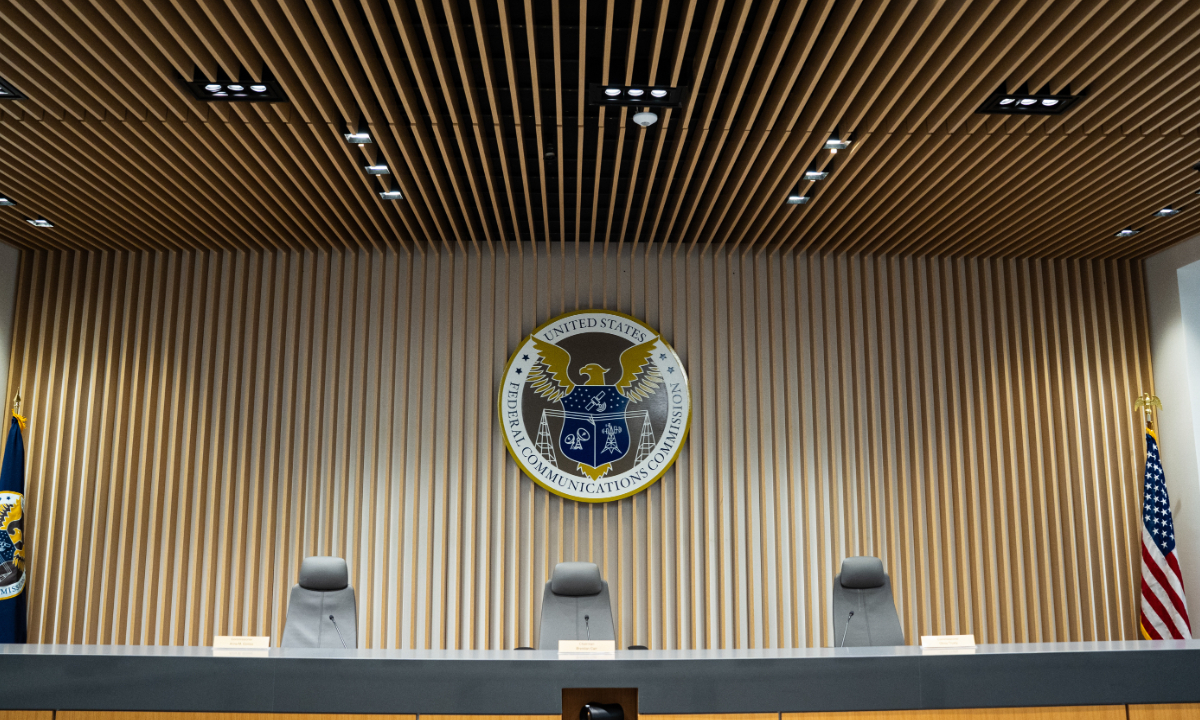
The seal of the Federal Communications Commission (FCC) prior to an open commission meeting at the agency's headquarters in Washington, DC, US, on Wednesday, Feb. 18, 2026. Photo: VCG
The US Federal Communications Commission’s (FCC) latest move to restrict electronic products containing components from certain Chinese companies marks a further protectionist escalation in Washington’s technology crackdown, with Chinese experts saying the measure is driven more by political considerations than by evidence-based security concerns.
The move shows that the US is shifting from targeting individual products to imposing broader technology supply chain restrictions, analysts said, noting that such government intervention could raise costs for US businesses and consumers while pushing Chinese companies to further diversify their global markets.
The FCC voted on Wednesday to prohibit the authorization of devices containing certain hardware components from Chinese companies deemed to be “national security risks,” according to Reuters. The measure expands previous restrictions that mainly targeted telecommunications equipment made by companies including Huawei and ZTE.
FCC Chair Brendan Carr claimed that the agency would “fully close the component part loophole,” Reuters reported.
Since 2022, devices made by companies like Huawei on a US government’s List have been banned from receiving new authorizations, but devices containing Huawei component parts could continue to get approval to enter the US market. Under the new rules, devices containing Huawei-made logic-bearing hardware components will no longer be eligible for authorization in the US market, per Reuters.
The latest move represents a significant expansion of Washington’s technology restrictions, extending regulatory scrutiny from finished products to upstream supply chains, Li Yong, an executive council member of the China Society for WTO Studies, told the Global Times on Thursday.
“Using national security as a pretext to interfere with normal market competition reflects a politically motivated strategy rather than a response to specific, proven risks,” Li said.
The expansion also reflects growing political pressure in Washington to maintain a restrictive approach toward Chinese technology, despite the absence of publicly disclosed evidence showing that broader component restrictions are necessary, Ma Jihua, a veteran technology industry analyst, told the Global Times.
“The move also reveals concerns among some US politicians about competition in technology and advanced manufacturing sectors,” Ma said, adding that such measures undermine fair competition instead of addressing the root causes of technological rivalry through efforts to improve their own competitiveness.
The latest FCC decision is the newest step in a years-long US campaign targeting Chinese telecommunications companies.
In 2019, the US Department of Commerce placed Huawei on its Entity List, restricting the company’s access to US technologies and suppliers. The following year, the FCC designated Huawei and ZTE as national security threats, restricting the use of certain federal funds to purchase equipment from the two companies.
Washington later expanded restrictions through the Secure Equipment Act, with the FCC adopting rules in 2022 that blocked new authorizations for certain telecommunications and surveillance equipment from Huawei, ZTE and other designated companies.
However, Chinese experts noted that the US government has yet to provide publicly available, concrete and verifiable evidence proving that Huawei, ZTE or other Chinese technology companies pose the security risks cited by Washington.
“Huawei’s rapid development shows that US political efforts to accelerate technological decoupling from China have failed to achieve their goals, as external pressure has instead driven Chinese companies to strengthen innovation and expand globally,” Li said.
In practice, Chinese technology companies have become less dependent on the US market as Washington continues to expand restrictions, experts said.
The latest restrictions are likely to affect certain industrial equipment products, for which it would be difficult to find alternatives with the same level of efficiency and cost competitiveness as Chinese products, according to Ma.
Li warned that forcibly excluding Chinese products would undermine market efficiency and ultimately harm US businesses and consumers, as well as global supply chains.
Noticeably, experts also pointed to the challenges of implementation, saying that “high replacement costs and technological realities have prevented many FCC restrictions targeting Chinese technologies from being fully implemented, leaving them stalled over the years.”
The FCC has stepped up efforts to expand restrictions on Chinese technology products and services in recent months. In June, the agency moved to bar additional equipment from certain Chinese manufacturers from receiving market authorization, with the rules taking effect on July 16.
In the months before that, the FCC also restricted approvals for new foreign-made drone and router models and considered further limits on network interconnection involving Chinese telecommunications companies deemed security risks.
On April 30, the FCC adopted measures that would disqualify testing and certification bodies from countries without mutual recognition agreements with the US and prohibit entities on the so-called “Covered List” from providing telecommunications services in the US.
In response, China’s Ministry of Commerce criticized the FCC for “overstretching the concept of national security” and discriminating against enterprises and products from China and other countries.
Such measures undermine the hard-won stability of China-US economic and trade relations, the ministry said, warning that they could disrupt global industrial and supply chains in communications, electronics and related sectors, affect international industrial cooperation and hinder technological innovation.
The ministry said that China would take necessary measures to safeguard the legitimate rights and interests of Chinese enterprises.
RELATED ARTICLES