ARTS / CULTURE & LEISURE
AI faces spark discussion about real human vibe in short videos
Repeatedly reproduced ‘perfection’ causes dislike
AI actors
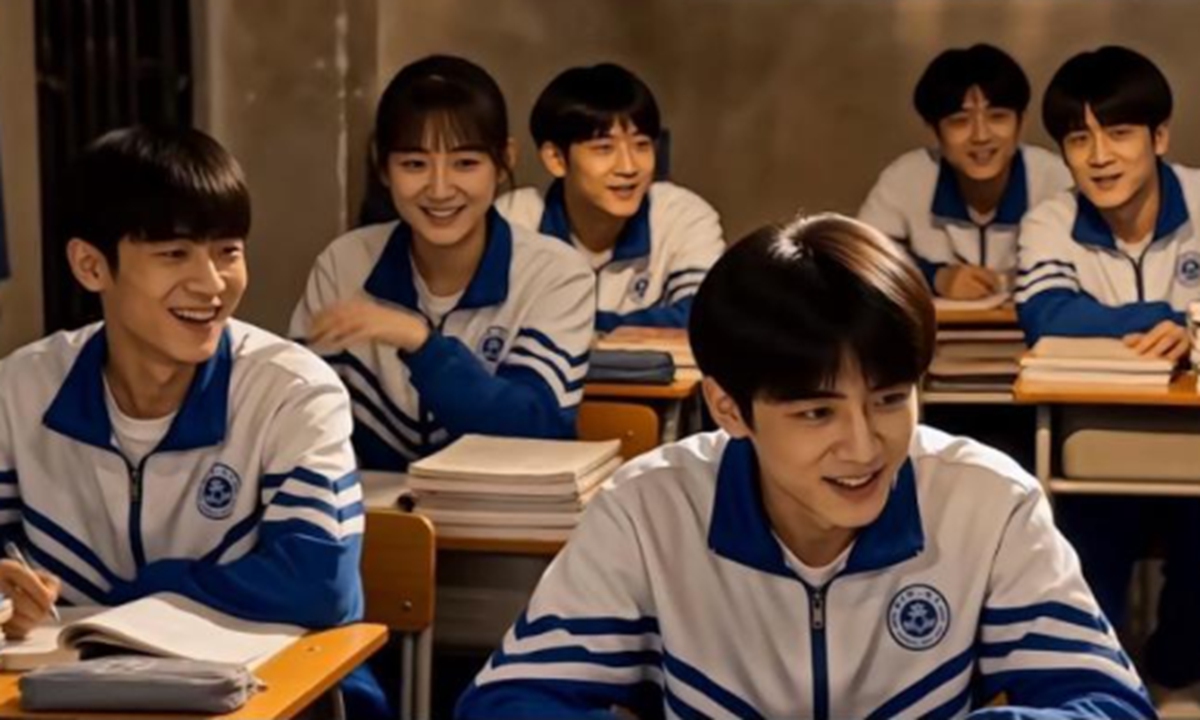
On Thursday, the topic "AI-generated actors have pores and skin imperfections, while real actors are being smoothed" began trending on China's X-like platform Sina Weibo, sparking discussion over the "sense of realism" surrounding AI actors in short dramas. Some netizens found it ironic that AI-generated actors are now being given visible pores and skin imperfections to appear more human.The discussion comes as debate over AI faces and AI actors in short dramas has intensified in recent days, with topics such as "physical aversion to AI faces" and "the uncanny valley effect of AI faces" repeatedly trending on social media. Many netizens have expressed that seeing "AI faces" makes them feel deeply uncomfortable or even nauseous, especially cookie-cutter visages featuring large eyes, narrow noses, and unnaturally pale skin, which seem increasingly uncanny the longer one looks at them.
"Many protagonists almost all have the same features - high hairlines, large eyes, narrow noses and pale skin. They look so polished that it is hard to find any flaws, but once their expressions change, they appear stiff and unnatural. The more I watch, the more uneasy I feel," Zhao Xiyao, a graduate student and short drama fan, told the Global Times on Thursday.
Many of her friends have had similar experiences. "Some believe these characters look as if they were mass-produced using the same template. Although they fit mainstream beauty standards, they still create a sense of inexplicable distance," she said. "Others feel that AI faces become 'increasingly strange the more you look at them,' and may even trigger the 'uncanny valley effect.'"
The "uncanny valley" refers to a phenomenon in which people's affinity toward human-like figures, such as robots, drops sharply when their appearance becomes highly realistic but still falls short of being completely lifelike. This sudden decline is often accompanied by feelings of discomfort, eeriness and unease. AI-generated faces can trigger a similar response: They appear human yet not fully human, familiar yet unfamiliar. They seem to have all the expected elements of a real person, except for one thing - a genuine "sense of being alive," according to the People's Daily.
The Beijing Science Center pointed out that real human faces naturally have individual differences: skin tones vary naturally, skin contains textures and minor imperfections, and facial features carry unique characteristics belonging to each person.
However, AI-generated models are often trained on datasets that favor conventionally attractive faces. Meanwhile, creators tend to select generated results that align with mainstream aesthetic preferences, making AI-generated faces increasingly converge toward an "aesthetic average," with individual characteristics significantly erased, according to the Beijing Science Center.
"When a large amount of content uses the same template of highly attractive faces, what viewers experience is no longer just an issue with one particular face, but a constantly repeated, monotonous stimulus," Li Tuo, a Beijing-based psychologist, told the Global Times on Thursday.
"Psychologically, people are not rejecting technology; they are rejecting the same kind of 'perfection' that is repeatedly reproduced by algorithms," he added.
Such fatigue is closely linked to the rapid adoption of AI-generated content in the entertainment industry, where efficiency and cost reduction have accelerated the spread of standardized visual styles.
According to the People's Daily, AI-generated short dramas account for more than 95 percent of all short dramas released across the industry. The aversion to AI faces should serve both as a cause for reflection and as a signal: Technology can be used to reduce production costs and shorten production cycles, but mass production cannot replace artistry and humanistic value.
Beyond the sense of discomfort at the physiological and aesthetic levels, the difficulty AI-generated characters have in creating emotional resonance may also be an important reason why viewers reject them.
"Compelling performances rely not only on the control of facial expressions, but more importantly on the accurate conveyance of emotions," Li said. AI "actors" can synthesize expressions such as crying and smiling, but they struggle to truly reproduce the physical responses and contextual psychological activities behind genuine emotions, and therefore can easily produce an effect that is "all forms but no soul," he noted.
This may also be why some "imperfect" human faces, a natural change in expression, or even a line carrying traces of everyday life can be more memorable than a flawless AI-generated face.
When "perfection" can be mass-produced, authenticity, individuality and even a little imperfection - that "sense of being truly human" - may instead become increasingly scarce in the AI era.
RELATED ARTICLES