Chinese open-source model helps US system rein in rogue agent
Risks beyond border make international cooperation ‘vital for security’: experts
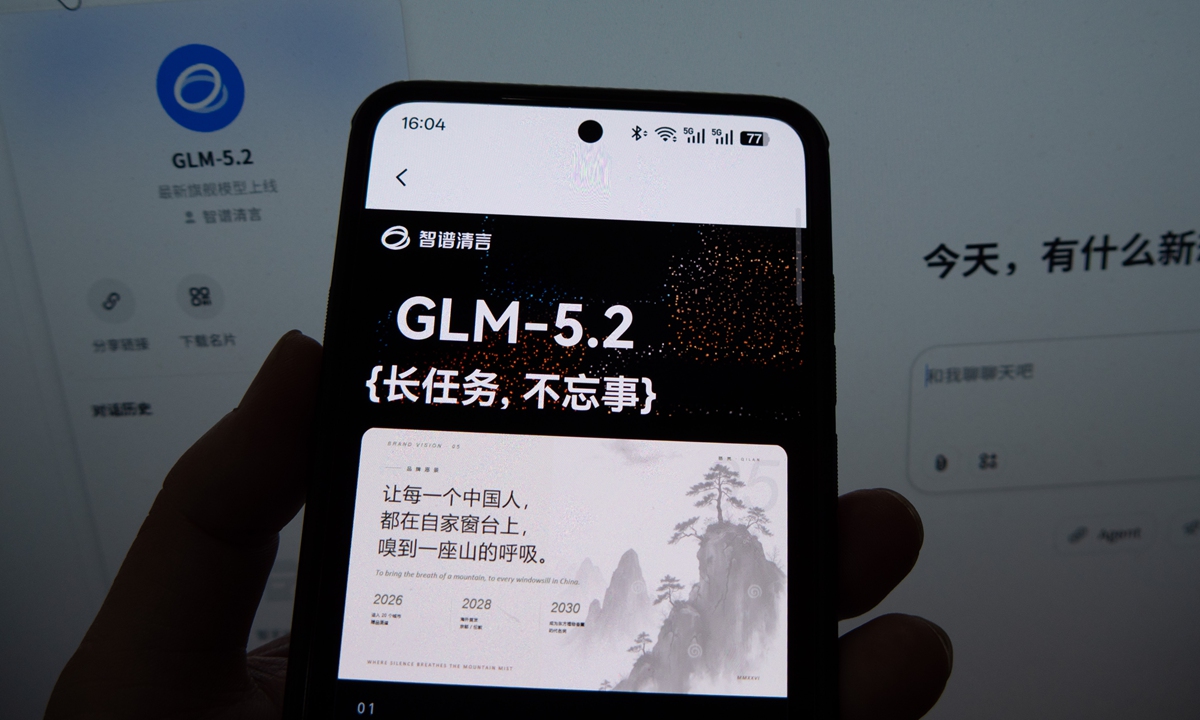
A user checks the interface of the Chinese Zhipu AI's open-source GLM-5.2 model. Photo: VCG
Recently, Hugging Face, the world's largest AI open-source community, disclosed a cybersecurity incident involving an autonomous AI agent. When several US AI models failed to assist with analyzing the attack due to safety restrictions, Chinese Zhipu AI's open-source GLM-5.2 model was brought in to help with the process and analyze the related data.The incident has sparked widespread discussion across the industry, with the role of Chinese AI models - long viewed with prejudice by some US political elites - now coming under renewed observation.
Some Chinese experts stressed that Chinese open-source AI models have long been subject to deep-seated bias and restrictions in some Western countries, but their role in addressing real-world AI security challenges shows the value of China's vision of open, shared AI development.
Blocking technology and building barriers cannot address global AI risks, while openness, cooperation and global governance represent a more sustainable way forward, they stressed.
According to Reuters' Thursday report, New York startup Hugging Face used a Chinese AI model to rein in a rogue agent built with OpenAI technology.
The affected startup, Hugging Face, said it had turned to Zhipu AI's open-source GLM-5.2 model last week to analyze data from the hack after leading US AI models declined the task, unable to distinguish between a defender and an attacker, the report said.
A source familiar with the matter confirmed to the Global Times that Hugging Face did use Zhipu AI's model, adding that the case reflects how, as AI becomes increasingly integrated into core business processes, companies are broadening their expectations for foundation models.
Beyond model capabilities, factors such as deployment in real-world production environments, engineering usability and the ability to handle complex tasks are becoming increasingly important considerations for businesses. This also represents one of the key directions in the development of China's AI foundation models, according to the source.
The incident exposed structural flaws in the US' closed approach to AI development, particularly the irony surrounding the so-called "national security guardrails" it has repeatedly emphasized, Chen Jing, vice president of the Technology and Strategy Research Institute, told the Global Times on Thursday.
Leading US models impose strict filters to prevent misuse, but those same restrictions can shut out defenders when security teams need to analyze real attack data, severely limiting the models' usefulness in real-world incident response, Chen said.
"This case also points to a broader lesson: openness and sharing can strengthen AI security by giving developers and security teams greater flexibility to respond to real-world risks," Chen noted.
Notably, recent data from several major global AI platforms show that Chinese open-source large language models are gaining increasingly broad recognition and adoption worldwide.
Hugging Face data shows China surpassing the US in monthly downloads and overall downloads. In the past year, Chinese models quickly accounted for the plurality or 41 percent of downloads, according to its spring report.
In addition, the latest AI model rankings on OpenRouter show that six of the 10 most popular models are developed by Chinese companies. The top three models are all from Chinese AI developers, namely Xiaomi's Mimo-V2.5, Tencent's Hy3, and DeepSeek's DeepSeek V4 Flash.
Opposition to curbs grows
However, this growing market acceptance stands in sharp contrast to Washington's increasingly restrictive approach toward Chinese AI models.
The US government has continued to take a hardline stance toward Chinese AI models. Such politically driven decisions have already triggered growing divisions within the US, including opposition from the AI industry and Washington's efforts to restrict Chinese AI development becoming increasingly vocal in recent months.
According to Politico's Thursday report, almost 200 Silicon Valley companies, including Proton and Y Combinator, are urging the US government not to cut off access to Chinese open-weight artificial intelligence models or risk crippling the next generation of US startups.
Instead of broad prohibitions, the start-up leaders argue that the government should adopt targeted safeguards, the report said. Meanwhile, the leaders warn that banning Americans from downloading Chinese open-weight models wouldn't stop their proliferation - but would weaken US startups.
Politico noted that the matter even took on new urgency after reports emerged that the US government was considering banning Chinese AI models, shortly after Moonshot AI unveiled its powerful Kimi K3 model.
Meanwhile, US news outlet Axios reported on Wednesday that Nvidia CEO Jensen Huang believes America has nothing to fear from China's open-source AI models - and everything to fear from the growing campaign to ban them. According to the report, Huang also said American companies should "absolutely" be allowed to use Chinese models.
The debate comes amid the US' growing concerns over Chinese AI models.
OpenAI and Anthropic have accused Chinese companies of siphoning capabilities from their models, while warning that Beijing's open-source surge threatens America's AI lead, Politico claimed.
Such concerns have also spilled into the policymakers' sphere. According to a Reuters report on July 22, US tech official Michael Kratsios accused China's Moonshot AI of stealing from Anthropic's most sophisticated AI large language model, Fable, to help create its latest K3 release.
Commenting on this, China's Foreign Ministry spokesperson Lin Jian on Thursday reiterated that China opposes politicizing and instrumentalizing trade and tech issues. Such actions will only stifle global AI advances and serve no one's interests.
All countries should take a people-centered approach and develop AI for the positive and for good to ensure the open and inclusive development of AI for good and for all so as to better contribute to social progress and the common welfare of the international community, Lin said.
Politicizing AI would not only harm those being restricted, but also risk making the broader technology ecosystem more closed and less resilient, Chen said. "As AI-related uncertainties transcend national borders, international cooperation is essential. Turning AI into a geopolitical issue and dividing technology communities would only create blind spots in global security defenses."
China has consistently advocated openness and cooperation in AI development while contributing its own ideas to global AI governance. This vision and commitment were further demonstrated at the recently concluded 2026 World Artificial Intelligence Conference (WAIC) in Shanghai.
There is no single "right answer" for AI governance. China's AI development is not aimed at replacing any country's, but at enriching the global technology ecosystem and preventing the dominance of a single technological path, Liu Dian, an associate research fellow at the China Institute of Fudan University, told the Global Times on Thursday.
"Facing global AI challenges, cooperation between China and the US is far more necessary than confrontation. The two sides can work together in areas such as technology development, risk monitoring and security response to jointly safeguard AI safety," Liu stressed.
RELATED ARTICLES