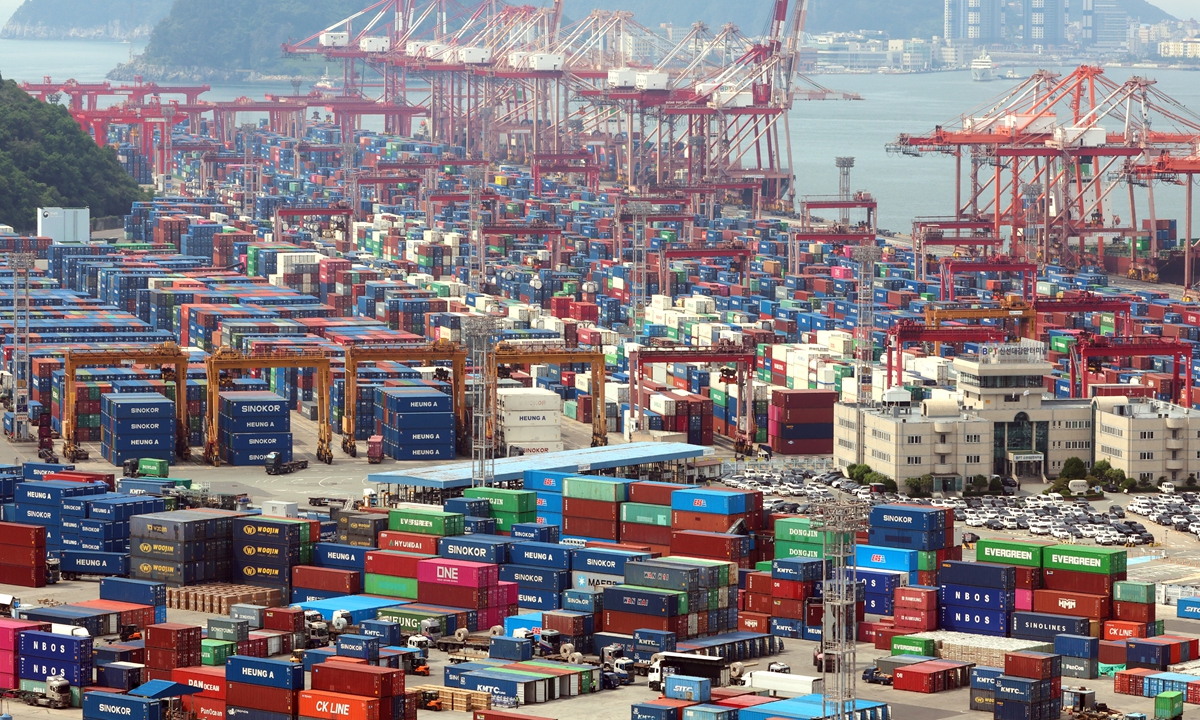
Containers are stacked at the New Port terminal of Busan Port in Busan, South Korea, on June 1, 2026. Photo: VCG
Advance data from the Bank of Korea showed on Thursday that the South Korean economy grew 0.6 percent in the second quarter from the previous quarter, beating market expectations, the Yonhap News Agency reported.
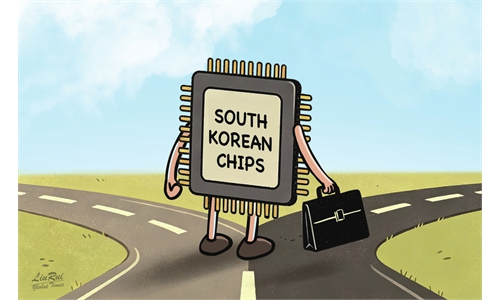
Amid a sluggish global economic recovery and rising geopolitical uncertainty, such growth momentum is hard-won. A closer look at the growth drivers, however, reveals that the solid expansion is propped up by robust semiconductor exports, which offset many sources of downward pressure. Behind the seemingly encouraging number, the structural flaw of South Korea's over-reliance on a single industry has again come to the fore, making accelerated diversification an urgent priority to consolidate the foundation for long-term development.
In recent years, semiconductors have become one of South Korea's most crucial pillar industries. The past two years have witnessed a global surge in semiconductor demand, which dramatically lifted the country's overall export growth.
Data from South Korea's Ministry of Trade, Industry and Resources shows that the country's exports hit a fresh high by surpassing the $100 billion mark for the first time in June, amid the record-breaking performance of chips. Exports of semiconductors nearly tripled to $44.82 billion, with one-month exports surpassing $40 billion for the first time.
Yet the greater the windfall from the artificial intelligence (AI) chip boom, the more starkly South Korea's structural vulnerabilities stand out. While semiconductors undoubtedly represent a promising frontier, no sector is immune to cycles. When AI-driven demand for computing power surges and memory chip prices rise, South Korean exports and GDP climb; yet when global capital expenditure contracts and inventory adjustments set in, the economy could lose momentum just as quickly.
Capital markets offer the most vivid illustration of this lopsided structure. Recent volatility in the South Korean stock market has been driven primarily by global uncertainty surrounding the semiconductor industry. Samsung Electronics and SK hynix together account for more than half of the Korea Composite Stock Price Index's market capitalization. Their combined weight gives them an influence over the entire market, which renders the benchmark index highly susceptible to AI‑ and semiconductor‑related risks.
Compounding this concentration risk, a growing volume of capital has flowed into single-stock exchange-traded funds tracking chip stocks. These instruments amplify momentum in both directions, magnifying market volatility.
What also deserves great concern is the impact of the excessive prosperity of a single industry on the rest of the economy. South Korea is witnessing a stark structural divergence: the semiconductor-related manufacturing sector is booming, while other traditional industries remain sluggish.
Capital, talent and policy resources have been continuously funneled into leading semiconductor firms, steadily eroding the diversity of the country's industrial ecosystem. This imbalance prevents the gains from economic growth from spreading across the entire society.
This actually exposes the South Korean economy to significant risks from global tech cycles. When enthusiasm for AI investment cools - even temporarily - the country is likely to be the first to feel the impact.
South Korean authorities have already recognized the urgency of structural reform. Last month, South Korean President Lee Jae-myung pledged to move beyond semiconductors for driving the nation's economy by fostering world-leading competitiveness across a range of industries.
As a highly export-oriented economy, South Korea cannot achieve industrial diversification without a stable regional trade environment and access to vast neighboring markets. Its limited domestic market means that internal circulation alone is incapable of sustaining robust and long-term economic growth. Nurturing emerging industries, revitalizing traditional sectors and bolstering domestic consumption all rely on expanded external demand and integrated global and regional industrial resources.
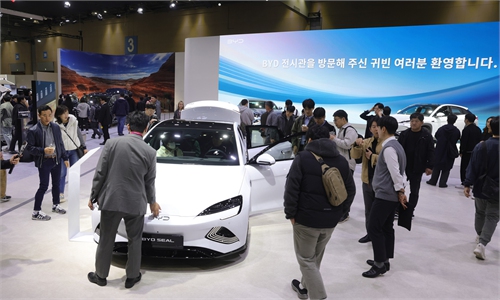
For instance, as South Korea's largest trading partner for many years, China offers a vast market, and the two economies are highly complementary across supply chains. Stable cross-border trade flows and diversified external demand could provide support for South Korea's emerging industries and drive synergies across upstream and downstream supply chains.
But external opportunities can only complement internal reform. Industrial diversification is ultimately a structural challenge that South Korea must address from within. Whether the country can make use of its chip boom to promote diversified growth will be the ultimate test of its policy wisdom and strategic resolve.
RELATED ARTICLES