Documentaries like ‘Unit 731’ should be aired more widely in Japan: Global Times editorial
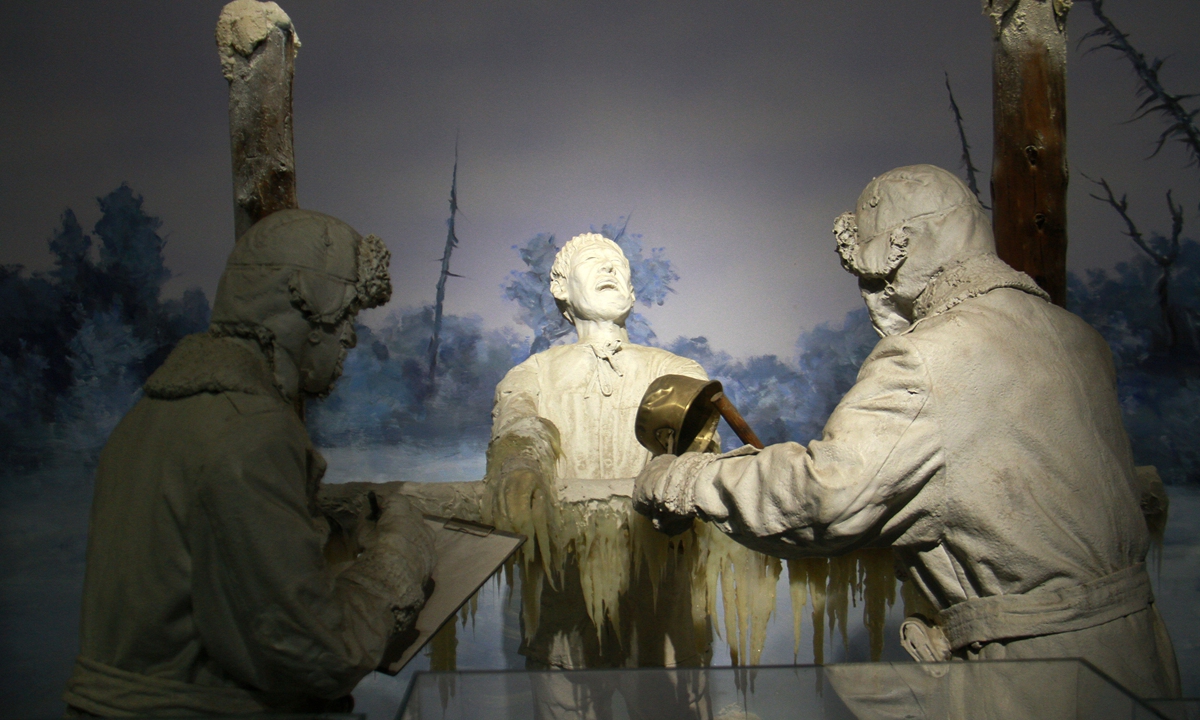
A group of statues in Harbin, Northeast China's Heilongjiang showing the brutal crime conducted by the Unit 731, an infamous Japanese germ warfare unit during its invasion in China Photo: VCG
If more major television networks in Japan were willing to turn their cameras toward Unit 731 as NHK did, and if Japanese history textbooks faithfully documented the truth about Japan's biological warfare program, how much room would remain for right-wing voices that denounce such reporting as promoting a "masochistic view of history"?
Japan's public broadcaster NHK aired a special documentary program on July 21 titled A Secret Unit: The Silent Postwar Era, which exposed the crimes committed by Unit 731 of the Japanese Imperial Army during its aggression against China. Drawing on surviving records, historical archives and testimonies from witnesses, including Hideo Shimizu, a former member of Unit 731's "youth corps," the documentary revealed this horrifying chapter of history. The title itself serves as a sharp metaphor: Who was hiding it? Who remained silent? The documentary triggered sustained debate online in Japan after its broadcast, including hostility from right-wing groups - precisely demonstrating that such programs have been aired far too rarely in Japan.
As Japan's only public broadcaster, NHK has broad influence in the country. This is not the first time that NHK has addressed the subject of Unit 731, a topic often regarded in Japan as a "historical taboo." In 2017, it released Unit 731: "Elite Doctors" and Human Experimentation, followed in 2018 by Unit 731: How Human Experiments Were Carried Out. This latest documentary, A Secret Unit: The Silent Postwar Era, further breaks the silence by presenting Japan's official archives, testimonies from descendants of perpetrators, and accounts from those who experienced the events firsthand, offering a powerful response in defense of historical truth. Unfortunately, the documentary was scheduled to air at 11:25 pm on July 21, in a time slot and channel with relatively limited reach and viewership. NHK's cautious arrangement reveals just how strong the current right-wing atmosphere in Japan has become.
This year marks the 80th anniversary of the opening of the International Military Tribunal for the Far East, or the Tokyo Trials, the broadcast of this documentary is especially valuable - and urgent. Japan's right-wing forces are accelerating efforts to revise the pacifist constitution, significantly expand military spending, develop offensive military capabilities and repeatedly cross the boundaries of the country's "exclusively defense-oriented policy," with some even openly discussing the possibility of acquiring nuclear weapons. At the same time, they are attempting to erase that bloody history from the memory of younger generations by revising history textbooks and whitewashing acts of aggression. If responsibility for historical crimes is not confronted, the roots of militarism cannot be eradicated. They are also seeking to completely deny the legitimacy of the Tokyo Trials and use "remilitarization" as a means to revive the prewar system. The concealed dark history of Unit 731 and the increasingly visible fangs of Japan's "neo-militarism" are bitter fruits borne from the same poisonous vine.
After the documentary was aired, many Japanese netizens expressed shock at the historical facts it revealed. Some said they were left speechless, while others noted that what was most disturbing is that former members are still alive, yet everyone chooses to remain silent. Yoshitomo Kawahata, a member of the Chuo City Assembly in Tokyo, wrote sharply: "The pettiness, the self-justification in trying to pretend that things that happened never did, or that they didn't. Unit 731 is one such example." Meanwhile, Japan's right-wing forces launched fierce attacks against NHK, accusing it of promoting a "masochistic view of history" and damaging Japan's national image. One documentary laid bare the stark divisions within Japanese society: Some chose to embrace conscience, some preferred to remain willfully asleep, and others tried desperately to shut their eyes to the truth.
These divisions also highlight a deeper problem: the steady fading of wartime memory across Japanese society. If more major television networks in Japan were willing to turn their cameras toward Unit 731 as NHK did, and if Japanese history textbooks faithfully documented the truth about Japan's biological warfare program, how much room would remain for right-wing voices that denounce such reporting as promoting a "masochistic view of history"? The truth does not fear repeated scrutiny. What it fears is never, or only rarely, being scrutinized at all. If younger generations in Japan grow up without learning about Unit 731, the "comfort women" system, or the Nanjing Massacre, how can they fully appreciate the value of peace? And how can they develop the historical awareness needed to prevent their country from sliding back into the abyss of war?
The atrocities perpetrated by Unit 731 were crimes against humanity, civilization, and basic human decency. There are established historical facts that cannot be explained away or denied. Japan should not only air more documentaries like this one, but also bring them into classrooms, textbooks, and the public consciousness. This must continue until Unit 731 is no longer treated as a taboo in Japan, until the country truly and unequivocally breaks with militarism, and until the tragedy of war is never allowed to happen again. This is not what Japan's right wing dismisses as a "masochistic view of history." It is the minimum level of honesty a nation owes to its own past, the most basic respect owed to victims, and the fundamental responsibility it bears toward future generations.
The influence of any one media outlet may be finite, but the power of truth knows no bounds. The Japanese society needs more similar documentaries. Not only NHK, but also other television broadcasters, streaming platforms, and film producers should shoulder their public responsibility by helping more Japanese people understand the historical record and appreciate how hard-won peace truly is. To confront the crimes of Unit 731 is to confront the devastation that militarism once wrought upon humanity. Documentaries of this kind are, in many ways, an urgently needed antidote to historical amnesia - especially for the Japanese society that has been drifting steadily rightward.
RELATED ARTICLES