Participants stress need to ensure tech dividends benefit all Asia-Pacific economies at APEC Digital Weeks 2026
By in Chengdu Published: Jul 24, 2026 02:17 PM

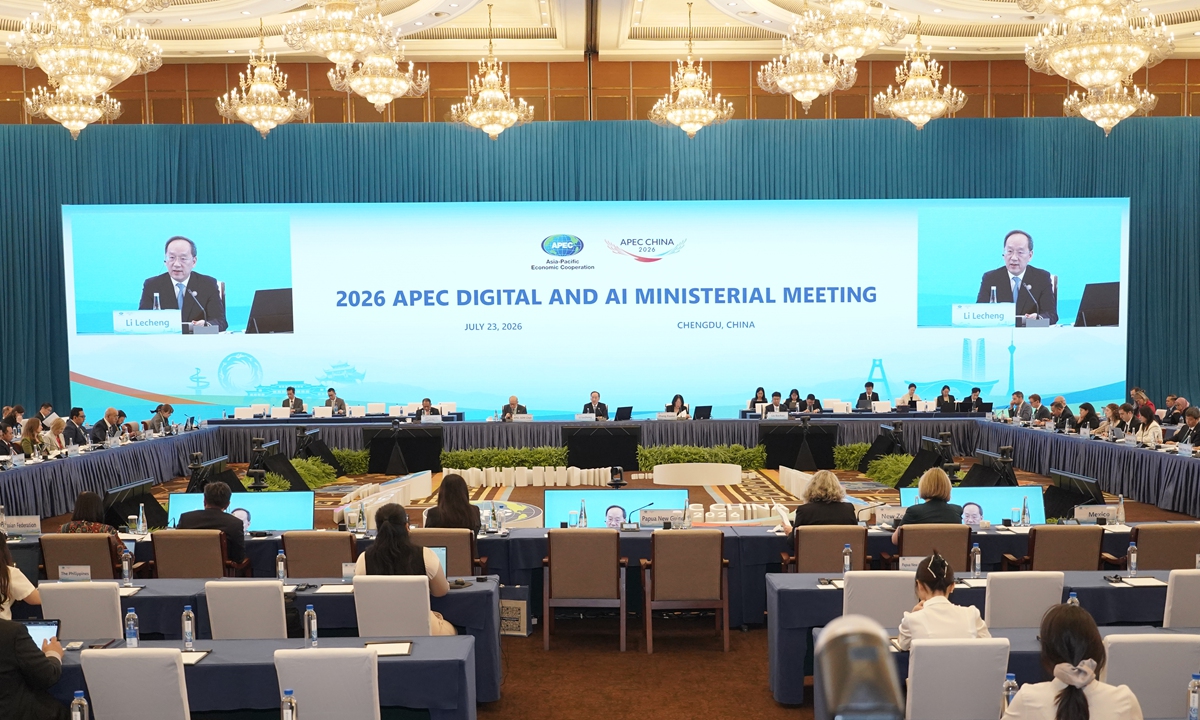
Li Lecheng, China's minister of industry and information technology, addresses the 2026 APEC Digital and AI Ministerial Meeting in Chengdu, Southwest China's Sichuan Province, on July 23, 2026. Photo: Courtesy of MIIT
Participants engaged in intensive discussions and emphasized that the dividends of technological advancement must be shared inclusively across all economies and peoples in the Asia-Pacific region at the ongoing APEC Digital Weeks 2026 in Chengdu, Southwest China's Sichuan Province.
Sun Dong, secretary for Innovation, Technology and Industry of Hong Kong said on Friday that the Hong Kong Special Administrative Region government closely aligns with the national strategy, actively promotes the healthy development and sustainable application of data and artificial intelligence (AI) technologies, and advocates that all APEC economies join hands to build a people-centered digital society.
Sun said that with its global networks, international legal framework, strong IP protection and advanced financing platforms, Hong Kong is well-positioned to serve as a vital bridge for China's digital and AI technologies in global development and governance.
China's Minister of Industry and Information Technology Li Lecheng said on Thursday at the 2026 APEC Digital and AI Ministerial Meeting that the event is a key APEC ministerial platform, and he highlighted the outcomes as a consensus on AI-driven innovation; a deeper commitment to risk management and safety; a focus on cooperation for shared prosperity; a goal of inclusive and equitable benefits; and a shared vision for an open innovation ecosystem.
The meeting brought together Asia-Pacific ministers and senior officials to discuss shared pathways for leveraging digital intelligence to achieve sustainable and inclusive growth.
The event adopted a declaration, calling for joint efforts to advance the application of digital and AI technologies to empower the Asia-Pacific community, thereby laying down an action-oriented framework for APEC's enhanced cooperation in the digital and AI domains over the next phase.
AI-driven technological innovation is accelerating, offering huge opportunities but also governance risks that must be taken seriously. Li said all parties recognize these risks and agree on balancing development with security. He called for sharing best practices in cybersecurity, data security, supply chain and infrastructure resilience, and anti-fraud, while promoting dialogue across government, business, academia, and civil society.
Data released by China's Ministry of Industry and Information Technology showed that in 2025, the scale of China's core AI industry exceeded 1.2 trillion yuan ($176.6 billion), with more than 6,200 enterprises operating in the sector. Open-source models recorded cumulative downloads exceeding 10 billion, ranking first globally in terms of downloads. These figures represent both a remarkable achievement of China's "AI+" initiative and a solid foundation for cooperation between China and APEC economies in the field of artificial intelligence.
Eduardo Pedrosa, executive director of the APEC Secretariat, praised China's active role in advancing regional connectivity.
Pedrosa said that China has placed strong emphasis on technology, broadband and invested in connectivity. "China has put a great deal of emphasis on the application of 5G and connectivity," he said, citing a sub-fund China created for APEC on how to use AI for sustainability and greener development.
Jiang Mingtao, president of the China Industrial Control Systems Cyber Emergency Response Team, said on Thursday that digital infrastructure serves as the "hard support" for Asia-Pacific coordinated development.
China is prepared to join hands with all partners to facilitate the coordinated deployment and interconnection of digital infrastructure — including 5G networks, gigabit optical networks, data centers, and computing power networks — across the region, building on the momentum of the APEC Connectivity Blueprint upgrade. China will also actively leverage its technological and construction expertise in submarine optical cables, satellite communications, and other fields to provide a solid underpinning for collaborative innovation in the region's digital economy, Jiang added.
"China's digital and AI technologies and industries will play the roles of promoter, practitioner, co-builder, and connector in APEC cooperation," said Jiang.
Official data showed that Sichuan has cultivated more than 1,900 AI enterprises, with industry revenue exceeding 190 billion yuan last year, and 18 industrial AI scenarios selected as national-level typical application cases.
These examples of industrial development serve as a microcosm of China's efforts to drive industrial growth through digital and AI technologies. China stands ready to share its practical experience with Asia-Pacific economies and provide replicable and scalable solutions for digital and AI development across the region, Jiang said.
RELATED ARTICLES