Artificial intelligence Photo: VCG
By a three-to-one margin, Americans are more likely to say that China, not the US, is more advanced when it comes to developing artificial intelligence, according to a Pew Research Centre survey.
Released on Thursday, the survey was conducted in June and polled a total of 3,488 adult participants.
According to the survey, 36 percent of Americans think that China is further advanced than the US when it comes to developing AI, while only 12 percent hold the view that the US is more advanced than China.
Another 18 percent say the two countries are about equally advanced, while 33 percent are not sure which nation is more advanced in developing AI, per the survey.
A closer look at the survey also revealed that both men and women tend to support China's advancement in AI, with 31 percent of men and 41 percent of women holding this view respectively.
While the survey said that there are also some differences based on whether people ever use AI chatbots, an identical 36 percent of US adults, regardless of whether they use such tools or not, believe China is more advanced than the US.
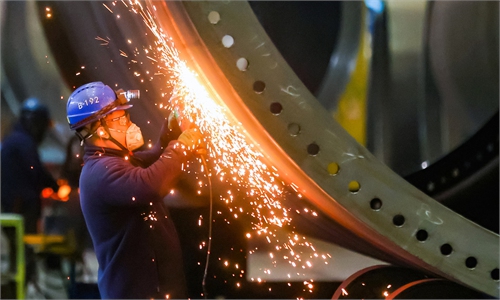
In recent years, a growing array of Chinese AI products have been deployed on a large scale across industrial operations, urban governance and other real-world scenarios, giving the general public a more tangible sense of China's AI advancement. This trend has also caught the eye of overseas netizens via social media platforms, serving as a factor behind the improved global perception of China's artificial intelligence sector, Liu Wei, director of the Human-Machine Interaction and Cognitive Engineering Laboratory at the Beijing University of Posts and Telecommunications, told the Global Times on Friday.
In addition, the intensive release of domestic open‑source models with massive parameter counts, coupled with the global dissemination of cutting‑edge technological breakthroughs, has further prompted foreigners to recognize the sophistication of China's AI development, Liu added.
Chinese AI startup Moonshot AI on July 16 released its latest model, Kimi K3, which features 2.8 trillion parameters, making it the largest-parameter open-source AI model globally, the company said, the Xinhua News Agency reported.
Kimi K3 natively supports visual understanding and boasts a context window of 1 million tokens. It has been optimized for complex tasks including software engineering, knowledge-intensive work, deep research and multimodal understanding, Moonshot AI noted.
Benchmark AI products such as Kimi K3 can drastically cut operational costs. Their prowess in handling intricate, multifaceted tasks amplifies the global outreach of Chinese AI offerings, emerging as a pivotal force reshaping international perceptions of China's artificial intelligence prowess, Liu said.
The expert also noted that China's consistent innovation capacity in AI, sound industrial ecosystem, and sustained state investment in technological advancement have laid bare the sector's immense potential to global audiences, who have grown increasingly convinced of China's robust AI development momentum.
However, the survey also said that "as the US and China compete for AI dominance, 43 percent of Americans say it is extremely or very important that the US is the world's leader in developing AI."
While some in the US are uneasy about China's breakneck progress in AI, China's practical applications and its global initiatives should make it clear that its AI drive has consistently been oriented toward serving the wider public good, said the expert.
The development of AI in China comes from greater self-reliance and strength in science and technology, and is fueled by China's vision of extensive consultation and joint contribution for shared benefit, Chinese Foreign Ministry spokesperson Lin Jian said on Thursday, in response to a question regarding a top White House official accusing Chinese AI start-up Moonshot AI of covertly copying the most advanced model of an American company.
All countries should take a people-centered approach and develop AI for the positive and for good to ensure the open and inclusive development of AI for good and for all so as to better contribute to social progress and the common welfare of the international community, Lin added.
RELATED ARTICLES