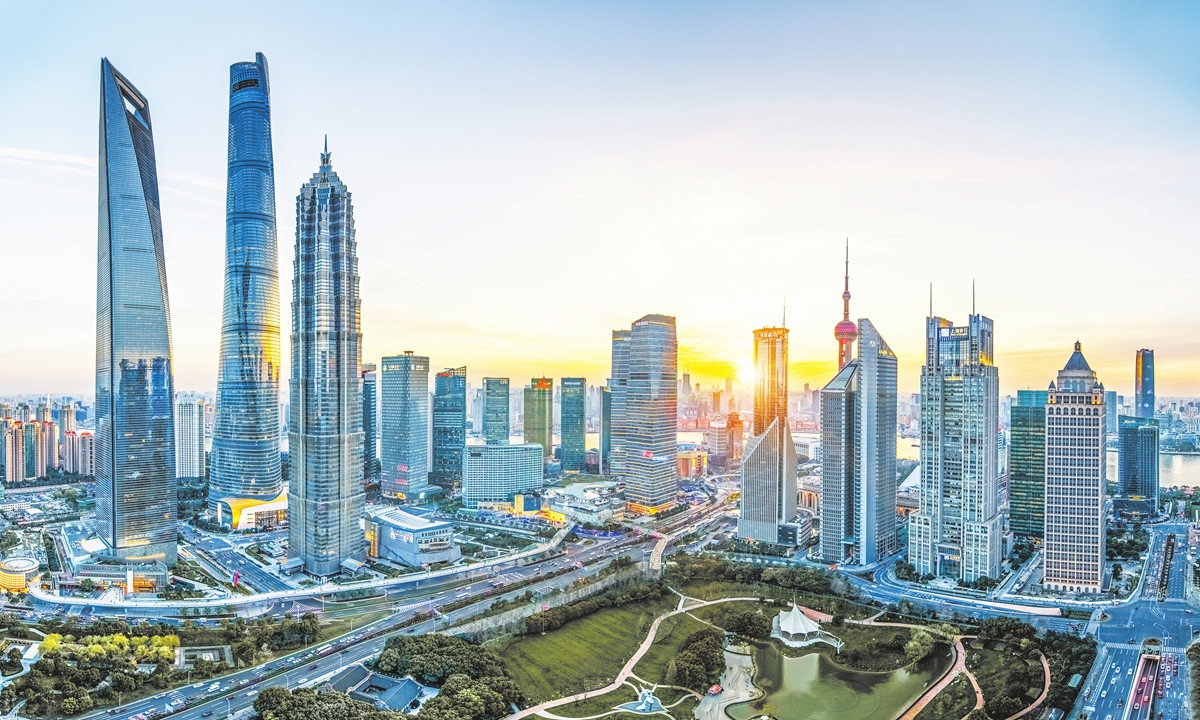
A view of Lujiazui, Shanghai Photo: VCG
China's GDP growth jumped 4.7 percent year-on-year in the first half of 2026, remaining well within this year's target range of 4.5 to 5.0 percent. The economic figures show that macroeconomic performance in the first half of the year maintained overall stability while making progress, demonstrating notable resilience amid both domestic structural adjustments and external uncertainties.
External demand provided a strong contribution. Driven by the global surge in artificial intelligence (AI) investment and related demand, China's trade growth accelerated further from an already elevated base in the second quarter, achieving 18.4 percent growth - the highest quarterly year-on-year growth since the third quarter of 2021.
A more structural and encouraging development lies in the performance of new growth drivers.
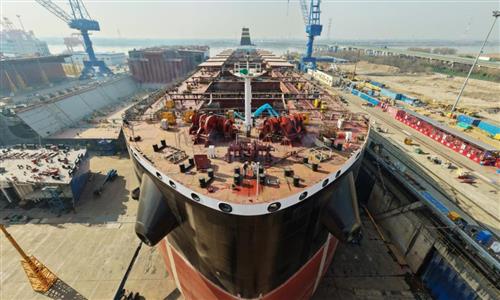
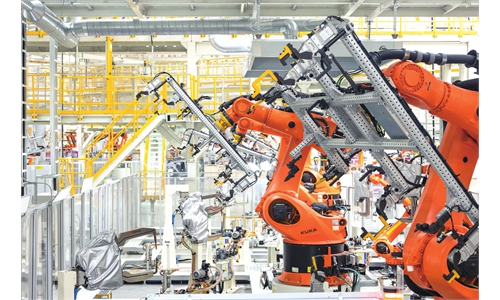
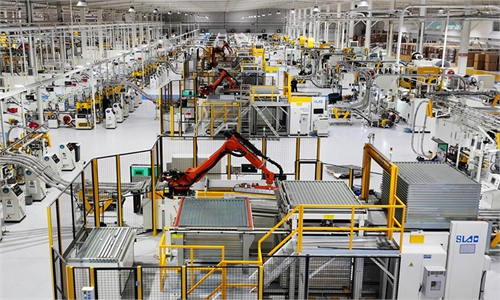
Notably, the value-added of high-tech industries, representing new quality productive forces, grew 13.3 percent year-on-year in the first six months, significantly outpacing both industrial production and overall economic growth. This rapid expansion signals that the ongoing shift from traditional to new growth drivers is continuing. High-tech manufacturing has, in fact, benefited from a favorable environment since the beginning of the year, characterized by robust market demand on both the supply and demand sides, as well as strong fiscal and financial policy support.
Looking ahead to the second half of the year, these new drivers are expected to maintain relatively rapid expansion, with high-tech industrial production likely remaining in double-digit growth territory. At present, high-tech industries already account for approximately 17 percent of industrial production above the designated size, giving them a meaningful capacity to lift overall industrial output.
While China remains on track to meet its full-year growth target, additional policy support will still be needed to stabilize domestic demand. Growth-stabilizing measures are expected to be moderately stepped up in the second half.
For example, on the fiscal side, authorities are likely to accelerate the issuance of government bonds and the pace of fiscal expenditure, while ensuring the 800 billion yuan ($118.16 billion) of new policy-based financial instruments is deployed quickly. As 2026 marks the first year of the 15th Five-Year Plan (2026-30) period, China also possesses a substantial pipeline of high-quality infrastructure projects that can be brought forward to help stabilize investment.
On the monetary front, we now expect the People's Bank of China (PBC), the central bank, to implement interest-rate and reserve-requirement-ratio cuts at an appropriate juncture.
It is likely that the PBC will implement a 10-basis-point policy rate cut around the end of the third quarter. This is predicated on several factors: the gradual dissipation of imported inflationary pressures from high oil prices, contained spillover effects from recent chip price surges, mild overall price levels in the second half, and the yuan's relatively stable exchange rate against the US dollar. Such easing would lower financing costs for both enterprises and households, providing an important lever for promoting consumption, expanding investment, and supporting efforts to stabilize the real-estate market.

Wang Qing Photo: Courtesy of Wang Qing
Additionally, given the pressure in the property sector, we do not rule out the possibility of a more significant targeted cut in the 5-year-plus loan prime rate (LPR) — potentially combined with fiscal interest subsidies — to substantially reduce mortgage rates to shore up housing demand.
Taking these factors together, the full-year economy is projected to follow a "V-shaped" trajectory. As growth-stabilizing policies are gradually rolled out, domestic demand is expected to recover, while certain short-term adverse factors are expected to fade. As a result, GDP growth is expected to rebound to around 4.6 percent in the third quarter and to accelerate further in the fourth quarter. High-tech industries, representing new quality productive forces, will continue to serve as the primary engine, maintaining double-digit growth and driving industrial upgrading.
This trajectory should allow the economy to comfortably meet the full-year growth target, with new quality productive forces continuing to serve as the main engine of industrial upgrading throughout the remainder of the year.
The author is the chief macroeconomic analyst at Golden Credit Rating International. bizopinion@globaltimes.com.cn
RELATED ARTICLES