From pop songs to classical poetry, exchanges reveal enduring ties among youth
Same culture across Straits
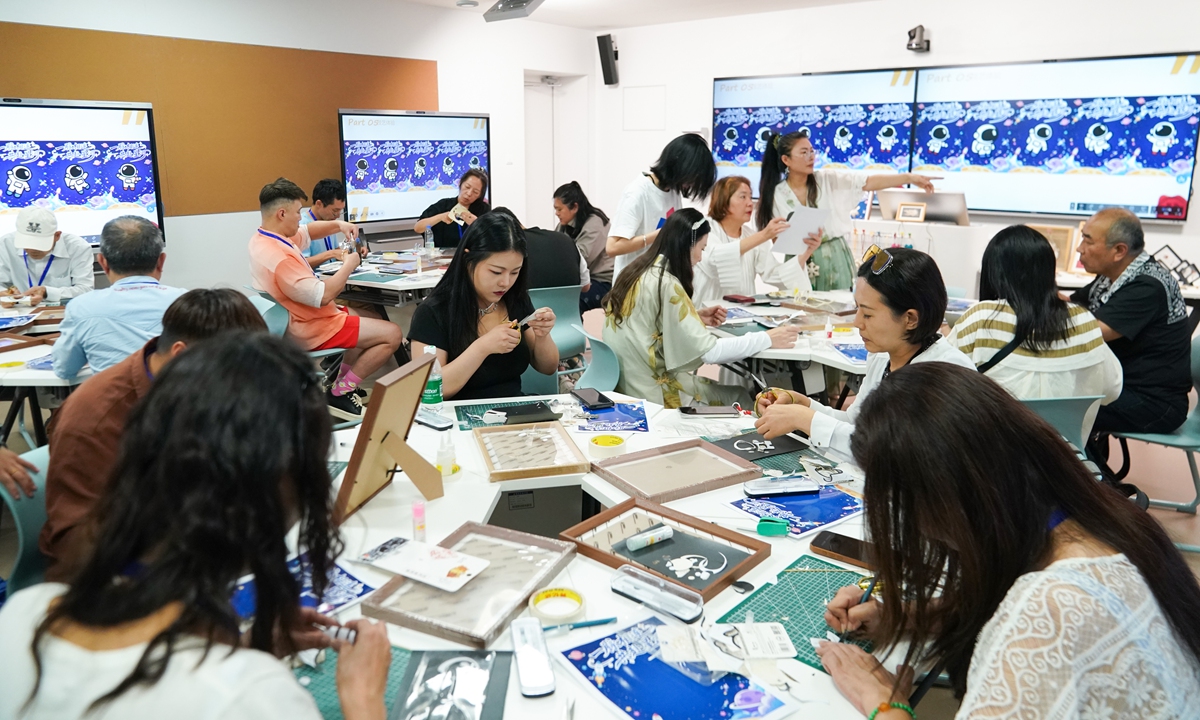
Taiwan residents learn to make fish-skin paintings during a cross-Straits youth exchange and visit activity in Harbin, Northeast China's Heilongjiang Province, on June 23, 2026. Photos on this page: VCG
The arena darkened as thousands of fluorescent light sticks began to sway in waves. Within moments, the opening notes of Phoenix Legend's The Hottest Ethnic Trend echoed through the venue, prompting more than 3,000 young voices to sing along. The chorus had barely faded before another familiar hit, Cyndi Wang's Love You, sent the crowd into another round of cheers. For a moment, it felt less like a cross-Taiwan Straits exchange event than a packed pop concert.
The scene unfolded at the 2026 Cross-Straits Youth Culture Month in Suzhou, East China's Jiangsu Province, where young people from the Chinese mainland and Taiwan island found common ground not through formal speeches, but through shared playlists, laughter and spontaneous singalongs.
The lively gathering stood in sharp contrast to persistent efforts by Taiwan's Democratic Progressive Party (DPP) authorities to portray cross-Straits relations through the lens of confrontation. Yet inside the venue, political rhetoric gave way to something more immediate.
Singing the same songs, waving the same light sticks and cheering for the same artists, the young participants demonstrated that the cultural affinity and emotional ties between people on both sides of the Taiwan Straits remain deeply rooted.
Across the Taiwan Straits, the resonance of Chinese culture has been building as well.
From July 2 to 5, the dance drama Poetic Dance: The Journey of a Legendary Landscape Painting captivated audiences in Taipei city, where all seven performances sold out almost immediately after tickets went on sale. Even after additional shows were added, tickets remained virtually impossible to secure. More than 10 days after the curtain fell, the production continued to dominate discussions on the island's social media platforms. Audience members shared emotional reviews and clips from the performances, while many who missed out on tickets expressed regret and called for the production's return to Taiwan island.
Perceptions change
Under the theme of "forge ahead together, with youth power," this year's event focuses on new expressions of traditional culture and aims to create interactive and immersive exchange opportunities for young people from both sides, Zhu Fenglian, spokesperson for the Taiwan Affairs Office of the State Council, said while introducing the event at a regular press conference on July 15.
Throughout the event, many young people from Taiwan island spoke with the Global Times about how visiting the Chinese mainland had reshaped their perceptions.
Pan, a university student from the Taiwan region, first traveled to the mainland four years ago. The moment he encountered the fantastically shaped Taihu rocks, he was captivated. Now, as an art student, he has chosen the iconic scholar's stones as the subject of his work, hoping to introduce their uniquely Eastern aesthetic to a wider audience through his paintings.
For another participant, the trip brought back memories of family. A middle school student from Taiwan island picked up a paintbrush to portray his grandfather, a veteran from Yunnan Province who has kept the habit of cutting his own hair at home for years.
Recalling the grandfather who raised him, the teenager told the Global Times that his grandfather often shared memories of his years living on the mainland. As he spoke, his eyes grew red with emotion.
Across the Taiwan Straits, stories of family, culture and shared memories continue to connect young people from both sides.
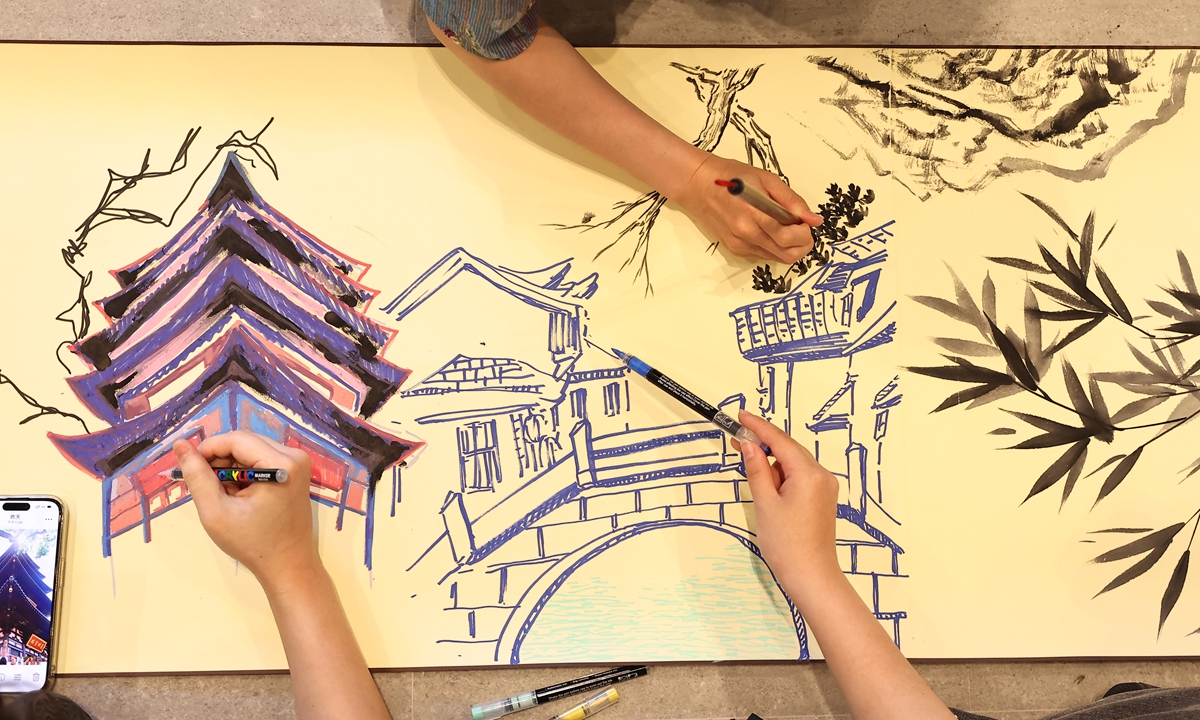
Young people from both sides of the Taiwan Straits jointly paint a long scroll at the opening event of the 2026 Cross-Straits Youth Culture Month in Suzhou, East China's Jiangsu Province, on July 15, 2026.
Kang, a high school student from Taiwan island and a fan of the hit Chinese TV drama Empresses in the Palace, had long hoped to visit Beijing to see the Forbidden City and experience the real-life setting behind the historical stories she loved on screen. Through the exchange program, she finally arrived in Suzhou, the city described in the textbook line "Outside Gusu city lies Cold Mountain Temple."
She also discovered another unexpected connection. Yu Guangzhong's Nostalgia, a poem she loves from her textbook, is also included in textbooks on the mainland and remains widely read among students there.
On the spot, the Global Times reporter and Kang spontaneously recited together the poem's best-known lines: "Nostalgia is a shallow strait, I am on this side, and the mainland is on the other side."
Written decades ago, the poem captured the longing caused by separation. Today, for many young people, that distance has become easier to cross. With a Taiwan Compatriot Permit, they can travel across the Straits and experience in person the landscapes, history and culture that they once encountered only through books.
First-hand impressions
Beyond the performances and cultural activities, many participants from Taiwan island also shared their personal impressions of life on the mainland.
"A series of first-hand experiences, from livestreams on the mainland by Taiwan-based hosts, have helped revamp some stereotypes and allowed more people to see the mainland through personal encounters," Zheng Jian, a professor of Graduate Institute for Taiwan Studies at Xiamen University, Fujian Province, told the Global Times.
Zheng noted that deeper understanding between people comes from sustained exchanges. While trade and economic ties often remain transactional, people-to-people interactions, especially among young people, can build stronger emotional connections.
"Young people are the future, and culture is a shared language," Zheng said, pointing to shared songs, traditional Chinese dance and Jiangnan heritage sites as examples of the common cultural roots and aesthetics among youth on both sides of the Taiwan Straits.
RELATED ARTICLES