China’s top market regulator fines Trip.com 5.179b yuan for abusing its dominance in online hotel booking market
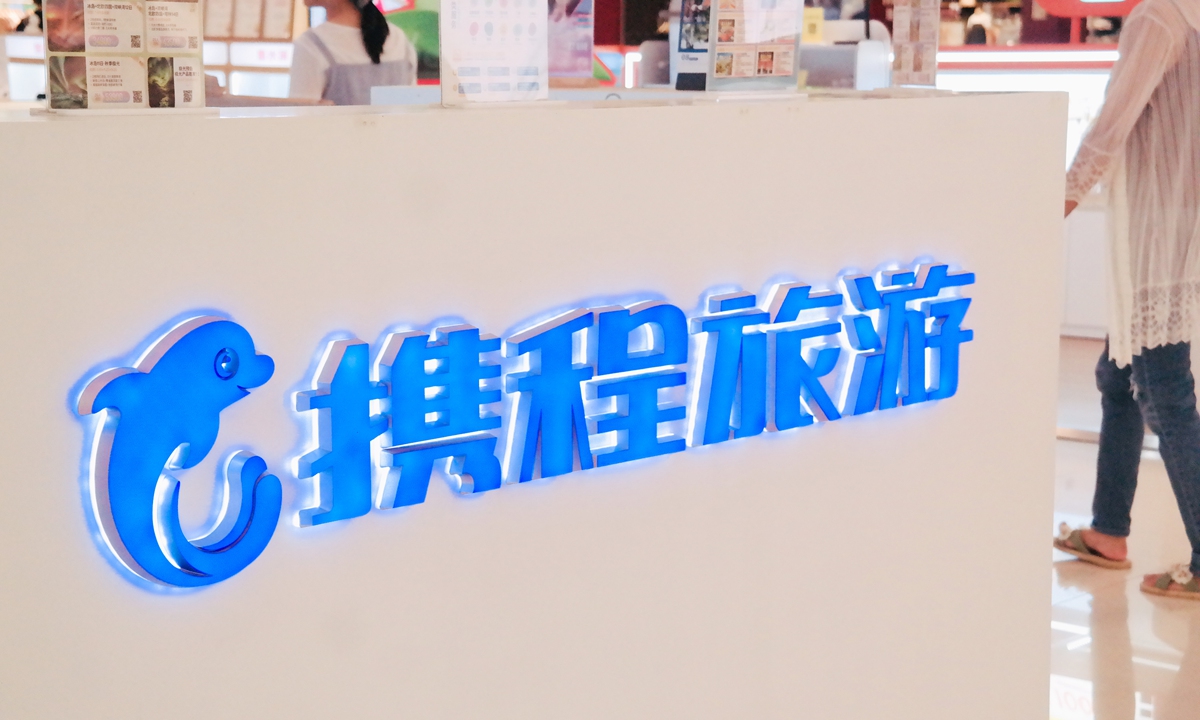
Trip.com Group Photo: VCG
China's top market regulator on Saturday fined online travel agency Trip.com Group 3.521 billion yuan ($519.93 million) and confiscated 1.658 billion yuan in illegal gains from its monopolistic practices by abusing its dominant market position, while also ordering it to refund 122 million yuan in deposits deducted from hotels.
The investigation and punishment of the Trip.com monopoly case is another major landmark case in the normalized antitrust regulation of the platform economy, with breakthrough significance in many fields, according to a report by the People's Daily on Saturday.
Trip.com said in a statement the same day that it sincerely accepts the decision and will firmly comply with the administrative penalty, and strictly follow regulatory requirements, advancing rectification and implementing it systematically to ensure that all measures are carried out in full.
The investigation found that since 2020, Trip.com has abused its dominance in China's market for online hotel booking platform services. With its traffic allocation mechanism as the central lever, the company used platform rules and technical means to carry out two types of monopolistic conduct, the State Administration for Market Regulation (SAMR) said in a statement published on Saturday.
Trip.com used preferential traffic and benefit support as incentives to induce high-quality hotels into exclusive "special-tier" partnerships, while barring them from cooperating with rival platforms.
The People's Daily report disclosed that since 2025, market regulators have received alarge number of complaints and reports about Trip.com's monopolistic practices. "Trip.com required me to sign a 'best-price clause' guaranteeing my lowest rates would be on its platform, and the commission rose from about 10 percent to more than 25 percent for some room types. Factoring in rent, labor and energy costs, my net profit margin is now below 5 percent," said a homestay operator in Dali, Southwest China's Yunnan Province.
"The Trip.com monopoly case is the first antitrust case in China's online travel sector. It is of great significance for regulating the competition order of the online travel service market, protecting the lawful rights and interests of hotel merchants and consumers, and promoting the high-quality development of the industry," said Ning Lizhi, a member of the expert advisory group under the State Council's Anti-Monopoly and Anti-Unfair Competition Commission and a professor at Wuhan University's School of Law, according to the report.
In addition, the company required lower-tier hotels to offer the "lowest price across all platforms." Once a hotel's price was found to be higher than on a competing platform, Trip.com directly lowered it through technical tools.
The company also used technical means to monitor hotels' compliance with the exclusivity and lowest-price requirements, and enforced them through punitive measures including traffic restrictions, revoking tier status and deducting order deposits, according to the SAMR statement.
The People's Daily report said that investigating the Trip.com monopoly case posed formidable technical challenges. The relevant data was scattered across terminal devices, cloud servers and business systems, with massive volume, complex interconnections and a high degree of concealment, noting that it is China's first case targeting a new type of monopolistic conduct in the platform economy.
Shi Jianzhong, deputy head of the expert advisory group under the State Council's Anti-Monopoly and Anti-Unfair Competition Commission and dean of the Institute of Data Law at China University of Political Science and Law, said that Trip.com integrated digital-intelligent technologies with its ecosystem layout to form a composite monopoly model of "technology + ecosystem + conduct."
Through algorithmic monitoring, traffic control and ecosystem bundling, the company implemented monopolistic practices with precision and efficiency, making the conduct more covert and harmful, Shi said.
Those conducts excluded and restricted market competition, limited hotel operators' ability to operate across platforms, infringed on their autonomy in setting prices, harmed consumer interests, intensified "involution-style" competition in the industry and hindered its healthy development, the regulator said.
The SAMR said it will supervise Trip.com's comprehensive rectification and require the company to publicly disclose its corrective measures and accept public oversight, so as to effectively protect the lawful rights and interests of hotel operators and consumers, maintain a market order featuring quality, fair prices and sound competition, and promote innovation and the healthy development of the industry.
The penalty strictly adheres to the Anti-Monopoly Law's provisions on the confiscation of illegal gains and the ratio of fines, Ning said. It takes into full account factors such as the nature of the illegal conduct, the severity of the circumstances, and the duration of the violations, fully reflecting the rule-of-law spirit while demonstrating the seriousness, authority, and effectiveness of anti-monopoly enforcement, he said.
The company said in the statement that it will take the penalty as an opportunity to reflect deeply and pursue self-reform, resolutely abandoning "involution-style" inefficient competition. It will publicly release its specific rectification measures and proactively accept oversight from all sectors of society to ensure the rectification delivers tangible results.
Global Times
RELATED ARTICLES